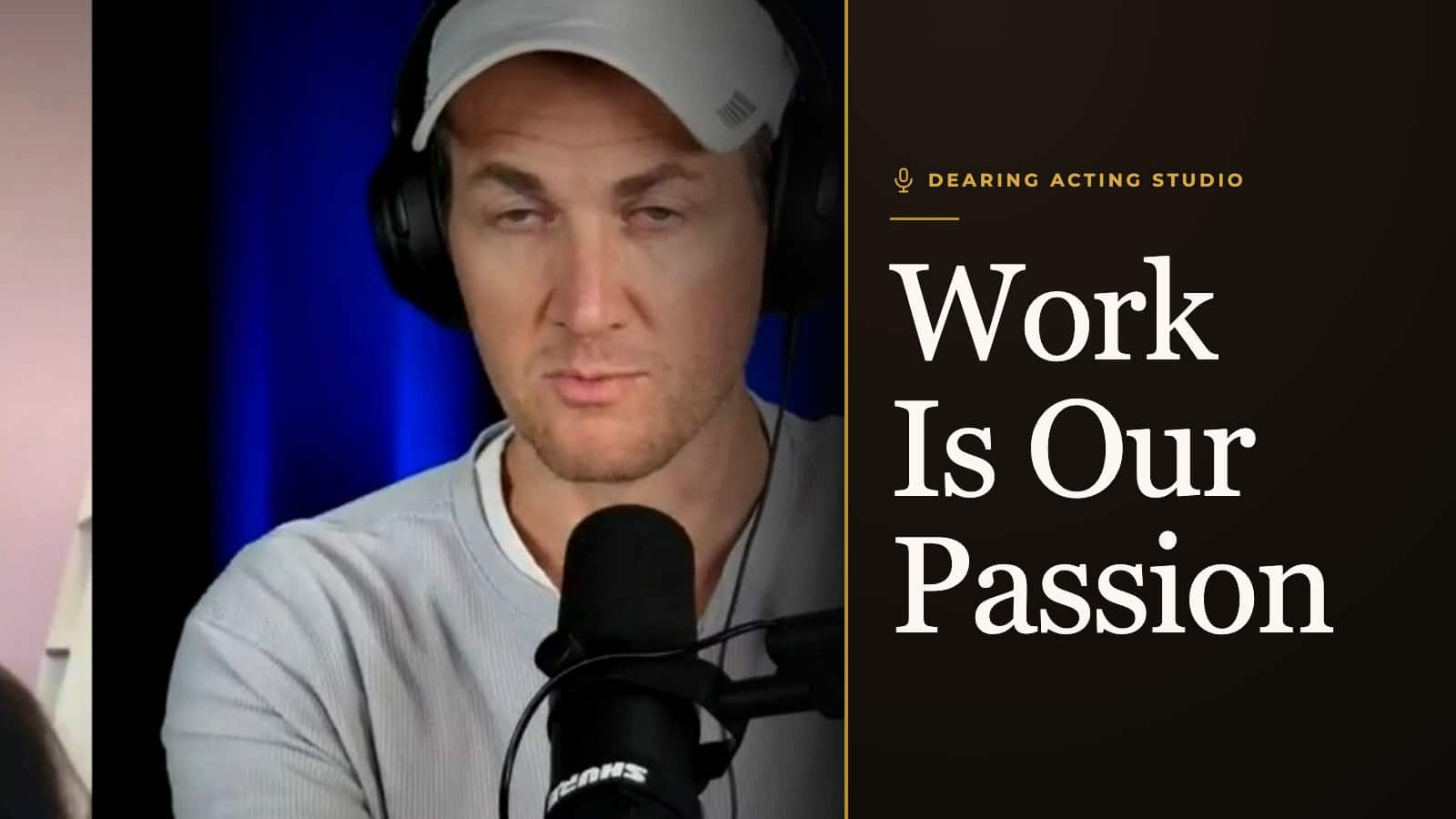
Shea got to the studio one morning and nobody else was there, so she called Joey, and the two of them decided to do a podcast. I was not in the room for this one, and I would not change a word of it. It starts with a video game and Shea’s husband, and it turns into the clearest picture of why the people who work here work here: a private lesson with a four-year-old, a student who drove to Los Angeles for a shoot that never happened, a four-hour cord, and the question Shea asked when everything changed: what can I do?
What does it mean to be passionate about your work?
Shea and Joey answered this better than I would have, so I will keep to what they said. Passion for the work looks like teaching from your strengths and from what you don’t know, because you never have to be better than the person you are teaching; a four-year-old can lap you in character work and that is the best part of the job. It looks like sitting down with a new student to find out who they are before you decide what to work on, because the lesson is human interaction, not a script. It looks like the light bulb moment on a student’s face, which is what all the hours are for. It looks like Joey refusing to stop until the footage from a class feels like a movie, because when a student watches it back and sees themselves, that is the whole goal. And it looks like Shea, sent home with time on her hands, asking what can I do, learning the website, crashing it, calling for help, and becoming the person the rest of us go to. Passion is not a feeling you wait for. It is the skill nobody assigned you, learned anyway.
What is in the episode
- 00:39 · Shea takes the intro. Nobody at the studio, so she called Joey and they made a show. Two live viewers, one of them probably Jake.
- 02:23 · Jake, and the 2K question. Shea’s husband asks why Joey can’t dunk. Joey explains his build. Nobody wants to be the big man.
- 06:23 · One hundred percent present. What I taught them about how to spend time: when you are with someone, be all the way there. Shea on coming home.
- 08:49 · Another form of art. Video games are somebody’s theater. We run one, and we get to do the thing we love every day.
- 09:31 · Part of a bigger picture. Both of them started as actors. Now they get to spread that love to students and to everyone watching.
- 10:03 · A private lesson with a four-year-old. The lesson queen’s first student that young. Fish on the floor, and a tiny human who was lapping her in character work.
- 11:51 · You don’t have to be better than the person you teach. Teach from your strengths and from I don’t know. Everybody has something to learn from everyone, even a first-time improviser.
- 12:19 · What kind of gold can they give me? Joey’s favorite thing: a scene with a brand new student, figuring out how their brain works and lifting them with what he knows.
- 13:22 · You tell me. What Shea learned from me about private lessons: you don’t decide what to work on until you know who is in front of you.
- 13:45 · Get to know who they are. A lesson is human interaction. Sit down first, coach second.
- 14:28 · Four teachers, four styles. All trained by me, none of us deliver it the same way. Why going back in front of a class is scary every time.
- 14:50 · The light bulb moment. The best part of teaching, in script and in improv: they hear the direction, they get it, and they feel more confident.
- 15:48 · Surround yourself with people who have strong values. An hour after class with a student, and a director who cancelled a shoot after he’d driven to Los Angeles.
- 16:40 · You lift them up, they lift you up. Choose people who align with your values, your love and your vision. It’s a team effort.
- 16:53 · I never touched a camera. Joey wanted a stage, not tech. There was a hole in production, he filled it, and he fell in love with it.
- 17:39 · Why every class is filmed like a movie. When a student watches their footage back it should feel like they’re in a show. It’s about making you better.
- 18:27 · Until it’s perfect. Joey and I slinking back to the same cord for three hours. Shea rewriting the ambiguous scenes because those are words people will speak.
- 19:43 · The studio is a different world. The way we’re trained and the way we talk to people can shock someone who has never been trained in it.
- 20:42 · What are your core values? Nobody asks that when they meet someone. What if we did? You do it in a relationship; do it with the people you work with too.
- 22:22 · Shea out-WordPresses me. She knew a little about the website. Now Joey brings her his questions, and most of our thumbnails are hers.
- 22:55 · What can I do? The question that started it. She saw the technical side, decided to stay involved, and took the opportunity.
- 23:22 · A lifelong learner, and no idiot. Shea on learning new skills to be more valuable, and the first lesson: how hard the other person’s job really is.
- 24:40 · Constant respect. You don’t understand someone’s responsibilities until you try them. Crash the site, call for help, learn.
- 25:29 · Learn a skill from someone you love. Sit down with them and let them teach you. It takes you farther, and it gives you mad respect.
- 26:24 · Color-coded cords. Every setup gets faster. Then the real work: how do we get creative, how do we look good, how do I lift Shea up?
What this has to do with the class
Everything Shea and Joey describe here is what happens in the room. The teacher finds out who you are before deciding what to work on. The class is filmed so you can watch yourself get better. And the light bulb moment they live for is yours: the second a direction lands and you feel more confident than you did an hour ago. That is the job, and it is why they love it.
Full transcript
5,404 words, transcribed from the recording on this side of the desk. Names corrected. Part of the recording is left out of the written version.
Read the whole conversation
This is the Dearing Acting Studio Podcast, where we discuss the connection between life and acting. Yo, yo, yo, what's up, you guys? Is that… Shea, are you introing the podcast today? Were you going to intro? No, no, no. I felt like there was enough space for me to intro, so I did. Usually, it's a meal, and sometimes it is the owner of the studio, like most of the time.
Right. And now, it is Shea Toepel. Thank you. I'm just going to… Where's the… Yeah. Thank you. You know, it's crazy. Well, it's just Joey and I here at the studio today, and it was funny because… So, I got to the studio this morning, and there was nobody… You know, you always know, because it's my car, it's Brian's Lincoln, or it's Matt's Volkswagen. So, nobody was at the studio, and I was like, well, I don't want to go in there by myself.
And I was like, what are you doing? I'm coming over. And then, I said, I was like, we should do a podcast today. And then, I came in, did my thing, and Joey and I were just hanging, and I was like, let's do a podcast. Yeah. So, here we are. This is going to be the number one podcast. Oh, my gosh. I can't go one without not doing this impersonation.
You guys can't go, you guys can't go, like, a day without doing that. No, it's really, really fun. And then, once you get into it, it's really hard to get out of. It's, it's, I don't even want to say it's bad, because it's pretty good. But, like, at the same time, excuse me while I just checked my watch, because… Ouch. No. Did Jake text you as well?
Yes. Yes. Okay. Well, he DM'd the studio. I'm assuming he said the same thing. He did. And I am really offended. Well, let's tell, let's tell the, do we have so many live viewers right now? Actually, we have two. We have two live viewers? We have two live viewers. That's so cool. And none of them are me. That's great. So… It's probably my mom. Yeah. And… Jake.
Jake. It probably could be Jake, honestly. Probably Jake, yeah. But, so, Jake is my husband. For those of you who don't know, my sweet husband, hi Jake, if you're watching this. He's the man. He is. He's the absolute man. And, I mean, I could talk… He does deserve an air horn, so I'm just… Yes, he is my studly Italian man. And we put on Instagram today, we just, I just put out a quick thing.
I was like, hey, we're doing a podcast. Give us suggestions. And my husband responded, you know… Wait, wait, wait, wait, wait. Yeah, you can read it. No, you got it. Ask him why Joey can't dunk in 2K, which is a video game that, I guess, is really popular. And what's funny is that my husband, when he's not working, he does enjoy a good game of 2K. And Joey, my coworker Joey, who's sitting right next to me, all of a sudden, like, joined in on this whole 2K playing thing.
So, not only… So, I'll get home, right? And Joey lives across the street. I live in the East Valley, so it takes me a while to get home. And I'll get home, and I'll start making dinner or something. And I'm like, Jake, come down here. And he's like, no, me and Joey are playing 2K. And I'm like, my husband and my coworker are playing a video game together.
How did this happen to me? How did this happen to me? All right, let's address one issue at a time here. Okay. So, first off, I don't dunk in 2K because I am a playmaking shot creator. That is my build. Are you guys all watching him right now? My whole build is based upon three-pointers, layups, mid-range shots, and passing the ball to the open man. That's what my guy does.
He's not supposed to dunk. He doesn't do any fancy stuff. Who cares if he's not supposed to? Just go for it. No, like, you literally can't in the game. Oh. Like, if you can't dunk. Like, for instance, like, I can't dunk. So, think about putting me into the game. Like, just because you press the dunk button doesn't mean it's going to let me dunk. Gotcha. Gotcha. Because I don't have the hops.
Thank you. My guy does not have the hops. Thank you for letting me know that. So, Jake, I'm going to just go ahead and put you in your place here. You are a power forward, okay? Who wants to play as a power forward? No one. No one does. Everybody's a shooting guard or a point guard. And there's a reason for that. Because nobody wants to be a big man in 2K.
Joey, thank you for that riveting monologue about 2K. You're welcome. I think our viewers wanted to see it. We are going to address one issue at a time, okay? Okay. So, the second issue, and this isn't an issue, but this is more your concern. You've set this up great. Okay. You know, basically how this happened is I've been praying for a long time for some homies to play 2K with.
And literally, like, all of my friends either play PS4, which is awful. Why would you ever do something? I'm just going to go ahead and… All right. Shots fired there. That was… Like, that's the constant sound in your head if you're playing PlayStation. Okay. Because Xbox is the GOAT. Okay. Halo tells you all about that. Xbox. Sponsor us. You don't get Halo if you play PlayStation. Right.
But when I found out Jake played 2K, I immediately hopped on my opportunity. And it's so funny because I always time it out. And so, whenever you leave, I'm like, oh, shoot. I have, like, five minutes to get home. And then if I turn on my Xbox right away, I can, like, hop on and I can play… You got, like, 25 minutes. Like, maybe two games with him before Shea gets home.
And then I know I'm done because Shea gets home and he's going to spend his time with you. And I'm like, all right, all right. I got a small window to work with here. That is so funny. You know, it's interesting because Matt talks to us a lot about… This is something that Matt has helped me with a lot is figuring out how to spend your time and doing it in the best way possible and being 100% present whenever you're spending time.
Yeah, 100p present with whoever you're with and spending time with. And my husband over the years, if anybody knows, my husband and I have been together almost… Holy moly. So, in November, we'll be two years married and 11 years together. Woo! Thank you. That is impressive. That was impressive. And what's super cool is that we've grown up together, you know? And so, it's funny because now we're in our mid-20s.
Mid to late 20s. Oh, my gosh. I just… I turned 26 last week, so I'm feeling old. Oh, my goodness. Stop. Anyway, he's very, very good. Because we work a lot of hours. We, you know, I'm at the studio a lot. And when I come home, man, if I don't hear that, it's like maybe two minutes. And Jake's like, Gigi's boys. Gigi's boys. She's home. Which sounds kind of scary, but it's very good because he knows that when I'm home, that's the best time that we get to spend together.
But it's fun because now he gets to include Joey in his favorite pastime. Yeah, and it's my favorite pastime, too. So, it's cool to have, like, because for the longest time, I'll just play solo. Right. And it's like, I don't have a problem with that. But when you're playing with, like, your friends, it's a whole different ballgame. Yeah. Because you're also engaging in social activity while you're playing a game or doing something that you love, which happens to be video games for me.
And you know what? I really have changed my stance on that because I don't understand them. Like, Darkness to Light. But I never played video games. All I ever played was Mario Kart. And I like to play Peach on my friend's little Nintendo GameCube or whatever. Mario Kart is the go. So, there's nothing wrong with Mario Kart. Mario Kart is one of the greatest games of all time, especially on the Wii.
On the Wii. Just saying. Yeah. But I never really understood video games. But I guess how people, everybody has their thing that they like to do. And Jake has always been into video games. And he was kind of telling me the other day, he's like, you know, it would be so cool to do what I do, like, for a video game company. Like, that would just be so cool.
And I guess it clicked for me that it's another form of art, just like we do. I mean, we run a theater. You know, we do content production. We do podcasts. We do scenes. We do improv. We do film. And all these things. And, like, that's so interesting to us. But video games are like that to people, too. Yeah. You know? Well, it's interesting you say it.
And especially in that way, like, oh, he said that it would be so cool to do that thing because it's a passion of his. Right. I, like, it just clicked for me there. Like, we get to do that every day. Right. Right? Both of us started as, I was an actor. You were an actress. Like, that was our dream. That was our goal. We were pushing towards that thing.
And then we came across the studio. And now we're a part of a bigger picture. Yeah. Right? So, not only do we get to act and do what we love, but we also get to spread that love to all of our students and all the people who follow us and help make other people better through our craft, through our love of acting. Yeah. Through art. And, like, so few people get to do that in the world.
That's so cool that we not only get to work somewhere that we're passionate about, but it's also in the field that we love. Right. Totally. I taught a lesson today. I did a private lesson with a four-year-old little girl. Shea, I'm just going to say it right here. Shea is the lesson queen. I will patent that. Thank you. Like, almost every week you have, like, at least three.
Thank you. At least three lessons. And it always sounds like so much fun from the other room. It is. And I get a little bit jealous. It is. You know, it is a lot of fun. Like, private lessons are great. And it doesn't matter if they're with a kid or a teenager or an adult. Like, I've taught so many different people at so many different stages of life.
But this was the first time that I taught somebody so young, privately. And it's, I don't have any kids. You know, I have five nieces and nephews. And people say that I'm very mom-like. And I know I'm good with kids and whatever. But it was interesting because we just had so much fun getting to know each other. And, you know, you've got this 26-year-old. And then her parents were in the room.
And then you have this little four-year-old girl who, and the only info really that I had was like, she likes performing, you know. And I told her mom, I said, cool, I'll get to know her strengths. And I'll get to know what she likes to do. And it was so fun to watch this tiny little human have so much passion for just performing and doing what she loves.
And it was, I had one of those moments today where I was sitting here and I was like, this is so, we were playing, we were, I was teaching her about character work, this four-year-old. And we decided to be fish on the floor. We were swimming on the floor. And I'm sitting here going like, this is my job, you know. And I'm doing this scene with this four-year-old girl who's lapping me in character development.
And it was just so fun. That's what's so cool about being a teacher, too, is it's like, you don't have to be better than the person you're teaching. You teach from your strengths. Right. And you teach from I don't know. And as soon as you understand that, everybody's got something to learn from everyone, even if they're a first-time improv player. You know, one of my favorite things in class is when a new student comes in and I get to do a scene with them.
Because even though they don't understand improv quite yet, like, everybody comes here for a reason. Yeah. They get excited. Yeah. They want to get on stage and have fun. So you get to figure out, okay, how does this person's brain think? What kind of gold can they give me and I can lift them up because of my improv knowledge? And that's really cool. That's always been something fun for me.
It's so fun. While we're talking about your lessons, I'm going to go ahead and go to a Mornings with Matt sound effect. Oh, yeah. Because I feel like this is a really good moment. Interlude? Okay. All right. Here we go. It's time now for Brian Sweeney's Shameless Plugs. Shameless Plugs. All right. So we talked about how great you are at private lessons. Now, I just want to know, what is the rate for an hour with Shea?
Just curious. Oh, that's great. Yeah. You guys can reach out to me. Both Brian and I and Matt teach private lessons. And you guys can reach out to us and I'll give you some prices on that. But what's interesting is I remember learning from Matt about this. Like, okay, what are we going to work on in the lesson? Right? And Matt was like, you tell me. I don't know what we're working on.
You tell me what we're working on. And there's so much truth to that because there's so much more than what we do of just like, okay, here's a script, go ahead and do a cold read or go through this commercial or whatever. There's so much more because what it is is human interaction. So when I meet somebody for the first time and they're looking to do a private lesson with me, I like to sit down and get to know who they are because then I can figure out how to coach them.
And just like you were saying, you know, this week has been really interesting So Brian was teaching the in-studio and I was teaching the virtual and sometimes it goes off and on. So I'll have like a good period where I'm teaching all the time and then I have a period where I'm not teaching. And it's always funny and interesting and scary and nerve-wracking when I go back in to teach because I'm a different kind of human being.
We're all very different. Our teaching styles are very different. Yours, mine, Matt's, Brian's. And we've all been taught by Matt. We've all been trained by him, but we deliver our information in a different way. And I left on Monday and Tuesday after the script class just feeling so invigorated because it's so fun to, the best part of teaching for me is to watch people get the light bulb moment when they understand what you're trying to teach them.
That's the best part. And the same thing with improv. It's a little bit of a different style, but it's the same thing when they hear a direction from you and they get it and it makes them feel more powerful and feel more confident. That's why we do it. And it's just so fulfilling to us when a student comes to us and they're like, hey, you taught me this really cool thing.
Even if it's a tiny, tiny thing, that's the best part for me. Yeah. I was talking to Ian last night after class. Shout out, Ian Seegers. Yeah. Ian, what's up, bro? Hopefully he watches this now. We'll send it to him and tell him that he got a shout out. Yeah. So we were talking last night and it was like an hour that we just sat and talked and where he's at and on his journey and whatnot.
And we were talking about the importance of associating yourself with people who have strong values. And that's something like I know for a fact from working here, like we all have that. Every single one of our staff members. But I was talking to him and he was talking about just this experience he had with like a sort of not so great director or whatever who just canceled a shoot after he drove out to L.A. for it and then was like, we'll reschedule.
And it's like, gotcha, no sympathy and empathy. Right. Right. And I was like, that's that's what's it makes me so sad. But like, that's the industry for the most part. Right. And we're changing that. So I was I was telling him, I was like, I was like, that's the whole point of associating yourself with people who align with your values and your love and your vision because you are talented.
And and when you do that, not only do you lift them up, but they lift you up. And it's like it's a team effort. Yeah. Because I was telling him, like, like we just talked about earlier in the episode, I always wanted to be an actor. Yeah. I never touched a camera. I didn't hop on editing software. I didn't want anything to do with tech in high school.
Yeah. Like, I just wanted to be on a stage and like go because I enjoyed it so much. And then my journey here was I I came along and there was a hole in the production department and certain things. And so I just slowly learned because I was like, oh, there's something there where like I can find value in this thing. And then I just sort of fell in love with it.
And now I'm strongly rooted. And I was reminded of it this week through having people back in class because it's really hard work what we do during the day. Yeah, it is. And a lot of people don't know that, but they don't have to. Like, it's no big deal. But but at the end of the day, it is. We put in a lot of work. And I have this strong why about the filmmaking of classes and why it's so important to me is because when somebody receives back their footage from a class and they get to watch it, I want it to feel like they're in a movie or a TV show or, you know, like they're famous because that's the whole goal.
Like, it's not about the gig. It's not about any of that. It's about making you better. And that's that's where we're different with the personal development side. It's like if somebody watches my class footage and gets super excited about it and sees themselves and and spurs their dreams, I could not be happier. Right. I would I would take that over anything else every day. Yeah. I think that's that's so interesting because we've talked about this before.
Like and I think all of us have different different versions of this, but there's times where Joey and Matt will not stop working on something until it's perfect. And then or until I come in and say, OK, you know, we're out of time. We need to table this and go to something else and then we'll table it. We'll go to something else. And then I'll watch Matt and Joey just slink back into the theater to mess with the same cord they've been messing with for three hours.
And then they figure it out. Right. And it's the same with me, like when I'm writing, I had to write a bunch of I got to write, I should say, all the ambiguous scenes for the last few months. And it took me forever because I wanted it to be perfect. And I went through and even though, sure, I can write, but I went back and back and forth and back and forth.
And I was like, no, because these these are going to be the words that people speak. Yeah. So I can't just write something real quick and let it go. And what's crazy is because you put that time in and that and that heart in, like so many people didn't even know you wrote them because they were so good. Like I enjoyed watching them every week and each one was different.
And like you could tell there was a lot of thought put into that. And that's so cool. Yeah. I want to go back to what you said about the values thing, because we we live. The studio is a different world. It just is the way that we're trained, the way that we communicate with people. It is a different world. And it's interesting when you try to tell people because they may be they it's kind of like sticker shock or not sticker shock.
But it could be shocking to some people when you're trying to explain something that you hold so so close to your heart. And they just don't because they've never been trained on that. And I'm thinking about these values. And it'd be interesting, like when we were talking to Ian and on the idea that finding out somebody's values is so important in the beginning of the introduction process and meeting with them and whoever that may be, you know, family members, business people, whoever, whoever you come across in your life.
That's important enough for you to be around and share yourself with. I think it's equally important for you guys to set set a discussion about what your values are. But like, think about that, like going up to somebody and being like, oh, my gosh, it's so cool that you're into art. I am, too. What are your core values? Yeah. You know, like that's so weird. And people don't do that in real life.
But what if we did? What if that was the first thing that you talked about? Because that's what you do in a relationship at some point, right? You're in a relationship. I mean, Joey won't know. You're asking the wrong person on the other side of this, Mike. But you do. You talk about the big stuff, right? And you talk about your values. And then you kind of figure out if your values align because that's somebody that you're going to be with, right?
But it should be that way for everybody you come in contact with, the people you work with, the people that you surround yourself with. Your closest friends, your mentors. And even if they don't align completely, I think it's important for you to get on the same page and be open enough for other people to explain their values to you. Yeah. And hold space for you to explain your values to them.
Yeah. 100%. You know? Speaking on the, this is so fun, by the way. It's so fun. Who needs Matt and Brian? Yeah. Just kidding. I mean. Kind of. No, this is for real so fun. But going back to what you said about, like, the studio workflow and, like, how hard it is but how people don't know, all that. You knew, like, a very small amount of WordPress, which is our backend, which is our website.
That's what we host through or whatever. That's what makes everything run. And now, Shea out-wordpresses me on, like, everything. Like, I'm going to her with questions. And now you're becoming more and more of an expert in that thing. Right. And you look at every thumbnail we do for Dearing comes from Shea. Big facts. Most of them. Thank you. And the thing is, that came from practice. That came from, okay, so what can I do?
Yeah. Asking yourself that question. We talk about that a lot, but that's where it came from. Yeah. What can I do? Yeah. And you just freaking took that opportunity and you were, like, cool. I'm an expert now. Big facts. Well, and I appreciate that. And that's, I agree. I'll say, like, I agree that I've grown in this way where I've decided to become this lifelong learner. And I think that was always in me, but I just really, really like to learn new skills.
And the reason I like to do that is, one, I want to be a lifelong learner. But two, I'm no idiot. I'm trying to make myself more valuable. Yeah. So, the more skills I can stick in my pocket are great. But what I had to learn first, ladies and gentlemen, was how freaking hard it was. And I had no idea. Like, you know, even today, I just want to say, we're sitting here, Joey gets the podcast stuff set up.
And I do ask him. I'm like, Joey, get the podcast stuff set up. Because I don't have any expertise in that area at all. And I wouldn't know what to do. I wouldn't even, I know pretty much how to turn the cameras on. That's about it. And, but that, that's not something I need to be an expert in right now. But we sit down and I was like, oh, like, can we turn the TV on, like, to see ourselves?
And Joey was like, sure. 30 minutes later, we get on the podcast because there's so much that has to be done. Yeah. And it's not hard for you. It would be like you asking me to, you know, write a quick monologue or whatever. It's not, it's not difficult. But it takes time and it takes a lot of energy and it takes a lot of mind that goes into it.
And it's just that constant respect that I think, I think that's what's missing from a lot of things or places, I guess. Not, that wasn't very good wording. But you don't understand what, what people's responsibilities are until you try to do, do them yourself. Like, first time I went on WordPress, I was like, this is what makes our site run. Why are there 400 different sections? Yeah, and how do I learn them?
And you learn them by doing it, crashing the site, calling Matt, calling our web team and being like, hey, I crashed the site. Can you help me fix it? You know, and then you learn and then you figure it out. And there's just so much, I think there's so much importance if you can find the time in learning a new skill. If that means, like, sure, if it helps you, that's great too.
But, like, go to somebody you love and sit down and try to learn a new skill from them. And I really think it'll take you so much far, so much far. So much farther. It's okay, Shea. I was on such a good tangent too. You were. But it also makes you have just mad respect for people too. Yeah. And that's cool. And what's interesting about what you said is, thank you, by the way, and I respect that so much.
And you've always had that mindset, especially with me, of just, like, respecting what I do. And I always feel that and I really love that about you. But what's interesting is, like, you talk about, oh, probably, like, 30 minutes later we're going live, right? And I'm like, okay, every time I set up and get everything done, I get quicker at that thing. For sure. Like, right now, like, it's crazy.
Here, I'll pull. I'll pull a cord. If you look at this, I've, like, started to color code things so that because there's so many of the same cords that, like, for certain setups, I'm like, cool. So I put a piece of tape there and then a piece of tape on what I plug it into, mark it, and then I go. Yeah. And every time I do it, I get quicker and I get quicker.
And so, like, 10 to 15 minutes of that was actually setting it up. The other 10 to 15 minutes was making sure we look good. Yeah. Right. And having fun with angles. Like, I had the cameras way back there, and then I was like, no, I want to pull them closer. Yeah. Because for a podcast, you don't need them far like you do for the morning show.
Right. You want to have them close, and you want to highlight the face and, like, you know. Things that people don't think about at all. Yeah. And so that challenges me in that way, and it's less about setting it up. It's more about, okay, how do we get creative? How do we make us look good? How do I lift Shea up? Right. You know, because I was so excited when you asked me to do a podcast because I was like, you know, sometimes a team podcast just doesn't happen.
Sometimes there's things that are more important or whatever, and we do our best to make sure it happens. We do our best to make sure it happens every week, but there's plenty of ways we can create content and do that. For sure. So it's not always a top priority, but, like, doing something like this is so much fun for me. So thank you. You're welcome. It was so fun to just be chatting with you today.
Heck yeah. I want to throw this out there to you guys. We are going to do a podcast. As soon as we get enough questions, that's where I want to do a podcast on it. But I really want to do this podcast about people's most asked questions to us and the questions we get all the time. And these can range from, like, are the plants real? Like, we just got that the other day.
Shout out, Connor Malone. Yeah, shout out, Connor Malone. Best comment ever. Yeah. So funny. And, like, why do you always have a blanket on? And silly stuff like that, but also the things that people just have no idea that we do here. So if you guys have questions for us, I want you to shoot us a DM on Instagram, shoot me an email, shoot me a text, shoot Joey a text, preferably.
Don't text me. I'm just kidding. But that's going to be one of our next podcasts. My phone is like a bat line here. Nobody has my number. No, yeah, Joey's phone is a bat line. There are very few people who have my phone number. Sorry, Shea. I'm just silly, and I just give out my phone number. I'm like, you want my phone number? Here you go. Here you go.
No worries. Take it. All righty, everyone. Thank you so much for listening. Thanks, guys. We had such a great time with y'all. Thank you, Shea. Thank you, Joey. For initiating this podcast. Nux. Love you guys. Have a dearing day, everyone. Oh, shoot. Have a dearing day.
Your next step
Find out what you're passionate about.
Adult Script meets Monday and Tuesday evenings in Phoenix, script in hand and on camera. Doctors, lawyers, actors and everyone in between, on the same curriculum.
See Adult Script All classes, ages 5 and up