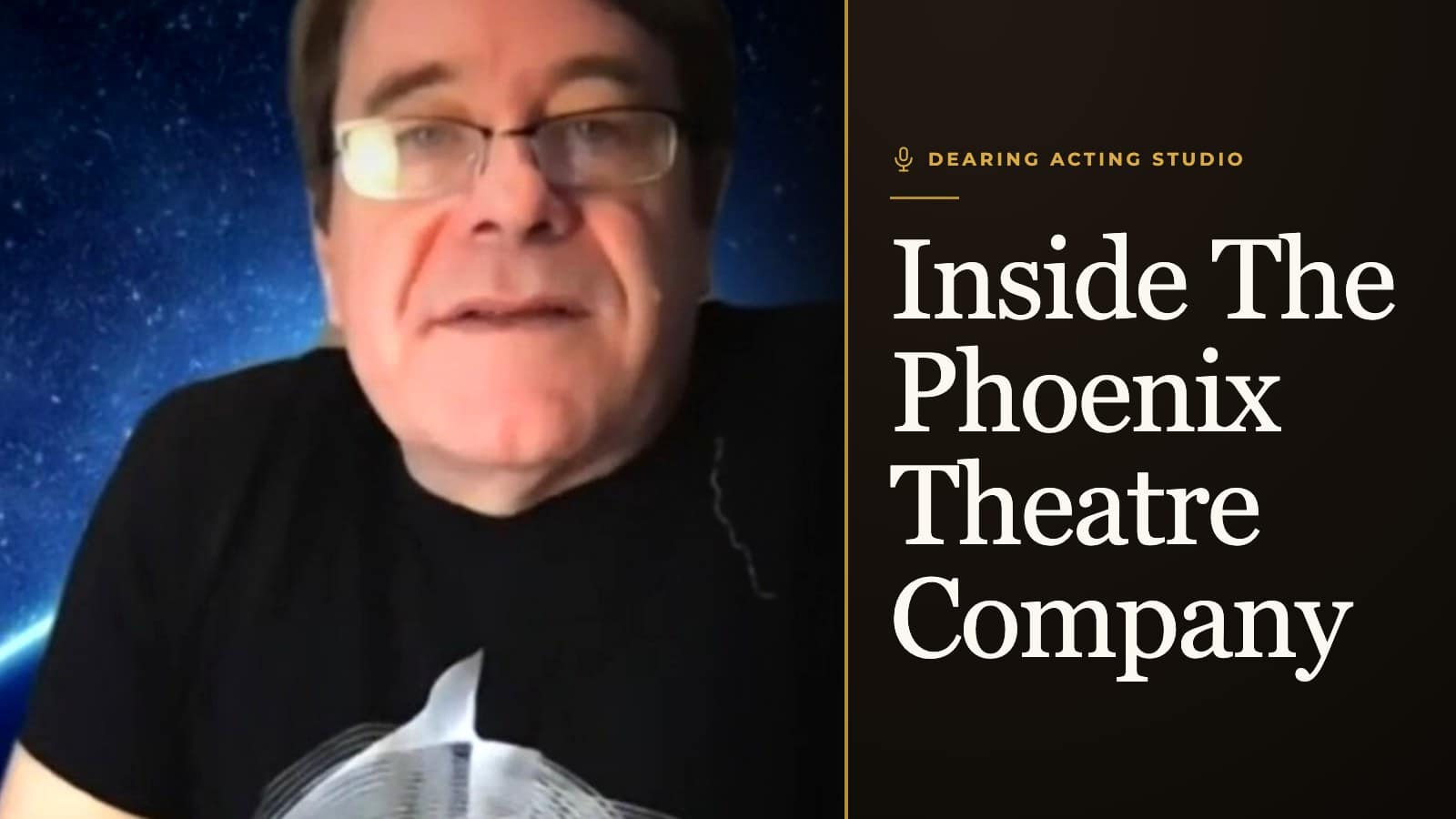
Some of our students were in a production at The Phoenix Theatre Company, and we were fascinated enough to ask for someone to come talk about it. Hanna Spence-Schehr came, from their education side, and within five minutes she let slip that her alma mater is the University of Arizona, in a building with a Go Devils button on the soundboard. She survived it. What she told us about the company is the reason this episode is worth an hour of a Phoenix actor’s time.
How has The Phoenix Theatre Company stayed open for a hundred years?
By never closing. The company opened in January 1920 and has not shut its doors since, not through the Depression and not through the wars, when it opened for the USO. It builds everything in-house, sets, costumes, its own musicians, and it stayed a non-profit while becoming fully professional. When it nearly went under, new leadership and a community that treated it as Phoenix’s theater, not the staff’s, turned it around. The lesson for anyone grinding at anything: consistency beats brilliance over a century, and they’ve got ninety years on us.
Prefer audio? Listen to the episode.
What is in the episode
- 01:48 · The centennial. January 1920 to January 2020, and why that’s rare for any arts organization.
- 02:15 · Never closed. Even in wartime, the doors opened for the USO. And the name change to The Phoenix Theatre Company, because people assumed the shows were touring in. They’re built here.
- 10:34 · From the lobby to running education. Hanna was turned down for the job she applied for, offered part-time work selling food in the lobby, and took it. Box office, sales, then education. A company that invests in where an employee is headed.
- 11:46 · The inclusive camps. With the Southwest Autism Research and Resource Center helping accommodate, kids as young as four with autism, anxiety and cerebral palsy learn music, rhythm and theater alongside their peers. By Friday they can’t get them off the stage.
- 14:30 · I love trash. The four-to-six-year-olds, cardboard guitars, and Oscar the Grouch’s song, on the main stage where Billy Elliot plays. Her rule for her teachers: the end product doesn’t matter, the week does.
- 18:50 · Ballet, and why she left it. A dancer who didn’t go pro, what the culture around ballet cost, and what she carried out of it.
- 20:28 · A master is a student for life. Where the conversation always ends up on this podcast. The actresses in the Valley who never stop training are the ones the theater keeps hiring, because nobody wants someone who thinks they know everything.
Why a Phoenix actor should care
Because the professional theater in this town is a hundred years old, builds its own shows, casts locally, and its education people talk about mastery the same way we do. If you want to work on that stage, the door is training and consistency, the same two things that kept the doors open since 1920. Their season and their classes are at phoenixtheatre.com, and the box office will take better care of you than the internet will.
Full transcript
5,444 words, transcribed from the recording on this side of the desk. Names corrected. Nothing else changed, so it reads the way we talk.
Read the whole conversation
This is the Dearing Acting Studio Podcast, where we discuss the connection between life and acting. All right, this is the Dearing Acting Studio Podcast. Welcome all of our listeners here. I am Matthew Dearing here with Joseph Sweeney, Shea Telple, and Brian Sweeney as always. How are we doing this morning, gang? Fantastic. Good morning, everyone. Really, really good. What was that voice? I don't know. It's like you were trying to sound cool.
I wasn't trying to. Come on. It just came out, and then I got worried about the microphone again. Good morning. Good morning, everyone. I'm so happy to be here with you guys today. Oh, man. Well, we better get right to it, because we've got an amazing guest here with us, Ms. Hanna Spence-Sher from Phoenix Theater. Thank you so much. I'm so excited to be here. We are so happy to have you.
So we were fascinated with Phoenix Theater. I love Phoenix Theater. I'm a theater goer, and I think we connected because I reached out and let you know that some of our students were in a production over there, and we had done a podcast about your theater, and so I sent it your way. And here we are. So talk to us about the beginning of Phoenix Theater, because it's pretty fascinating how long y'all have been around.
It is. It is. I just said y'all. Did I just say y'all? You did say y'all, yeah. Y'all. It was good, though. It was good. Was it? Like, tell us how long y'all been around. It worked. It worked. Because it was like a long time ago. We are a Western state now. You know, I should really let Hanna talk, don't you think? Because that'd be good. Well, this is a very exciting time for this question in particular, because we actually just hit our centennial.
So in January, we will be celebrating our 100th season. We are saying we're in our 100th season already, but we technically opened in January of 1920. Whoa. Yes, yes. And for an arts organization in general, that's amazing. But we are the oldest arts organization this side of the Mississippi. So it's just amazing. And what sets us apart is we've never closed our doors. So even during war times, we would open for the USO and perform for soldiers for free and figure out ways to do things for the community that made sense for the time.
It's just a really exciting time for the company. And we just had a big name change as well. So we went from Phoenix Theater to the Phoenix Theater Company. I didn't know about this. That is a big deal. Yes. It was important for us because so many people think that shows travel through, like Gammage, and we produce all of our own shows. We have production staff that's backstage painting, designing, constructing all of our sets.
We have our own musicians and talent that we bring in. It was a thing about ownership. We wanted to own the fact that this is our company and we are creating something special in the community. I love that. Can I just say that your sets and that stuff is so amazing. Like when we just went recently, we were so sucked in. I felt like I was there.
Like it was, it was incredible. I think, I mean, of course I'm biased, but I think that our production value is extraordinarily high for the size of the company that we are. And that was the first thing that struck me when I moved to Phoenix and wanted to get involved there was just how can a company that's so small and with such a smaller artistic team be able to create something so incredible and so professional.
And it's, it's not about money. We're still a nonprofit, but it is really special. I think that sets us apart. But I'm, you know, one of the, one of the things too is it's about consistency. You know, you look at, so we're always grinding over here and trying to find ways to expand and, and make ourselves better and whatnot. And we forget that we're still in our first like 10 years and they've got 90 years on us and, and, and they're crushing it.
And the fact that they'd never quit, you know, to me, that's so important to say, Hey, there's going to be good times. There's going to be bad times. There's going to be war times yet. We're not going to quit. No matter what happens, we'll find a way to keep our doors open. And those bad times certainly happened. I mean, about 20 years ago, we got very close to needing to close.
And then I remember that we donated. Yep. And Michael Barnard came in as the producing artistic director. And then also the team with Vincent Van Vliet and a score of other people who have come onto the team who have just completely turned the theater around. And I think it's that entrepreneurial spirit that you have. It's that same idea that we need to make this happen. And this has to stay open, um, because it's so much bigger than just the staff that work there.
It's a, it's a Phoenix institution at this point. So you, um, forgive me, but you look very young. Thank you. So, so tell us about how you got connected with this company and in where you're at with, with what they do and how you got started and whatnot. Sure. Um, I graduated from the U of A with a sociology degree. So, so we were off to such a good start.
Oh, no, no. It's not about the U of A. I am wildcats a hundred percent. So that don't you be controlling. Oh my God. Great. So if we could just not say that name again, we'll just refer to it as the school down south. And then, uh, so you went, you went to that place. I went to that really awesome school down south and graduated with a sociology degree.
Um, and moved to Phoenix with my then boyfriend because of the job market on all of that. Why would you bring up your boyfriend on a podcast? Aren't you married? He was my boyfriend at this time. No, but then boyfriend. I know. So why would you bring up a then boyfriend? I mean, there was probably a reason that he was a part of that. Okay. My future husband.
Is that better? No, no, no. I was, I was trying to set her up and you're getting defensive. I was trying to set her up to say, I married my boyfriend. Like that was the idea. Yeah. I did marry my boyfriend. I know it was a lob. I was setting you up for a spike. I missed it. I missed it. And I let you down. But Shea had my back and I appreciate it.
It's okay. It's probably it. I wouldn't expect too much more from the school down south. Anyway. I'm just making this story about me. I didn't want to talk about him yet. Cause this is about my adventure. He must be wonderful though. That guy. He's, he's great. Yeah. I did marry that one. Tell us about the man. The man. So, um, funny you bring up the U of A because we met each other when we were 10 in Flagstaff and we were childhood best friends, lost touch in high school, and then ran into each other again down south at that amazing school that I love so much.
And, um, we were together ever since he just caught my attention on campus one day and was like, Hey Hanna. And I was like, why do I know this name? And it just ended up working. I mean, he was just that guy. He, he, I just knew, um, I mean, we had, I just love this story. I love it. I love that. I just love that. We needed like some hearts or some sort of like a sound effect.
Yeah. Oh yeah. That's perfect. Thank you, Joseph. I mean, we, I mean, it was fun because our parents worked together. So we went to like all the staff holiday parties together and we went to middle school together and it was just this ongoing thing. But then he went to like the prep school and I wanted, I was like, that's lame. Um, and he kind of became, Matt went to the prep school too.
So we get that. College level and high school sucks. Whatever. That doesn't make you better. No, no. I didn't say it does, but it doesn't make us worse either. I'm just defending the man. I like this guy. No, I didn't. I didn't mind the prep school thing. It was more that he got it like super into sports and I was a super theater kid. And so it was very much like the opposites.
And I thought he was really rude. I didn't like him anymore. So when we ran into each other at the U of A, it was great to, um, reconnect and we'd both grown so much. We'll bleep it out. Don't worry. It's fine. All right. You're so rude. No, you know what's funny? I know. I know I am. I'm just kidding. Of course, but I'm serious. And, um, you know, I just saw this article on the Arizona Republic the other day.
This was just like yesterday or the day before that the Arizona state and the other schools rivalry between each other is, is the most heated rivalry in the nation. I believe it. In the nation. More than any sports team, more than any college teams. And they did this like survey where they sent it out and they, they, they had these like different determining factors and both schools are like 90 plus in the hate for each other.
It's so silly. Cause like, I like you as a person. I mean, it's fine. I do too. I was proud of it. I'm like, okay, cool. Yeah. That's fine. Cause I think it's fun. It keeps things interesting. Totally. And it depends on like the year or the decade, whether or not a school gets to brag about anything in particular anyways. Absolutely. So we're in that place right now.
I also did two years at NAU. So. Yeah. And we can all love NAU. Like NAU is great. Yeah. We can all love NAU. They're lumberjacks. And NAU is Switzerland. Yeah. They're great. So NAU is like, oh. They never win. So it's like, hey, everyone can love NAU. Yeah. And NAU is like a bi-week win. And it's fun up there. It's cool. Like, it's great. Yeah. I'm from Flag.
So I was definitely, I did two years at NAU before transferring to the U of A. And I, yeah, I loved both schools for very different reasons, but I wanted that like big school experience. All right. So I should probably stop hijacking this and we ought to get back to a Phoenix theater. So I apologize there. So, so you get started here right, right out of college.
Yes. So, um, I had had a really tough time getting a job, obviously sociology degree. It's 2013. I couldn't find anything. And I applied for a job that was way out of my league, um, at Phoenix theater. And it was for like, I think an event management position, something like that. And the, the position I interviewed with Vincent Van Vliet, the managing director, thank goodness I didn't know at the time who he was because I would have been shaking in my boots.
Um, just cause like he was the top dog and, um, did not get that job a couple of weeks go by. And then he calls me after hours one day and it's like, Hey, I really liked our interview. I don't think that position's right for you, but I know you're looking for work and I'm starting this new thing in our lobby with concessions. Um, do you want to come in and just work, you know, part-time in the lobby selling food?
And I was like, all right, you know, I'll do anything. So I started doing that. And within a month I was working full-time in the box office. Um, what's so unique about my experience with Phoenix theater is I've sort of, I've gained a new position or title or promotion every year, pretty much since I started, um, or every other year, because there is this investment in the employee to say, where are you headed and how can we both benefit from that?
So now, you know, I've worked as the volunteer coordinator, I've done house management, I've done sales on the floor, sales in the box office. And then finally I got into ed, um, and education's always where my, my end goal was going to be. So once I kind of weaseled my way in there, they couldn't get rid of me. I was like, nope, this is where I'm headed forever.
You know what? Let's talk about education a little bit because that's obviously our main focus over here. And you've got an extensive background now through Phoenix theater working with, um, is it kids with autism? Is that right? Yeah. Yeah. Tell us about that a little bit. So, um, when I took on my first year of summer camp, I was really, um, surprised to see that we were venturing into this inclusive environment and inclusive is just saying that whether or not a child requires an accommodation of any sort, um, whether that's for autism, whether it's for anxiety or, um, we've had kids with cerebral palsy, we've had all kinds of stuff.
If we can accommodate them to make sure that they can participate alongside their peers, we're going to do what we can to make that happen. So during my first year, I found out that this was happening at the time, um, my first summer, it was about, it was two of our age groupings. So our older age groups had, um, a SARC helper and SARC is our coordinator.
Um, SARC is the Southwest Autism Research and Resource Center. And they partner with us to provide free training for our teachers. And then they come in every week to answer questions and help us accommodate our students the best we can. So if we're having a challenge, SARC will come in and say, hey, I just watched your staff with this student. This is what I recommend we do to help them.
Um, so at the time it was just two classes, uh, and we were accommodating about two kids per week, sometimes up to four, um, but a lower number. And we were doing it really well. We got really good at what we were doing. Um, and then last year, two years ago, my, my SARC partner came to me and said, let's push this. Let's start training more of your staff.
Let's start opening up these age groups and getting, get it, uh, uh, making it available for more kids to come in. Um, because we start as young as four in our camp. And, um, so we wanted to be able to offer as young as four these families, the opportunity to bring their kids and have them learn music and rhythm and theater alongside their peers, neurotypical peers. Amazing.
Yeah. So it was, um, just when I started the project that just hooked me. And then do you do a show as a part of your camp? We do. Awesome. We have a few different offerings, but the most popular is, um, it's just a weekly camp. Uh, the kids it's themed after something. Um, so newsies, uh, Matilda, whatever the kids are into these days. I did descendants last summer.
Um, and the teachers actually just use the, uh, original content as a jumping off point. So for our older kids, say we have Hamilton theme week, they actually work with the kids to create a script using the original material. So the kids are writing their own stories and, um, with their teaching artists. And then for our younger kids, you know, oh my gosh, my favorite is, um, Sesame Street with the four to six year olds.
Did you know there's a song called I Love Trash that Oscar the Grouch sings? I know that now. I, why your life was not. You used the voice again. Yeah. Uh, well, no. I know that now. This is a really good thing. Getting four year olds to sing I Love Trash while fake playing cardboard guitars. I mean, it's my favorite thing in the universe. So we've never, I don't think any of us have ever actually heard the song.
Have not. No. We'd love to hear it. Oh, it's not coming out of my mouth. Oh, I mean, wouldn't that be amazing? That would be amazing. That's not happening. That would be so, it would just be very neat. It's way cuter when four year olds do it. But, um, yeah. So then they get to perform on our main stage theater for their parents, um, on Friday. And usually the showcases are 15, 20 minutes per age group.
Um, we don't want to, my, my goal with my teachers is always to say, I don't care what the end product is. It's really what they learn on the way there. I'm sure you guys are very much along the same lines. Um, and that's really become the focus. So the showcase is just fun for the parents to come and cheer and bring flowers. And the kids are like, oh my gosh, I'm on the stage.
We're like, we saw Newsies and we saw, you know, Billy Elliot. So it's really exciting to connect them to that big stage. So go ahead, Brian. I was just going to say that that's just such, so cool. I mean, just watching and just imagining it all in my mind. Um, I was curious when you were talking about the, the autism and how you help with that, I could just tell how passionate you are about it and that you have a real heart for it.
And, um, I was wondering where that comes from, or is that something that this came from, from doing the camp or. Um, I was terrified when I took on as director and the first time I sat down with my coordinator from Sark, I told her, I was like, I don't know what I'm doing. Um, I have one cousin who's on the autism spectrum. Most people do. Um, it affects, I believe it's one out of 59 people in the United States.
Um, and so most of us can say that we know someone with autism or who is affected by autism. For me, it wasn't as close. Um, it was mostly that I started to watch these kids learn faster and be capable of more than anyone else thought they were. And there's something about that to me that just sparked something, um, to have a child come in day one with challenges, even being able to transition between like going from the theater, to going to a classroom.
And then by Friday, we can't get them off the stage because they're having so much fun. They've started to connect with their peers. Um, of course, every child is different as, and, um, so the experience is always unique, but I also get to know these families more. Uh, we all, we have a more in-depth process to make sure before they show up day one that they're set up for success.
So I get to know the families a little bit more than I do with the average camper. And it just, it, it makes my job shine. It's, it's what makes me want to do this for the rest of my life. And, um, working with children of any disability has just made me better at teaching in general. Um, the, the skills that we learned through SARC, it's, um, applied behavioral analysis and it just, it's made my teachers say, oh my gosh, I use that technique in my classroom year round.
And it has helped so much because every child thinks and feels the same. Some express that differently, um, some intake information differently, but it just opened up this world that I didn't know was possible or didn't know existed. And the community surrounding it is amazing. There's so much support from these families. It's really incredible. I'm just going to cry. I don't know if I was to that.
Yeah, that's very cool. So along the lines of the education, something that we believe in and focus on quite a bit is this idea of mastery. And what that means. And I love your story of how you got started with Phoenix theater and the, and this, the consistency, the, the willingness to do whatever it takes to get in the door and then move your way up. And, uh, and I'm interested in your take on mastery.
Also knowing a bit about your history being a ballet dancer, where were you, did you try to go pro with that? Is that something that you did do? I did. I really wanted to. Um, so you know a lot about mastery then. Cause I always say like, that's one of the disciplines. That's one of the hardest. It is. And that's where I really wanted to go. Um, I wanted to go onto company once I graduated high school.
What ended up happening is I didn't feel that the culture surrounding ballet was a healthy one for myself. Um, and while I encourage everyone to study ballet that has any interest in performing whatsoever, um, there, there is certain cultural things that come along with working in a, and, um, performing in a ballet class. I was taking classes, um, up to four, six hours a night, multiple nights a week.
Um, and the pressures on your body and between peers can become a lot. And so I absolutely recommend that ballet as a discipline is such an incredible foundation for any other type of movement you want to do. It has very much supported every endeavor with acting, musical theater that I did since. Um, but that's why I kind of pulled away from that and why I shifted to musical theater.
Sure. I just found it to be a much more accepting environment. And I'm sure you've been able to apply some of the disciplines though, that you learned. So, so give us your take on mastery. Like, what does that mean to you? Practice, practice, practice, practice. I mean, as far as mastery, do you, I don't think that you ever master. Yeah, that's exactly what I was getting at.
So that, I think anyone who gets it understands that to be a master means you've become a student for life. Correct. It means that you've invested in the fact that you are never going to be as good as you want to be. That's right. Yeah. And for some people that is not comfortable. And there's a very big reason why I, I didn't go into this as a lifestyle.
Um, of course I wanted to go to New York and be on Broadway and be an actress, but there's so much more that comes along with it. Um, because, but now you're, but now you're mastering something new, right? So, so now you're in something that you've decided is your passion and it's not like you're ever going to stop growing, becoming a better director and, and getting to know these kids with autism better and learning those skills that will be a lifelong journey for you until if God takes you another direction and you're going to do something else.
Um, and, and that's the, that's the point. Like that's, that's one of the messages that we're trying to get across to the world is like, Hey, you can use our courses. You can use the art of acting in order to learn the discipline of what this means to, to be a master, to mastery of something. And it's, it's really the, once you can grasp it and it's so hard, like you said, it's difficult for a lot of people to say, Oh, there's no end.
Like, no, no, we're not going to give you a certificate that says you're done. It's not going to happen at our studio. That's not the way we operate. Right. And I think any, any professional that, um, is striving for perfection, cause that's what you need to do. You need to strive for it. You need to push yourself past the limits that you think that you have. Um, but you also have to be comfortable living in this place of, um, reflection.
You're constantly going, how did I do that? What did I do well? And how can I make it better next time? Yeah. And that doesn't make you weak in any way to say that there are things you can work on. Um, in fact, it makes you strong. It makes you stronger. And the best actors that I know in the Valley, there are some incredible actresses, um, that we work with at the theater and they never stop.
Ever. I mean, they're constantly going to workshops and they're constantly honing their craft and that's what sets them apart. It truly is because nobody wants somebody who thinks that they know everything. That's not, that's just not somebody you want to work with in general, let alone somebody who's mastering their craft. Well, we are, uh, we are coming up here on the end of this podcast. I'd like to, um, just take a second if we could just stop and say, Hey, what's going on at Phoenix theater right now?
And how can we, how can we plug you, support you and send, send people your way right now? Um, there's some really awesome things happening. Um, so we just opened the curious and curious incident of the dog in the nighttime, um, which is actually about a young boy with sensory sensitivities. So if you are interested in that at all, it's a fantastic story. It's very technological and, um, a little bit grittier.
It's an off Broadway show. Uh, then we've got sound of music opening up for our classics. We are doing a new work in January called Americano, which is about a dreamer. Um, it's based on a true story of a dreamer from Arizona who didn't know he was, um, born here or was born and brought here illegally until he tried to join the military. It was all based on a true story.
Um, so there's all kinds of like really cool different offerings. There's a little bit of everything for the, for our audiences this season. I'm really excited. Great. Yeah. We'll definitely recommend everybody go see those shows. So with that, where's the best way for them to find that and go through that? Probably the website. Yes. Phoenix theater.com. I also recommend calling, um, our box office is amazing. And if you're afraid you're not going to get the best deal, call the girls in the box office.
They will take very good care of you. Yeah. Uh, so what's that? What's the number there? Do you know that number by any chance? You're testing me. It's been a while. Hold on. Hold on. We can find this. I'm, I'm on the website here. 602-254-2151. Again, that is 602-254-2151. And you can also go to phoenixtheater.com. All sorts of things on there. Hanna also has a podcast of her own called Hanna Wonders.
And just so you guys all know, this is Hanna with no H. So, I'm so glad you got that in. She spells it the cool way. It's H-A-N-N-A. I, I, I don't want to, I don't think we should say that. I don't, cause what if, what if we have Hanna's that, that, that have an H? We don't want them to feel bad. But they're in the majority and I've always been alone.
So the more unique way? Can we say that? Sure. Can we say that? I just, I just don't want to, you know, I just don't want to make all those Hanna's with an H feel bad. Right. You know? You're absolutely right. Whatever. There's so many. There's so many other ones. Let me be unique and special. You can be unique. You can be unique. And it is very cool.
Yes, it is. So it's Hanna Wonders. So it's Hanna Wonders, the podcast. Great. Yep. All about the wonderful world of theater and dramaturgy. So if you like musical theater history especially, that's my forte. Did you say dramaturgy? Dramaturgy. I know, it's a really weird word. Speaking of weird words, didn't you have like a quiz? Let's give a quick pop quiz here to Hanna with no H. We get, in our junk mail every day, we, and I go through and I look at all the junk mail and we get a word of the day from a place called Word Genius and I just started noticing them in our inbox and I like to look at them every day and figure out the new word of the word of the day.
So every time we get one, I ask the boys what they think the word means. So I would, I would like to ask you what. Why don't we all take this, this, this little quiz? Are we up for this? I believe you two know it. Joey may not, but it is. I also asked my husband last night, poultry, poultry, trued, poultry, trued, poultry, trued, poultry, trued, it could also be poultry, trued, poultry, tude, poultry, tude, I think it's poultry, tude, I haven't heard this word yet.
Is that, is it like, if I did hear it, I forgot it, I'm just going to be out. No, you quizzed us on a different word yesterday. No, it's like a pig with an attitude. Okay. Yeah. Wait, is that the definition? Your best guess. That's like, I thought it was like, a chicken that needs their attitude checked, I don't know. Poultry, tude, poultry, tude. That's cool. Pat, we got the same idea.
What's your guess? Poultry, tude, poultry, tude would be, um, uncomfortable, like extremely uncomfortable, you're feeling a little. Great. In the poultry, tude. Wait, do you remember what the definition was? Yes. Oh, okay. I would probably say some form of fighting. I don't know exactly what, just sounds like a fight. So, this is what's so crazy. I just, I just double checked just to make sure that I wasn't telling all our listeners the wrong thing.
It's a chicken with an attitude. It's a chicken with an attitude. It means, it means beauty. Beauty? Right. What? And my husband last night, he goes, that is, he said it was a protrusion on your face. Yeah. And I said, Jake, it means beauty. And he said, he's, he, it was such a great moment. He got silent and he said, that is an awful word. Yeah, that is an awful word.
It absolutely is. You blossom with poultry, too. Babe, how am I looking? Poultry, too? This is the, the sentence that was given. The irresistible poultry, too, of her friend. That doesn't sound like beauty to me. No, it definitely sounds like she was rocking. We have to embrace it. We've got to embrace the trash. Right. Just like our friend here. I think we ought to end the podcast here on a little Oscar the Grouch.
I love trash. I love trash. If you really want to see something trashy, look at this. I have fear. Thank you so much, Hanna, for being on our podcast today. Thanks, guys. Have a great day. PhoenixTheater.com. Don't forget. From my mother, the day I was born.
Your next step
Consistency is what keeps the doors open. Start yours.
Kids, teens and adults train from the same curriculum in Phoenix, script in hand and on camera. One class a week, and it compounds.
See all classes Adult Script, Monday and Tuesday