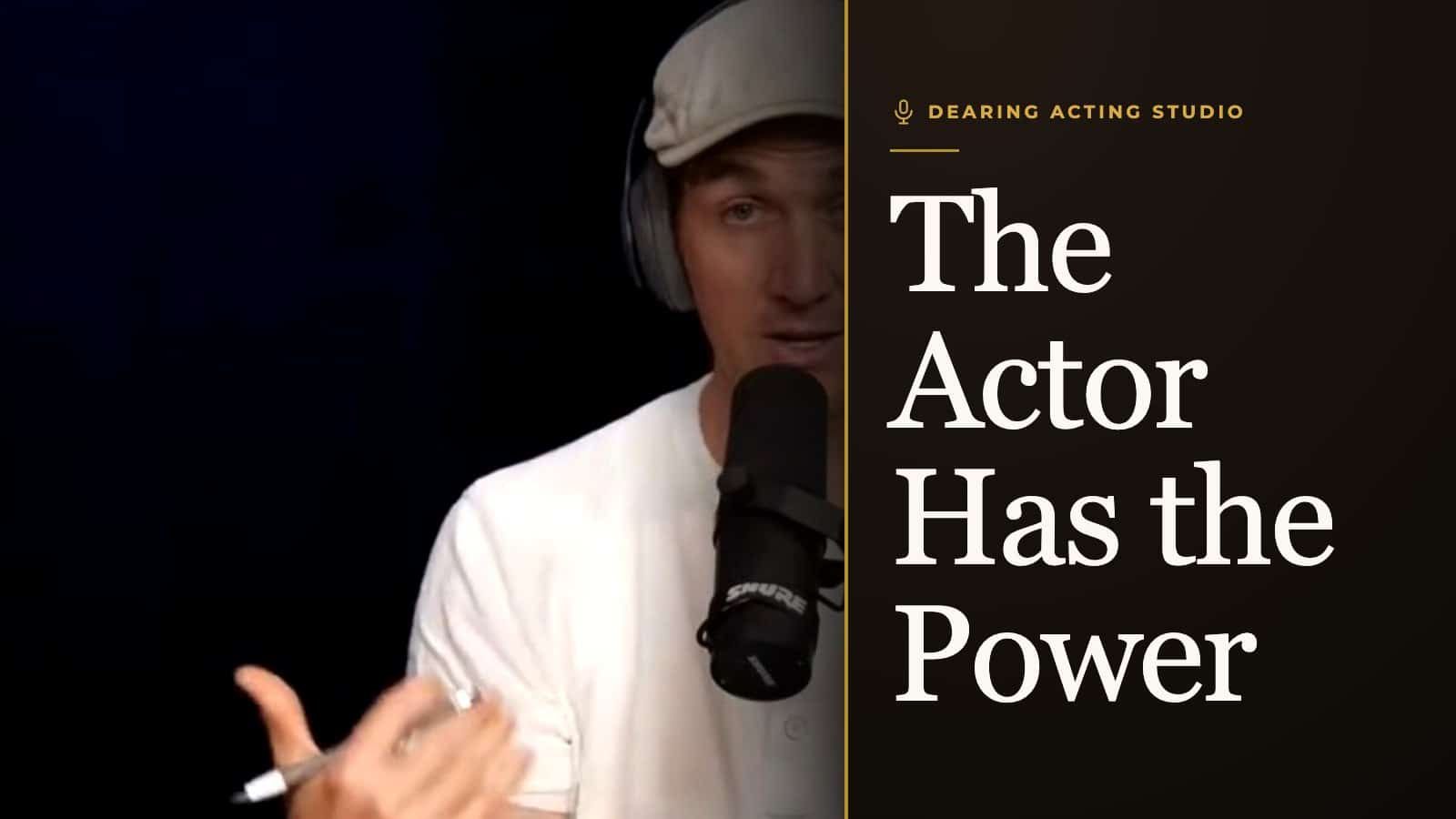
I wasn’t on this one. Shea and Brian recorded it in a week when the team had been pulled in every direction, and what they landed on is the thing I’d most want an actor to hear from us: you have the power. Not the coach. Not the trigger the coach gave you. You. Shea had proved it that week with a student, and she tells the story herself.
Who has the power in an acting class, the coach or the actor?
The actor, every time, and a coach who lets you believe otherwise is building a dependency, not a performer. A student emailed Shea to say she couldn’t get emotional in the scene that night, and she put the credit for the times she had on Shea. Shea wrote back with the truth: it isn’t the coach and it isn’t the words, you’re afraid of something, and once you knock down that wall the whole stage is available to you. You are the only person responsible for removing it. We’re the guide. We hand you the tool when it’s needed, and then we take it away, so you find out you’re capable.
Prefer audio? Listen to the episode.
What is in the episode
- 02:35 · That’s just the devil. Brian’s answer to Shea on a hard day: the thing dragging you down is a negative force, not the truth, and how you react to it is your choice. Naming it takes the weight off.
- 05:39 · The student who apologized. A student came to me after class to apologize for something I hadn’t even noticed. Brian made a point of it in front of the room the next night, and you could feel the release in him. Unsaid things sit on both shoulders, yours and the coach’s.
- 06:53 · The light switch. Darkness creeps up in a lot of forms. Picture the hand under the bed, then picture flipping on the light. The dark didn’t go anywhere. It just can’t be active in the same room as the light.
- 09:23 · I couldn’t do it tonight. The email, and Shea’s reply: you’re putting the credit on me, and that is getting in the way of your performance. You’re afraid of something. That’s hard to hear, and it came from love.
- 10:44 · You are the only person who can remove it. Knowing you have a wall is the first step, the same as anywhere else. Then it’s yours to knock down, and once you do, the whole stage is available.
- 11:19 · We’re just the guide. Coaches in every discipline love to take the credit; that’s their darkness. We refuse it on purpose. We don’t want students dependent on this place or on any of us. We want them to come here and play.
- 14:08 · You don’t need the trigger. Shea used to cry on cue when I said one thing in masterclass, and got bummed when I didn’t say it. The tool was real and it was important once. Then it was time to take it away, so she’d know she could do it without it.
Why this is the whole studio in one episode
The point of training here was never to make you need us. It was to hand you the tools, watch you use them, and then take them back so you find out they were yours all along. A coach who keeps the credit keeps the student small. So we give it back, every time, even when it would feel good to keep it. The actor has the power. Everything we do in the room is designed to get you to believe that, and then to prove it.
Full transcript
4,333 words, transcribed from the recording on this side of the desk. Names corrected. Part of the recording is left out of the written version.
Read the whole conversation
This is the Dearing Acting Studio Podcast, where we discuss the connection between life and acting. All right, welcome to the Dearing Acting Studio Podcast. My name is Matthew Dearing. I'm here with Ashae Toepel and Mr. Brian Sweeney. Hi, guys. Hey. This is an amazing week, although it's been challenging, truthfully. you face adversity. Hmm. And we've been facing a lot of adversity. Yeah. And we grew through it.
I mean, that's the coolest part is that you. Oh, yeah. You make the choice and you rise up and then you grow through the adversity. And I, I feel like that's happened here. Definitely. We talk a lot. Brian sat me down one day and we were talking, I was having a really hard day and I can't remember what it was about, but I was, I was telling him something I was going through and this was the first time that I had heard it.
And now we, we talk about this all the time, but I believe I heard it from you first. And you said, that's just the devil. It's just the devil. Like, that's all it is, is it's, it's somebody trying to bring you down. It's a force. It's a negative force that's trying to bring you down. And I had never thought about it that way. Like, all I could think about was the negativity of it and how sucky it was, but I wasn't thinking in the perspective of, oh, it's just this.
And that's the way you worded it. You said, it's just this, like, like you were saying, you know, it's just broccoli. Like, that's exactly how you worded it. You're like, it's just the devil trying to bring you down. So it's up to you to do, to, to decide how you're going to react to that. And it was, it take, it took so much of the drama out of it and it took so much of the weight off of it.
So now every time that we face, you know, and every day comes with new challenges and new issues that we're learning to love and grow through. Yeah. And the cool part about that, Shea, is like when you start to recognize that and realize that, then all of a sudden that spot is somewhere that you can't be attacked as much anymore. You still can be, but it's, yeah, it's like happening less because you're aware of it.
And so we as a team have been doing that and being more aware of that and trying to focus on that. And so within this space, it's become really hard for enemy to attack inside of this space, inside of this loving place that we're building. And Matt's built this place of transparency, radical transparency, where we just have to speak up our minds and it's really hard to be attacked in that way, in that space.
And so then he'll go for different ways. And we experienced that recently through just like personal, different, for me, financial stuff from all of the bills, from all of those things, and even ignoring some of that. And it was just this hit. And I felt the same thing. It was like, Hey, this is an attack because you can't get us here. And when, when you're rising up and things are going amazing and you're affecting a lot of people, the enemy's scared.
There's this like fear. Yeah. Well, and then you think about, you know, what, what is that, that we have worked so hard to get and that we're fighting to, to maintain every day. And it is culture. Right. So we have, yeah, we've built a culture among the, the, the four of the five of us, really Leeann, you two and Joey and myself, we, we have this just understanding now between us and it's infectious.
The students can feel it and they understand now when they show up, you need to, you need to release and go all in or, or you got to get out and figure it out and wait till you're ready and then come back. And we just had that happen actually the other day. And, and Matt was out, um, kicking some, some booty with a client and I stepped in to teach an improv class while Brian was away.
And we had talked because the night before we had a student and I hope when this gets released, he listens to this. Um, we had a student who had come up to Matt and said, Hey man, I'm sorry. I feel like I brought some negative energy into the class tonight. I just wanted to apologize for it. And it really blew us all away. And the next night I, I made a big deal out of it in front of the class and said, that's what we want.
And by the way, we didn't necessarily notice that, but it doesn't matter because you brought whatever your darkness was to the light and brought it out. And at that point there was a release that we could feel off of him and the class was great and the energy was great solely because you said, Hey, I brought my darkness into the door indirectly and I needed to let you know that.
Yeah. And, and the power of that, what's interesting is we've been using this terminology, darkness versus light, and you can call it a bunch of different things. You can call it the goodness and the badness. You can call it God, devil, but I like the dark and light idea because darkness is sneaky. You know, darkness can, can creep up on you in many forms and it can be scary.
You think about the darkness and you're like, Oh, like it goes back to being a kid and walking through your room and, and visualizing a hand reaching out from underneath your bed and grabbing your foot. You just feel fear and, and whatnot. And that's, that is what venturing through the dark is all about. And then you just visualize this idea of flipping on a light switch. And when you flip on a light switch, the light comes into the room and the darkness cannot exist.
It goes away. It is gone. It just cannot be there. Now it's still there. Interestingly enough, if you allow the light switch to go off. Right. Then, then, then, then it's, it's always, it's always been there. It never really went away, but it just cannot live and be active and vibrant in the same room when the light is shining. And so to this example, yes, the student came up and I didn't even know necessarily that this was something that he had brought in.
And it wasn't until later when I reflected on it and I was like, yeah, we actually for him and I, because we normally get along really well, there was a tiny bit of tension, but it wasn't anything that I would have even registered on my radar, but to him, he would have had to carry it. And whether I knew it or not, it would have been sitting on my shoulder as well.
And I, I might not have even known. And then that could have crept into my personal life. I could have crept into our day the next day as a staff. But instead he was willing to say, Hey, here's the deal. Here's the thing that's going on. And I'm going to say this. And then it was released and then it's, and then it's gone and he doesn't have to carry it.
It's literally the most selfish thing you can do to admit you're wrong, to admit, yay, this is, this is what's going on with me and let it go because then, then you don't have to carry it anymore. Yeah. Yeah. We, we talk a lot about this, especially with the life stuff. So something just came to me thought wise. I'd like to get you guys' thought on it.
Like was in directly into acting specifically. How do we think this applies? Obviously as humans, when we're doing that and growing it, we're going to be better versions of ourselves. So I just wanted to open that up a little bit. I'm sorry. Can you rephrase that question? Like basically as an actor, how does that apply to my acting specifically? Cause it will help it grow and change certain things.
But like, where does that apply? Like if I start applying this, where am I going to see the difference, I guess. And, and that sort of thing. So I have a, I've been working with this girl, um, one of our students and I got to work with her last week and she sent me an email and she said, Hey, I wanted to let you know everything we talked about last week.
I was, I wasn't able to get to an emotional, um, point thus far until I was in there and kind of heard what you were saying, whatever. And I expressed my thank you. And she came up to me last night and said the same thing. She goes, I couldn't do it tonight. I couldn't do it tonight. And I said, you're putting the credit on me. First of all, thank you.
But it's wrong. And I said, you have to know that you have a fear of not releasing your darkness. And that is getting in the way of your performance. And she fought me on it in a, in a kind way. And she goes, no, it's, it's not fear. And I said, it is though, it is fear. And that's hard to hear when somebody is like, you're scared.
And you know, you have to be careful about saying that in a, in a, in a, in, and she needed to know that it came from love and she did, but I just calmly said, you're afraid of something and there's a wall there. And once you knock down that wall, the whole stage is available to you. Once you trust, once you get rid of the fear, once you place the fear on your audience, once you get through that giant steel trap that you, that you have put up in front of you, either directly or indirectly, once you knock that down, there's nothing that you can't do in terms of performance.
So that one, that's my thought on it is like, you have to be able, it's like, um, when they say knowing you have a problem is the first step, that's what it is here too. Knowing that you have a barrier, knowing that you have some sort of chip that you have, that you are the only person that are, is responsible to remove that. When you do that, the world is your stage, man, pun intended.
Well, let me just, just say, wow. First of all, Shea, because, because what great coaching that is. And I'm so excited and proud of you for, for handling it exactly that way, because that's, that just shows this next level humility that we hope to share with every student because, because it's like, they're the ones doing it. They're the hero. We're literally just the guide. And I love that you didn't take the credit and you wouldn't allow her to give you the credit.
You say, Hey, you know, okay, good. I'm, I'm, I'm glad that I helped you make a breakthrough, but you did it. It was you and you have to get back to source here. Otherwise, because if you hadn't done that, and, and let's be honest, there are other places, coaches in, in every discipline that love to take the credit and that's their darkness. Like that's their own thing that they're holding onto the, I think versus the, the, how do I help you?
We idea. And by letting go of I and saying, no, no, no, no, no, no, no. I'm not going to take any credit. This student is no longer dependent upon you and we don't want students dependent upon us. We want them to come here and play. We want them to come here and explore and to grow, but not to feel like they're dependent upon this place or me or you or Brian or anyone here.
And so, I mean, that, that's such a, just a wonderful, wonderful coaching job. I want to say, well done. And I, I came from that space actually, when I was a student, I'm still a student, but when I was in Matt's masterclass, when it started, he would, he would say one thing and it's still very fresh in my mind. Um, he would say one thing and it would get me to cry and I became super dependent on that.
And I would hope that he would do that every time because I knew it would get me there. And then it bummed me out when he didn't. Cause I'm like, I found myself almost being like, well, if he would have said this, I would have cried and which is ridiculous. But in my head, I was like, I put two and two together. If he says these words, then it'll make me cry.
And that was so wrong, you know? And I knew it was my, it was my issue that I needed to do. And he was trying to get me to, to figure out my own fears and stuff. But I was dependent just like that too. So being able to say to another student, like, this is on you. So cool. I just sprinkle a little sparkle on there and call it a day.
And the truth is I could have every time so that I got the credit and you got the cookie and you felt good and whatever. But, but it's like, no, no, no. I don't want you to get it because I I'm handing it to you. I want to, I want to hand it to you when necessary. So you understand you're capable and then go great. So now you know you're capable.
Now let's find how you can manufacture it on your own so that we can help you go next level. And then what's the next level after that? Yeah. And then the other thing to think about too is we do the same thing with things as well. Sometimes we give credit to the wrong places when it deals with certain things and rely on certain things. So in this last week's class, Kylie, who's amazing, you know, she comes out and she was like, I just didn't feel good about it, whatever.
And I talked about it with her for a second. And it was, she goes, she goes, I just didn't, you know, tap into that trigger and that trigger. Yeah. And I was like, I was like, you don't need the trigger. Like coming from trigger guy. Okay. And I told you this afterwards. I was like, she just was mind blown because Brian is the trigger guy. He knows about this stuff.
And here he was saying, yeah, yeah, yeah. I know I said all that. Now I'm saying this and it was such a cool moment because Matt does that all the time. I do that all the time. Like it's, it's not in turn to contradict ourselves, but what we're doing is sure. I told you that two years ago when you needed it, then I thought that that was the case that you needed that and that that was super important.
And, and we learned too. So now I go, okay, I was wrong. And that shows how you evolve. Yeah. Triggers are important and they have a value and here's what those are and where you should use them. You shouldn't need it. If you're needing it during the piece and whatever, then you're not in your space. Yeah. You're in two different places and it's the same as being reading lines.
And so, yeah, it was a really cool moment. I was exciting. It was exciting. It was really cool as a, as an onlooker in the class to see the evolution of you as a teacher in that moment because the class didn't understand, nor would they, um, how crazy that was to watch you and be like, oh my gosh, little do they know this guy teaches classes on triggers or used to.
And now it's like, let me, let me tell you, this is what I said then. And this is what I'm saying now. And they're both true in some way. Yeah. So the evolution of that was, was wild to watch. That's amazing. I didn't know that story either. That's pretty great. So, so to come back to your question, I'm going to, um, tie this in also you were, you were asking specifically.
So this idea of light to dark and applying to acting, because much of what we do is acting applied to life. So let's just call this life and let's, let's apply it backwards over to acting for the actors that are listening. And a couple of things happened yesterday. And, and this is a, this is something that if you, if you figure this out as an actor, it, it, it 100% changes the game.
So, uh, we, this is just the internal admin stuff that I'll share with our listeners here. We're, we're always trying to better around here. And so we were trying to find a better organizational system. And I found this one app and I'm like, oh, it's going to be the, you know, this is going to save the world right here. And so, um, you know, Shea had her, her skepticism and turns out she was absolutely right.
I was wrong, but I, I dug in, I watched all the tutorials. I was really excited about it. And I got knee deep into this thing and it's just way too confusing. It's not a good app. It's not something that it's going to be user-friendly for us. So it was a loss. Long story short, I was staring at this computer for longer than I realized, maybe an hour and a half.
And I'm not used to that. And I kind of was in this zone of, of work, which I think, you know, a lot of people are, are, can, can relate to in their own lives. And I'm, I'm not so used to that. I'm lucky. I don't do a lot of just sitting and staring like that. So I'm just like staring and clicking, you know? So I come out of this trance and it's, and it's class time.
I didn't realize it. And there's people in the, in the lobby. And as I'm walking out, my eyes are glassed over and I might, they're red and then, you know, and I'm feeling drained. And one of the students is like, Hey Matt. And I made the choice right then and there. And this is a discipline. It's not something that's inherent. It's something you can choose. I just made the choice, like, I'm going to be the, the most happiest version of me right now that I can possibly be.
And I shook it out like immediately. And I just was like super loving and excited. And I couldn't wait to talk to everybody and just, and, and that just flipped the switch. Right. So then later in class, we're doing an exercise and, and, and somebody said something that was, you know, a little bit, you know, negative ish, you know, just, but it was from their insecurity of, of this particular exercise.
And, um, but then follow-up question from the same person was like, they asked me, how you doing? And you guys know, what am I going to say to that? Exactly. Happy to be alive. Happy to be alive. I'm happy to be alive. A hundred percent. Cause, cause I am like, that is my answer to that question. And I said that in the same person who had that tiny twinge of negativity, their reply to me was, I just love when you say that it makes me happy.
Like it changes everything. And I can't not be happy after you say that. And I thought to myself, I didn't say it out loud, but I thought to myself, that's why I say it because no matter what's going on, if you focus on good and there is good and just being alive. So that's to me is like the, the, the bottom default. If I can just be grateful for the baseline, just being alive, Hey, I can handle anything else.
And so, so I was thinking to myself that that is what you could do as an actor. It is that choice. And I would say that the dark is the, is the staring at the computer and me realizing that I wasted three hours on, on an app and, and that, you know, I'm not a good CEO and, you know, or you call me that or whatever, whatever you want to say about if I got, if I wanted to go negative, I can make that choice and I can make myself feel bad.
And then I could give a negative teaching experience. Right. Well, as a performer, you have that same ability where you can make the choice, take whatever's going on in your day, throw it out the window and walk in and be loving, grateful, excited, generous, and you change the space. And so you get rid of what we call dark and you just flip on the light switch and you just make the choice and it's going to impact how many acting gigs you get.
It's going to impact how you perform. It's going to impact the relationships that you form inside the casting room. I mean, it's just going to work. I promise. So if you, so I think what you're saying is if you get rid of that in typical Shea fashion, I'm making an analogy. If you, um, make the choice to get rid of being nervous to perform your fear, whatever insecurities you have to, to get up in front of stage, whatever, whatever it is that you're dealing with, if you make the choice to get rid of those things and bring light into your, uh, your space or your mind, then you can make the choice to connect.
You can make the choice, right? That's right. It's not going to go away. Like I said earlier, the darkness is there, but if you just fill it with light, the darkness doesn't have the same power. So I'm not going to say that just positive self-talk immediately is going to just make you not be nervous on stage. It's not like that, but you don't have to add on top of whatever else, any kind of backwards baggage because you are where you are right now.
That's the truth. Yeah. And you own it and you deliver it and you say, here's where I am. And even if, even if where you are is I didn't prepare this week, I didn't do the work. Right. By saying it, by acknowledging it, by, by realizing it's true and not trying to cover it up, that in and of itself is bringing the darkness to the light. It doesn't mean you're going to be as good as you could have been had you done the work, but it means you're not going to be even worse because you're trying to cover up something and, and bring, bring out something that's fake.
Yeah. Yeah. And then when we do that too, that's, it's so powerful. Like when you said it that way, I just thought of my teen class and you start creating something and they come in and they, they, they want to grow and be great. And if they forget their notebook and they're really just genuine about the why, then it's like, it's powerful. It's a really powerful thing.
And the entire class becomes better for them versus if they just walked in and didn't have it when everyone else did, it's different. I can feel the difference. They can feel the difference. Like, and I, I mentioned it in a week, a class a few weeks ago, someone stepped in and they, they basically like spoke on it right away. And they're like, Hey, I'm so sorry. I forgot my notebook.
Um, usually place it in my backpack and I, I totally forgot this week. And I said, Hey, no problem. Thank you for telling me let's get in there and let's grow. Yeah. And, and he had an amazing week. It was really, really cool. When you do that, it's like an out of body experience. Oh my God. He was so excited. That's it. He was watching your lips.
He's like, there's so many buttons on this thing. I just want to play with it. Dude, you're so right, Brian. Oh man. There's too many buttons. Let's give you credit for credit to this deal. But no, seriously, you guys are, uh, hilarious. Oh. All right. Well, this was an amazing podcast. So great. We did miss our boy, Joey. I wish we could keep talking, but we've got a pretty important meeting coming up.
We do. Yes, we do. Can't talk about it yet, but maybe it'll come up here in a future podcast. Thank y'all for listening. We'll see you soon. Peace out.
Your next step
Find out what you can do without the trigger.
Adult Script meets Monday and Tuesday evenings in Phoenix, script in hand and on camera. Worst case you leave more confident in rooms that have nothing to do with acting.
See Adult Script All classes, ages 5 and up