Tony Calvis emailed me an agenda before he had walked in the door. His signature had a logo on it. I pulled Brian aside and said, look at this, we need to be doing that. That is the whole episode in one email: a guy from a thousand-person company sat down in our four-person studio on a Saturday afternoon, and every one of us walked out with homework.
Tony leads the creative team at Nextiva. We’ve been a Nextiva customer since 2009, and Nextiva has been a client of ours for years, for corporate training, keynote writing, speech coaching and sales workshops. He came in to look at how we make things and tell us the truth. Brian, Joey and I put him on the mic first.
How do you keep growing when things are going well?
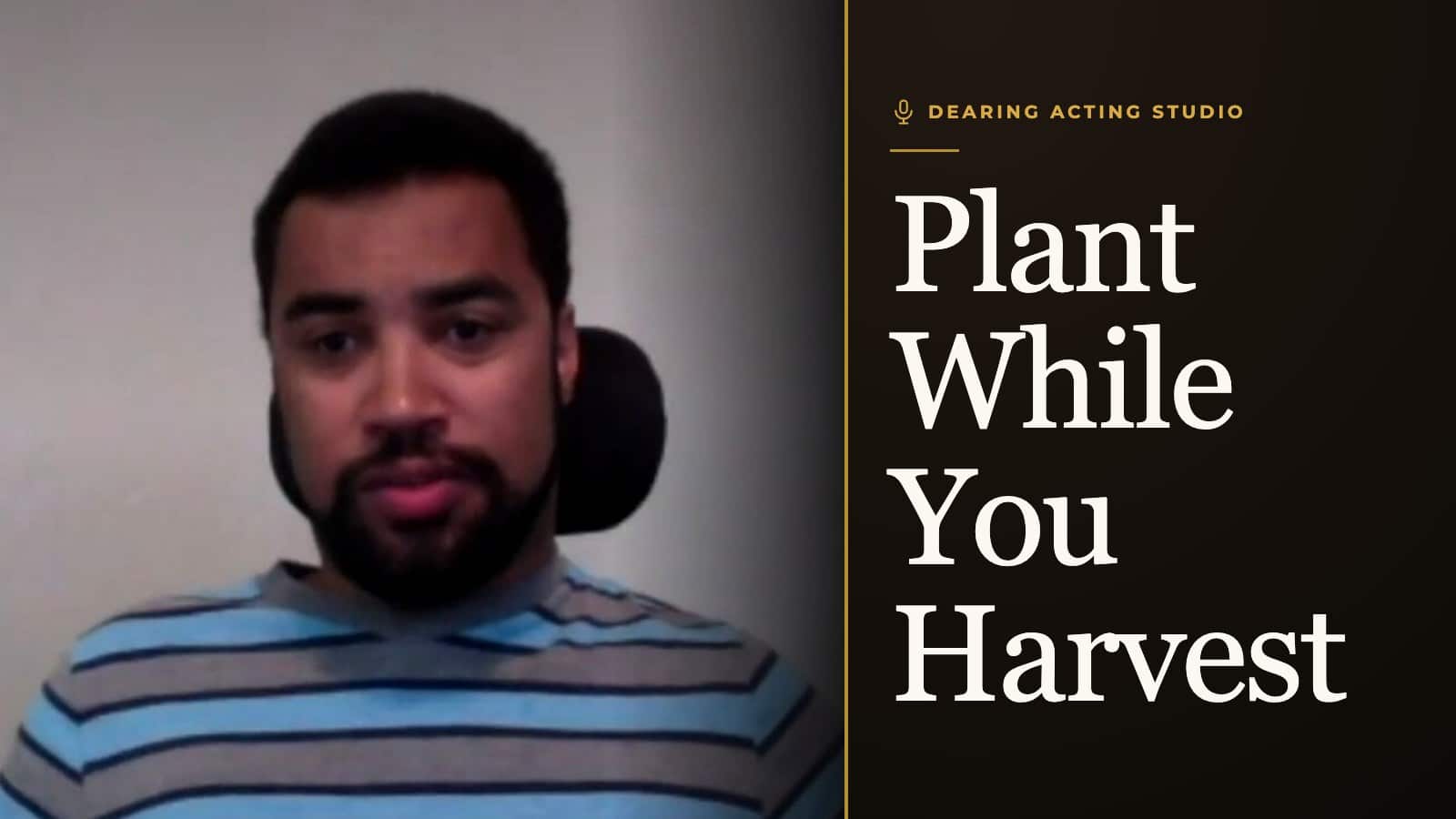
You plant while you harvest. When the clients are rolling in and you feel overwhelmed, that is exactly when you make the next sales call, submit for the next audition, go after the next client. Not because you need it that day. Because if you don’t, you forget what barren feels like, and you drift back to whatever your average was. I said on this recording that it is a concept I have failed at more times than I’ve managed it. That is still true, which is why it is worth a whole episode.
Prefer audio? Listen to the episode, or find it wherever you get podcasts.
What is in the episode
- 01:47 · What Nextiva is, and why a four-person studio has used it since 2009. Tony explains the company in plain terms. I explain the two cell phones I used to carry, one for my real job and one for the studio, and answering the studio line in a bathroom.
- 07:18 · Celebrate, learn, grow. A consultant asked Nextiva’s leadership how often they praise the wins, and the room laughed: it is always a loss, always something to improve. Tony describes the culture; I describe why happiness lives in the progress, not the destination; Joey points out that the studio celebrates everything and then immediately asks how to do it better, and that it is sometimes frustrating.
- 13:54 · Plant while you harvest. The idea the episode is named for, and the part I admit to failing at. Tony’s version, from hiking: find the pace you can hold through the hard parts and the easy parts alike, and never get too high or too low.
- 14:30 · Conflict provides the energy to grow. Tony’s rule from the film set: no conflict in the scene, no growth in the story. Then Brian’s version for a room full of kids, a movie where a man walks across a bridge and gets to the other side and it ends. Nobody wants to watch that movie. The struggle is the part that makes us who we are.
- 19:26 · What a producer is actually looking for in an audition. Tony casts in three stages. First, one small note after a good read, to see whether the actor can take direction. Second, the chemistry read, because nobody should be judged in a vacuum. Third, who they are: do they arrive on time, will they stay late, can they take a million things going wrong on set and still be present. Two perfect actors, and the one who can take more punches gets the job. My half: a casting director is a people gatherer, I don’t make the decision, so you don’t need to kiss up to me. Let me help you give a good performance.
- 25:49 · Joey’s notebook on Tony’s set. Joey went to a Nextiva shoot with a notebook and wrote down every light. What I told him afterward: it is not which lights, it is why each one was put exactly there, and why Tony was on set six hours before anyone else. Then the question every young filmmaker asks: why boom audio with the lavaliers as backup, not the other way round. Safety nets.
Why this one matters to a business, not only an actor
Tony works next to Tomas Gorny, and he says ten minutes with Tomas feels like a two-hour workout. I’ve felt the same thing. The company grew from about two hundred people to more than a thousand in the years Tony has been there, and the thing you feel in the building is that nobody is done. That is the mastery mindset with a payroll attached, and it is the same thing we teach in the room with a script: the work is never finished, and that is the good news, because it means there is always a next step to take. If your team could use a Saturday like this one, that is what our business training is.
Full transcript
6,172 words, transcribed from the recording on this side of the desk. Names corrected. Nothing else changed, so it reads the way we talk.
Read the whole conversation
This is the Dearing Acting Studio Podcast, where we discuss the connection between life and acting. All right, welcome back everybody to the Dearing Acting Studio Podcast. I am Matthew Dearing, here with the boys, Mr. Brian Sweeney and Joey Sweeney. What's going on, gentlemen? Hello. Hello. It's a great afternoon in the studio today. It is, yeah. It's a happy Saturday. We've got a lot going on. We're putting up some new things in the lobby and doing some crazy things, and we've got an awesome, awesome guest here today, Mr. Tony Calvis.
Welcome, Tony. Oh, thank you. Quite an intro. Yeah, I was wondering, will you voice that over just with your deep voice? I feel like it would sound so cool. Yeah, Tony has the silky, smooth voice. Let us hear you say, welcome to Dearing Acting Studio. Welcome to Dearing Acting Studio. Yeah, yeah. We're going to definitely… It's like butter. Very Jon Hamm. Yeah, it is a little Jon Hamm.
That is quite a compliment. I will take that. Thank you. Brian has said that since the day he met you. Since the day I met you, yeah. So Tony is the lead marketing, or he leads the creative marketing team over at a company called Nextiva, which I've worked with several times, and I've got a lot of respect for Nextiva. And so let me just start here with the Nextiva team.
And you can tell me, for those listeners out there who don't know, would you tell us what is Nextiva? What do you guys do? So Nextiva is a cloud communications company for businesses, and we focus on not just all the different tools that you might need to connect with your customers and anybody that you work with in business. It's more about looking at how do all these tools benefit off of each other so that you can give the best customer experience possible, right?
So our flagship product is voice over IP, VoIP, so your phone system over the internet. But we also have offerings like service CRM, sales CRM, surveys, live chat, things of that nature. And I can say I jumped on some of these new services recently, and they're incredible. I mean, the things that you guys are allowing small businesses to do is a complete game changer. It's like, it's a, I think your CEO, Tomas Gorny, likes to say we're leveling the playing field a little bit, right?
Absolutely. And that's been his mission since day one. So it's nice to work for a company where they have not changed what they've said by any means. I mean, maybe the products have changed, but the overall mission has been there from the beginning and you can really feel it in the culture, in the, uh, and in the executive team. Absolutely. And I've gotten to be a small part of watching the company grow sort of from the inside out.
Um, this interesting connection. I, uh, am a customer. We, we, the Dearing Acting Studio has been a customer since back in 2009. So I was a customer for probably five, six years. Wait, 2009? Yeah. Is that, is that not right? No, that's a long time. Long time. Yeah. Well, pretty much since we opened, I mean, we were, yeah, we, we, we kind of figured out the VoIP system.
As soon as I stopped using a cell phone as my, I used to have two cell phones in my pocket and I would go to my, my real job quote and then I'd answer the phone sometimes in the bathroom and then Dearing Acting Studio. Um, and so, uh, so yeah, so once, once we grew up and we, we had a real business phone, this was the first company we use and we've never, we've never gone back.
So, um, yeah, I'm a big Nextiva fan, but what's interesting is then I got a chance to come in there and work with you guys. And then I don't, I don't really know anything about your business, which I ended up finding to be an advantage in helping out. Cause I was able to, to go to Tomas and say, Hey, what's cool is because I don't know what I don't know, if you can explain it to me and I can understand Mr. Layperson here and I am your customer, then, Hey, we were onto something and, uh, our sort of relationships took off from there.
Yeah. No, I mean, you spend 10 minutes with Tomas Gorny and you feel like you did a two hour workout. I mean, it's yeah, exactly. It's incredible the way his mind thinks it's, it's so awesome. I feel just honored and privileged to be in the room with that guy. And you're right. It's, it's a workout. And, and, and when we're doing the next con work that I do a lot of times, I'm working sometimes 12, 14 hour days next to that guy and then waking up the next day and doing it again.
It's, it's, uh, it's intense. But I look at him and I say, wow, I mean, every entrepreneur can look up to what he's doing. I mean, he is the absolute American dream story. He's a guy that, uh, like you said, whatever he says he does and he backs it up and he follows through. And, um, he even joked about it. I mean, it just feels like the things he touches turns to gold, but it's not even, it's not that it's just that he works harder.
I feel like than everybody else. Yeah. Yeah. It works harder and adapts quicker. He's very adaptive to whatever the situation is. So I've seen you guys and I've watched you just sort of like grow and explode. And so could you tell us a little bit about what's going on at Nextiva right now? I know you've, you've added quite a few employees recently and, um, I don't know if you call them that your team members.
Um, talk to us about what's happening right now. Yeah. So, uh, just a little bit of background. I joined the company in late 2014. Oh, so I've been in the company longer than you. Yeah. Uh, but, uh, anyway, I came in as a video producer basically for the company and I was the second video producer there in the marketing team. Uh, at around, at that time we were probably around 200 ish people, uh, 200 ish employees.
Which is crazy because we're four employees here, like our full team, four or five. And so you were 200, but that was small, right? Yeah, that was. So we were the fastest growing tech company, uh, in Arizona for the year after year. And the only other competitor that we, uh, kept butting heads with for that prize was the sister company, SiteLock. So I mean, another company that, uh, that Tomas is involved with.
Exactly. Wow. So two home runs from this guy at the same time. He's probably angry and happy. Always. No, it's all happy. It's like when you play yourself in chess, you're like, ah, yes. Oh. But, uh, so after about three, four years, I think we hit a thousand employees. Wow. And I mean, that is, I mean, being part of that wave and feeling that growth, I mean, we definitely felt that there were plenty of growing pains, but there were also just these insane opportunities, uh, NextCon being one of them.
Yeah. Um, so yeah, it's, uh, the company now is a little over a thousand, uh, team members and I mean, there is no stopping in sight for that growth. So speaking of growth, growth is a part of the mastery mindset. And I think, um, Tomas definitely embodies that idea of continual growth looking. I've, I've, I've watched him and you and me have conversations about, Hey, if it can be better, it should be better.
And, um, and we got to do better than we did last year. And so can you talk to me a little bit about Nextiva's take on that and maybe even your personal take on, on mastery and a growth mindset? Yeah, we, uh, we actually just a quick tidbit had a, um, had a consultant come in and they, and he, he's trying to help us with, you know, branding and making sure that we can be as best, as good as we can for the next 10 years.
Right. Um, and one of his topics was, uh, you know, how, how often do you guys, uh, praise the wins and we all just kind of laughed. Like, why would you praise the wins? I mean, it's always a loss. It's always something that we can improve. Yeah. Uh, and you know, that, that mindset can feel like a lot of struggle, but at the same time, the purpose of Nextiva is so strong that we don't typically feel that pain, right?
It's always this, every, every day we look back at what we did yesterday and we say, you know what, this, maybe this was good. Maybe we hit our number or whatever, but, uh, how do we make that number bigger and how do we, how do we make our customers love us even more than they did yesterday? So that constant pursuit is, you'll feel that anywhere you walk in the office.
Well, it's the joy. I mean, my, my opinion on life in general is when you're going after the progress and not the destination and you, and you live in the state of progression, that's where happiness is. I mean, that's when you're at your, at your peak state is when you're moving forward and progressing. Yeah. Yeah. Matt, you had a cool way of putting that like a while back, the celebrate, learn, grow.
You remember that? Yeah. It's that idea of like, you're celebrating something and then you learn from it and you grow from it. And like, you're still having those little celebrations, but then it's all about learning and then growing. Cause if you just celebrate and stay stagnant, nothing happens, right? We don't get anywhere. But yeah, I just, that just came to my mind. It's funny. You, uh, you could, you could almost consider me a consultant of sorts when I come in there and work with you guys.
And I've had the exact same conversation with Tomas when I've said, Hey, make sure you're celebrating the little things because you really need to do that. I believe in, in say, Hey, let's, let's celebrate what we've done. We do need to have a quick celebration and say, Hey, good, good job. Like, look where we were and where we are. Awesome. But then immediately you decide to grow and, and how can we get better?
Does that remind you of anything, Joey? Oh yeah. Yeah. Just about every day. It's any project. It's like, Oh, that's so great that that video got out. But, uh, but, uh, why is that logo there? You know, like certain things where you, you do that, like you practice what you preach, you celebrate almost everything we do here. And that's pretty cool. Like castings, whatever, but immediately you're looking for that.
How can we get better next time? And honestly, that's frustrating sometimes, but, uh, but you know, it's funny. I was going to tell you, I, we were talking earlier. So the whole reason I should talk about this really quick. The whole reason we're having a podcast right now is, uh, Tony volunteered to help us out with some of, some of what we got going on over here.
So he's going to take a look at, um, he is, he is a production master. I can say that about you. You really are. Thank you. And, um, and so we, speaking of growth, we're looking for ways that we can improve. So we like what we're doing and we're going, Hey, how can we get better? And so, uh, reached out to you, you volunteered to come down.
And so the reason we're having a podcast is Tony didn't just say, cool, let's have a meeting. He sent over and said, Hey, you should create an agenda for our meeting so that we don't waste time, which I loved. I love that idea. And I'm like, dang, that's awesome. Hold me accountable. So then it took me about 45 minutes to figure out what would be cool to do during our meeting and really show you what we do.
And I had the idea, let's do a podcast. Like, why not? Cause we do that all the time. So, so that's the reason we're here. I have to say that was a very thorough agenda. So I was not, it was great. Well, here's the deal. It was because your letter to me with your signature at the bottom, I'm like, this is awesome. I'm going to have to create an agenda for this guy.
What's funny is he pulled me aside and he was like, he was like, Hey, Hey, check this out. And I was like, okay, cool. And he was like, he was like, look at this email that Tony's like, he was like, look how professional this is. He has this logo on it. He was like, he's like, we need to be doing that. It's so funny. Cause I can't even, I can't receive an email without dissecting it like that.
It's like, if I, if I love it or hate it, I bring the team in and I go, Hey, why do I hate this? Tell me why I love this email. I love doing that kind of stuff. That's yeah. Or even if an email catches my attention and I'm like, Oh, why did I open that? I'm curious to know why I opened this. And then I'm like, Hey guys, come in here.
Let's look at this email and figure out why I opened it. Yeah. Yeah. So, uh, so I did take a peek here at your website, which is your pretty face here staring back at us. And I, you know, going on to what we're talking about here, you just have the word onward. Talk to me about that. So, uh, that pretty much is a, that's a single word that can sum up a lot of what we've already talked about just in this five minutes here.
Uh, you know, to me, um, always moving onward, whether it's good or bad, you know, whether, whether you've had just the worst day possible, uh, you know, you lose your girlfriend, you, uh, you got in a car accident, you, whatever, uh, just the fact that if, as long as you are breathing and you can take one more step, yeah, that's the most important thing that you can bring into your life.
I've had a mentor talk to me about the idea of, of really striving to not get too high or too low. Yes. Yes. Finding that perfect balance. And, uh, I think of it as when you're hiking, uh, you should try to find a rhythm where the hard part, the hard parts versus the easy parts, you're always going the same speed. Right. Yeah. So you, you should find that cadence where you can really toughen up to get through the hard parts, uh, in the same pace as you would and then you can relax on the lighter parts and not, you know, not overstress yourself on those, uh, on those areas.
But then at the same time, when we're, when we're experiencing that victory and we're celebrating, we're having a good moment, um, I believe in this concept that I, that I have failed at so many times because it's so hard to do, which is to plant while you're harvesting, you know, like when times are good and things are rolling in and you're feeling great to be, to be putting out those sales calls or putting out like for us, uh, another audition or something like going after the next client when you've got four and you feel overwhelmed, you forget what it's like to be barren and if you're not careful, you, you, you don't grow and you, and you go backward to whatever, whatever your average was.
Yeah. Yeah. So, uh, so something in my personal life that I try to apply to that type of situation is, uh, I'm a big believer that conflict provides the energy to grow. Uh, so if you think of, and I mean, this, this applies to, uh, my film set days, uh, basically if there's no conflict in the scene, there is no opportunity for either of the characters to grow in the story.
There's no opportunity for the story to grow. There's no, so you bringing that into your personal life, you know, if you have too many clients and you're finding that it's overwhelming and it's tough on family life and your clients are not having the best experience, that conflict is exactly what's put you in a place to then say, how do I make this better? How do I, how do I change a few little knobs here and there so that my customers are happy?
My family is happy. I'm happy. Yeah. And then you go on to the next conflict. I love that. Brian, you have a similar, I was about to say that. Right? Yeah. So Brian, Brian goes out and he speaks to kids and he, he, um, he tells them a little bit about his story and just tries to inspire the kids. And he came up with this really great analogy.
Do you remember this? The, uh, which one about the movie? Yeah. The movie. Oh yeah. Yes. So it just came to me. It's similar to what you just said, but it's, it's really, uh, tailored for kids. And I love the simplicity of this. Go ahead. So I was like praying about what to do in that morning and I, it just, I swear it just came to me.
So we, we came up to, I came up to speak and like, there was this idea. I set them all up and I got them all ready and I go, okay, I love movies. Who loves movies? And they all like raise their hand. And I was like, I just saw this really, really good one. And like, uh, and then I went to describe it to him. So I was like, so there's this guy and he's walking across the bridge and he gets across the bridge and the movie's over and just everybody goes so quiet, like just silent.
And they're just like looking at each other. Like, I was like, does that sound like a great movie to go see? Like nothing happens, no conflict, but he gets to the other side of the bridge. It's awesome. Right. And they were like, no. And they started like shouting, I don't like it. And, and the idea was just like the conflicts, the, the struggles, the pain, that's what we enjoy watching because that's what makes us who we are.
Yes. Like that's, that's what's interesting about us. Yeah. No, you know, that, that sums it up perfectly. And that's why sometimes you can, you can actually end up feeling bad for people who have too much, have it, have it too cushy because yeah, they, they don't, they don't have anything to go up against. And that's, you know, that's the exciting part of life. Yeah. Like in my happiest times, I'm like angry that I don't have conflicts, right?
It's almost scared, right? Cause you know, the next one's around the corner. Um, so Tony, I can see why, uh, uh, you're such a good fit over at next Steve because it says here right on your website. Um, if, if you need someone with experience from big business and passion for small, let's go onward. And, uh, thank you. And, um, and, and that's crazy cause we're small and you, you saw our mission vision values and you said, Hey, what's this?
And you asked me about it and you're like, Hey, I like this. Let me come in and help. And I, I just so appreciate that you, you have the same mindset as Tomas. Like you, you back up what you say. And, and, and I think that's really Nextiva's thing too, right? Yeah. No, I mean for myself and for Nextiva, we love doing cool S H I T, but, uh, you know, it's, it's always about building things and building things that not only are we proud of, but also find, uh, our customers find value in, uh, the people that I work with find value in.
So that's so fulfilling. It's fulfilling every day because of it, because we get to do some awesome stuff. Yeah, absolutely. So, um, so we got into the topic of movies here and, and, and production. And so you, as I mentioned, are a production master, which is why Nextiva grabbed you. Um, do you remember when we met? Yes. I don't remember the date. Do you remember the date?
It was, it was a long time ago. I don't. I was trying to think if I was in college still. I might've just been out. I, it was this building, I think. Yes. Maybe. So it was just re, re, re designed different. We were in the back. It was because he came back into the back office. In the sweaty, sweaty, hot office. So you were just graduated from college at the time?
It must've been. Okay. Yeah. Cause, uh, I did a lot of data work for you and that's kind of what I was doing. And you were recommending these big, massive hard drives for us and different things that we, we don't have to use anymore. Thanks to technology. Yep. Um, but, uh, but yeah, so, so we met in that way, but, but tapping into, um, you know, a lot of our, a lot of our clients and listeners are very attracted to the personal development side of things, but we, we do have a lot of actors out there as well.
So, um, when you were casting or even are casting now, cause I know you, you, you run commercials and different ads and things, um, through Nextiva and you've got a hand in that. What, what are you guys looking for? What are the qualities of a performance? You can give any kind of hints or tips. Oh boy. Uh, so first off, uh, I find one of the most valuable people to hire on the film set is the casting director.
They know what they're looking for. They know to sort to, I mean the amount of time that it's saved. It's saved to, to sort through the, you know, actors that show up. They didn't memorize the lines. They didn't even read the lines, you know, and they, they sit down and they say, Hey, can you give me just like three minutes so that I can look this over?
It's like, okay, well, this is done. I'm so glad you said that. We spend a lot of time on our casting side of our business, uh, Phoenix casting, phoenixcasting.com. Anybody's looking for a casting director. Um, uh, actually it's phxcasting.com. I apologize. Um, but yeah, it's, it's an under, uh, people don't really know exactly what the casting director does. And I always tell them that, um, we are people gatherers.
So when I look at the casting process, uh, my philosophy is let me bring in the best talent that there is. Let me narrow them down for you. And then let me, let me help bring out the absolute best performance out of each person so you can see them kind of at their best. And then you, and then I, and I tell people, I don't make the decision though.
At the end of the day, it's guys like Tony making the decision. So, um, so you don't need to kiss up to me, you know, just, just allow me to help you give a good performance, please. And, and allow me to help ease your nerves in the room. That's my goal. Yeah. And I would say that it, uh, for casting for me, I look at it in sort of three stages, basically.
Uh, after I receive, you know, a list of headshots, uh, uh, from the casting director, uh, that's when you start bringing them in to do their, uh, their casting sessions. And so the first thing, uh, you, you normally read with the, uh, the actor, whatever they're acting, uh, uh, uh, casting for, and you look at number one, how like invested are they in their craft? Not even in the script, right?
Cause the script, they just got it. It's not fair to judge them and have them feel like, Oh, I love this. This is a perfect story. All that. I just want to see that they are passionate about delivering the best experience or best, uh, uh, best performance. How can you tell? Like, what is the, is it? So you get into, uh, instances where you start reading with them, you see, you let them feel it through.
And, you know, if you have to give lines back, then, you know, getting that cadence, uh, felt through, but then looking at, you know, even if I think they delivered it perfectly the first time, I'll give them a note and say, how would you do it? If this character had, uh, had a huge cortisol spike right beforehand, right? Yeah. So you just give them one tiny little direction and you ask them and you wait and see how well they took that direction.
Yeah. So that's, that's the first phase is seeing, you know, I'm going to be working with this person. If I give them a note, I need them to pick up on that and feel all the nuances that I meant. Right. I always think too, that you can tell someone who's very invested in their own craft when they want to learn more. Yes. Yes. So if an actor in a room this time, and it's not, it shouldn't be stupid questions that they already should know based on, you know, coming in, but something interesting, like, you know, have you thought about this with the character and maybe even after a read, you know, would you like me to try it this way or that way?
Um, would probably tell you, give you a hint that, Hey, this, this person had knows how to use a script. Yeah. Yeah. And, uh, so after, after I've selected the actors that have passed that test, then you go into the chemistry reads, right? And that's where I find the most value in casting. It's not so much the individual giving the, the, um, uh, their delivery of the lines.
It's how well do they play off other people giving the lines of whoever else is acting in the scene with them. Or, or maybe even how well do they fit with the energy of. Yes. The particular piece. Because sometimes it's a solo read, right? Sure. Yeah. And your voice and my voice would, would do well for two different pieces. Yeah. Yeah. Yeah, absolutely. So, uh, but I, I just, uh, I guess I, I don't think it's too fair to judge someone in a vacuum, uh, for the most part.
Uh, I mean, there, there are times when you have to do it and you just try to get as far away from that as possible. So the chemistry reads offer a very simple solution to do that. Um, and this is exactly how I've cast it from, you know, my thesis film in college all the way to now. Yeah. Um, so yeah, that, that second phase is looking at the chemistry, uh, between one actor and the other.
Maybe you're selecting for both. Maybe you already have one selected and you need the other person to work off of them really, really well. And that's where you start to really feel the magic between two people and their deliveries. Uh, you know, I've had plenty of instances where I thought a guy was great, but as soon as you get into the chemistry read, uh, somebody else worked out even better that I hadn't, that I just kind of brought along cause it wasn't bad.
Uh, so you, you learn a lot through the chemistry read. Um, but, uh, after, after that and going into phase three, it's really not so much looking at the, their performance, it's who are they? I mean, what kind of pursuits do they have outside of acting? How dedicated are they to acting? What other sacrifices have they made in it? Uh, you know, do they, do they show up on time?
Yeah. Do they not mind staying late? You know, these are all things that when you're on set, there are a million things that are going to go wrong. Are they going to be able to stand those million things or are they going to tap out after 999,999 things going wrong? Right. And I need them there the entire time. Yeah. Right. And present, right? Yes. So that, that's really what will determine if I have two perfect actors and both could fit the one who can go through more punches with me is the one I'm going to go with.
I love that. You know, when I met you, Tony, it was on a shoot for Nextiva and, uh, Matt called me up and he was like, Hey, do you mind like bringing Shea to the shoot? Like I'm with Tomas already. We need to be here. Like, can you just take Shea, uh, bring a notebook, check it out, see what you can learn. Right. And so I was like, okay, cool.
That sounds awesome. And, uh, we pull up into this house and, uh, and we're in this tiny room and it's super nice. It's like a, it's like a study and there are lights everywhere. And I was like, okay, I have no clue what half of these lights are. And so I just started writing down like, Oh, a big bar light and, and a boom operator. And then like, I would write down little things that you said, like light from below, light the back.
And, and I learned so much from being around you for like three hours, maybe. Which by the way, Joey, to your credit, um, that says a lot about you because a, you've adopted that growth mindset and be what we are able to accomplish considering you are self taught and just, you know, kind of soaking up what you've learned from me and whatnot, which is, you know, I know very little.
Um, I was a like sort of filmmaking photography major at ASU, but I was really just trying to get done so I could start acting. So I should know a lot more about apertures than I do. Um, but yeah, I mean, I mean the idea, like the whole point, I told you this earlier, I'm like, cause I think he was a little nervous when I said, I'm going to have Tony look at your processes and stuff.
And he's like, well, maybe we'll focus more on SEO. And I was like, no, dude, trust me. He's going to be, he's going to be nothing but complimentary because, uh, Tony knows me and he knows that I have a similar mindset to Tomas, only less of a budget. And so, so sometimes, you know, Joey will come to me and I'll go, well, you know, can we do this?
And he'll say, I don't know. And I'm like, well, could Steven Spielberg do it? He's like, I don't know. Well, we should probably, probably look it up first. Uh, so anyway, yeah, no, it's a, it's a big testament to who you are, Joey. Thank you. Yeah. Yeah. No, we loved having you on set that, uh, that was, that was a, that was a fun time. Yeah. I, I'll never forget that night.
So much fun. I saw Tomas's eyes light up too. Cause he came in the room. Yeah. That was actually one of the first times he's really been on, on set when, you know, I, I've done one of my shoots. Yeah. Uh, and I, yeah, I mean, it's, it's great having those, those stakeholders have such an investment and they get to be part of the process and, you know, it's helpful for me too.
Cause if I have a question, I can just look over and ask them, Hey, do you want this way or that way? Um, but yeah, I mean, I, I, I love teams. I love collaborating on set. I mean, I try to bring set life into anything that I do because it's, it's such a unique experience where you've spent 99% of your time on a project just to execute on 1% of that time.
Right. Yeah. So, you know, you've spent months just to make three hours go a specific way. Well, and I told Joey too, I was like, when you're writing these notes down, cause we didn't, we talked about it afterward and we reflected and I said, it's not, it's not how many lights are which lights. It's why each light was put in the exact position it was. And that's why Tony was there six, eight hours before everybody else to set up and, and manipulate just inches with these lights to, to make it look and feel a certain way.
And it did look amazing by the way, like phenomenal from the audience perspective. Cause I wasn't there that night they left and I was, and I was here, so I hadn't seen any of it. I hadn't, I just heard things, you know, and then being in the audience and watching it on the big screen at next con, it was so cool. Like hearing all the laughs and seeing it and it was, it was next level.
I mean, the video was, has that video gone up on the website? Not yet, unfortunately, but I have to, uh, I have to tip my hat to, uh, Brian Roth, who was the director of photography on it, uh, which is another role that I would say is critical to any, uh, production is that, you know, if, if you're directing actors, you need to make sure that someone is worried about everything else around them.
Right. And that's going to be your director of photography and perhaps a, um, uh, a production designer, uh, art director, all of those people. But, uh, in general, having good lighting, good sound. Yeah. Yeah. So big deal. So, so quick question based on that night. I know we got to wrap up. Uh, I noticed, so you had labs, but you didn't, you, you use them as a backup to the boom audio.
And I was like, oh man, I'm doing something wrong. I've been filming with labs and using my boom as backup audio. Why did you do that? Ah, so it's, there's a lot of different, the, the, the real answer is safety nets, right? So you want to make sure that you have as many different, uh, opportunities to save yourself if something goes wrong. Uh, you know, I, I personally prefer the, uh, audio that comes out of a boom mic.
Uh, but I know a lot of people actually prefer the lavaliers and the mobility of that. So, um, you know, I, I, I don't claim to be too, uh, technically, uh, smart in the sound department, but, uh, you know, just from my hearing and what I like to listen to a voice from, you know, my, I go towards a shotgun mic. Cool. Bye. No, that's awesome. It's good to get that answer.
All right. Well, we have, uh, we have squeezed out quite a bit of knowledge from you, Tony. So thank you for joining us today. That's going to wrap our podcast here, special Saturday edition. Thank you to all of you who are listening and we will see you next time. Have a deering day, everyone.
Your next step
Nextiva trained with us. Your team can too.
Corporate training, keynotes, speech coaching and sales workshops, taught by the same people who teach the acting classes, because it is the same skill: listen, then act.
See the business training Or take the adult class yourself