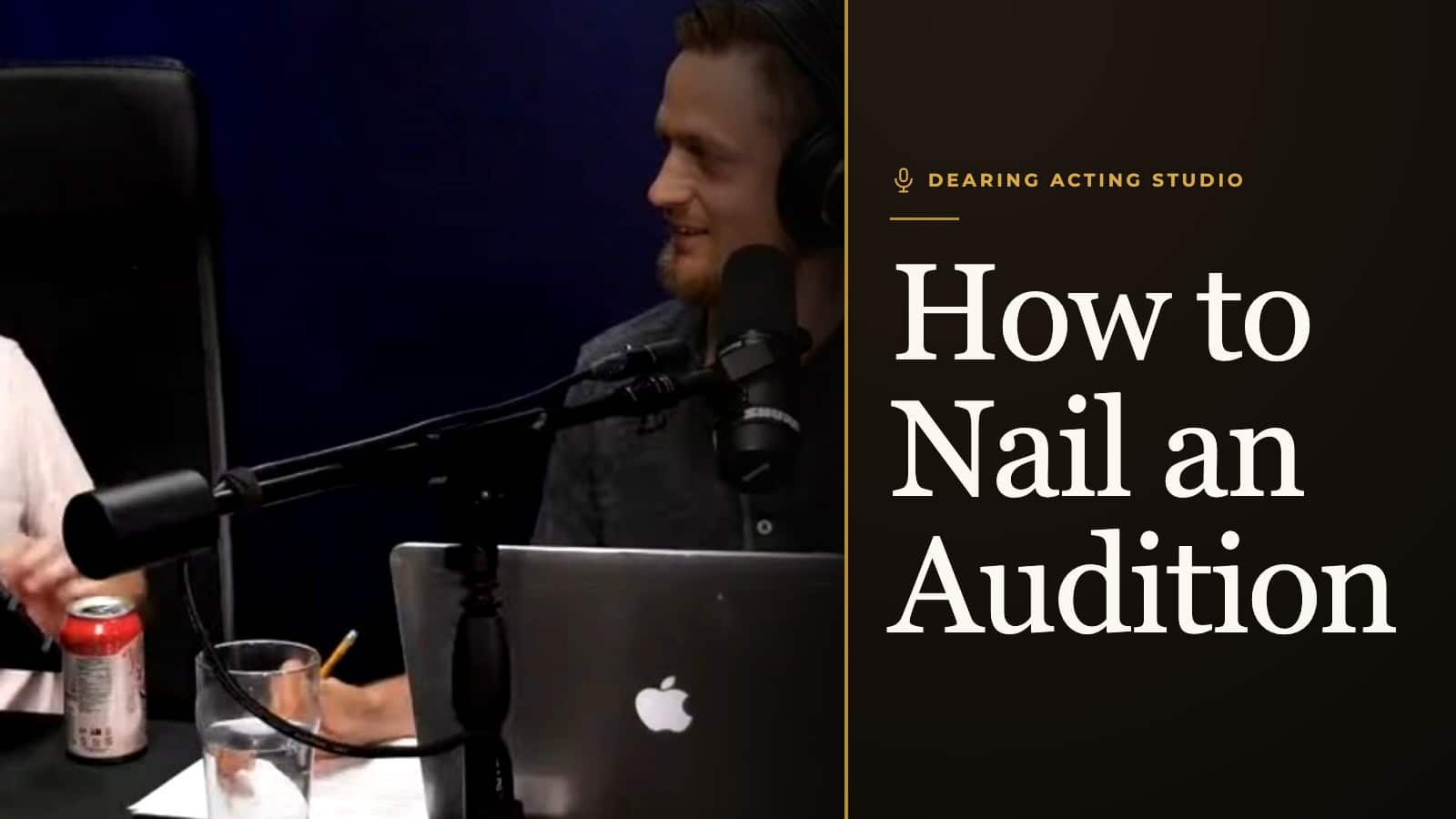
A listener named Steve asked us to talk about killing auditions, so Joey told the story of his first one. He was training in our teen program, he talked his way into an audition he wasn’t invited to, he printed his headshots at Walgreens the night before, and when they handed him the script he hadn’t read page four yet. They were talking fast in the room. He panicked a little. Then he took the script and went for it, said the line, and they called him back the same day to see him with a different energy. On the way out, one of them said: next time, don’t hurt yourself. He got the job.
That’s the whole lesson, and he didn’t know he was teaching it.
How do you nail an audition?
You want to be there, for its own sake, not for the money or the credit. You breathe, and you lean on the training you did before you walked in, so that you can connect to the script instead of your nerves. And you dare to be wrong, because your authentic self is the most attractive thing you can bring into that room, and a bold wrong choice reads better than a safe nothing. Then you do the part most people skip: you audition every day, whether or not anyone is asking you to, until an audition is just another Tuesday.
Prefer audio? Listen to the episode.
What is in the episode
- 02:48 · You can choose to be happy today. The book had just come out, people were buying it, and I wasn’t excited, which confused me. What I worked out: happiness isn’t in the thing arriving, it’s in what I’m doing today. There’s always another step.
- 05:37 · Joey’s first audition. The Walgreens headshots, the cold read, page four, the callback, and don’t hurt yourself.
- 10:31 · What was actually in it. Three things. He wanted to be there. He breathed and leaned on his training. He dared to be wrong, and gave everything he had, which is what made it attractive.
- 12:47 · You have to act every day. It’s in the book and it’s the answer to Steve. The way you kill auditions is to kill auditions every day, whether you get them or not. Get on the sites and audition ten times a day for the practice. Book one, great, that’s a bonus. The point is that when the real one comes, you’re already auditioning.
- 16:04 · My dad is an author. The day the book showed up at the house, and what it did to the kids who had watched it get written.
- 19:31 · Memorization, and how my wife got Joey past the fear. Repetition until the line is part of your day, so you never forget it. Then the trick Leeann used on him before a musical audition: build the circumstances so completely that there’s no room left in your head for the judges. Fear is real; what you do with it is the choice.
Good nervous
Fear is real. False evidence appearing real is a good motivational line and it’s true some of the time, but the feeling itself is not false. So the question is what you do with it. Joey asked what a first date feels like, and I told him: freaking nervous, and the good kind. You want that kind on the walk into an audition, and you want it a year later too. I’m more than ten years into my marriage and I still want to surprise my wife. I’ll settle for nothing less than better than it was yesterday, because I believe it can be. The stages get bigger, the rooms get bigger, and the nerves come with them. That’s not a problem to fix. Happiness lives in the progression.
Full transcript
6,231 words, transcribed from the recording on this side of the desk. Names corrected. Part of the recording is left out of the written version.
Read the whole conversation
Here we go. We are… Farmers. This is the Dearing Acting Studio Podcast, where we discuss the connection between life and acting. All right, welcome everybody to the Dearing Acting Studio Podcast. I am Matthew Dearing here with Mr. Joseph Sweeney. What up, Joey? Not much. Just excited to be here. Happy to be alive. Happy to be alive. That is a dope track, bro. Thank you. I appreciate it.
Joey, mix that on almost our first take on this thing. It was like the third take or something like that after some coaching, but I love the song, the energy. It just fits us so well. And I mean, maybe you've got a voiceover career, bro. Yeah, we'll see. I mean, that would be great. So we had Frank Caliendo come in earlier into the studio, hanging out. He was teaching us a little bit about social media.
That dude is popping off right now. Oh, yeah. Yeah. I was so impressed. He's in this phase, which I love and I believe in. He's just giving all over the place. You can tell he's just being generous. Like, whatever. He's like, take, take, take, take, take. Because he knows one of the laws of life. He's just, he's an intelligent man. He knows one of the laws of life is the more you give, the more you're going to get back.
Yeah. I was just really impressed also with the, uh, the, the type of research he does on literally every niche of whatever he wants to attack. You know, totally. Um, like he has a dummy account for Instagram so that he can see what it looks like before it goes up. Yeah. Which is, I mean, I would have never thought of doing that. It's next level. And it takes that much longer to do it.
But if you're going to do it right, you're going to be next level. That's where you want to be. Yeah. Yeah. That's something actually you've taught me a lot in rising up into this position as, uh, sort of co-leading the social media with you, like editing the videos and all that. Some days I'll just bring you a video and you'll just have to rip it apart. And at first, like, especially a couple of weeks ago, like I would just get disheartened about it.
I was like, ah, my editing's not good. I'm, I'm like, I think it's good. Why don't you think it's good? And then, um, slowly I've gotten over that. And it's, it's a big deal because it, it really does whatever you say is making our videos better. And why wouldn't we want our videos to be the best they could possibly be, you know? Yeah. Yeah. And that's just all of life in general.
So I, I actually said this last night in class, but there's this idea that I believe in. It's so firmly, which is to be happy. You can choose to be happy today. You should be happy with, with where you are as long as you're progressing forward, right? Yeah. Uh, but you should strive to progress forward. There's always another step, always another step. And if you're not progressing, you're not happy.
I'll give you an example. Uh, my book just published. I might as well just name drop. Thank you. Thank you. Thank you. I appreciate it. It is called acting is my day job. Seven strategies to market and make money as an actor. And, and it's gone out. It's, it's gone out and it was a long process and it took a whole lot of effort to get it out there.
And now it's, it's sort of taken off. People are buying the book. It's really exciting. Uh, but I wasn't excited. I was sad. And that's the weirdest thing. Like, why would I be sad when the thing I've been working so hard to, to do finally came to be? I mean, randomly, Frank texts me out of the blue and he's hanging out here again and we're going to be working together again.
And, um, it's just not a coincidence that people come into your life at the right season when you're ready and prepared for them. Yeah, yeah. And it's super cool to see somebody of that caliber. I mean, like we said in the beginning, Frank's super successful. He's doing all his own self-progression and he's sort of throughout his career, um, changed paths a couple of times. You know, first it was the, the sports and then it was the imitations and then it was the videos you guys used to make of like Trump and the celebrities.
And now he's getting into this podcast thing. And what's crazy is, uh, he's just one of those dudes that whatever he does, he goes all in and he, he does it a hundred percent. And that's, that's why he's so successful. Yeah. And we had a talk, which was, which was the idea of, of stop making good enough, good enough. Yeah. You know, like that's not good enough should never be an option.
So, um, all right. Well, we were, we, we jumped on Instagram before the podcast started and we, we did a little live post and we asked some people what they would like to hear about, what they'd like us to talk about here on the podcast. And the first one that came up was from Steve and he said, uh, killing auditions. So, uh, we should talk about that.
Yeah. Maybe the first topic. So I've actually got a great story for that. Okay. So I remember, I haven't been on many auditions to be honest with you, but I remember my first audition and I was about 12 years old and I'd already made the decision. I wanted to be an actor. This is what I was going to do. I was training in our teen program. I was on teen chaos.
Like I was really, I just had the fire underneath me where I was like, Oh man, I love this. Like I could do this all day, every day, every minute, you know? Yeah. And, um, and now you, and now you are. Yeah. And now I am. I'm living my dream and it's amazing. But, um, I was at lunch with my brother, Brian, and we weren't as close as we are now back then because there's such an age gap and we lived a while away from Phoenix.
So I was at lunch and he was telling me about a casting he had the next day. And I was like, Oh cool. What's it for? Like, cause I was so interested in just acting and I wanted to learn as much as I could. And he was like, Oh, it's for cable one. Like the, it's, it's like a family and all that. And I was like, cool.
Can I like come? And he was like, no. And he shot me down at first and then he thought about it. And it was like towards the end of the lunch where he was like, you know what? You could probably come in. Like, like, why don't you do that just for fun? Like they get the experience. And I was like, cool. So I went in, obviously super nervous, never done this before.
I, I didn't have headshots with me. Like I, we printed them out at Walgreens before, but they weren't like legit headshots. And I remember going in the casting room and just taking a dig, a big deep breath. And then I was just like, okay, relax and read. And it was something that I remember you saying, which is when you do cold reads, you actually don't read over them a bunch of times because then you get the honest reaction in the moment.
Well, yes and no. So if I get a, if I get a legitimate cold read, nobody's read them over. Yeah. Yeah. So that's the difference. So if, if a cold read is really going to be when you show up to the audition and, and they write, they give you the script right there and they say, oh, you got a few minutes work on it. That's a cold read, which is what you ended up doing.
But I don't, I'm not sure that that's what everybody did. It could be, but I don't know. I think it was because I do remember them saying that like, this was the first time they'd seen the script. Yeah. So I don't, I don't not read it necessarily on purpose. It's that I, if I'm getting a cold read, I just don't focus more on the words than I do the other person.
Gotcha. Yeah. That makes sense. So anyway, continue with your story. Cause I know where this thing ends and it's a, it's a great story. So I was in the audition room and I was reading and it was the fourth page of this. And honestly, I, I hadn't read the fourth page yet. And so I was kind of a slow reader too. So we were getting there and I was, I was panicking a little bit because they were talking pretty fast in the audition room.
And I was like, oh man, like I gotta, I gotta read this, this, uh, subtext. So I know what's going on. And then it says falls on the floor, like of my character, because he's supposed to fall from this hamster wheel through the ground to the basement. And so I just took the script and I straight up just went for it. And I went right back on my back and like landed and you could hear the smack.
And then I was like, I said the line, I was like, I'm okay. And, uh, I'll never forget it. And then they brought me back in, um, the same day just because they wanted like to see me with a different energy. But I, on the way out, the guy was like, yeah. And, uh, and next time when you come in, like, don't, don't hurt yourself, please. But it was just like that willingness to just go all in and, and, and just do whatever my, my brain told me to do.
That's awesome. And I'm so, so here's, what's so cool is I can answer Steve's question through your story. So Joey accidentally broke down what you should do for an audition. Cool. Okay. And, and, and it's, and, and you know, the answer to this, I mean, you did land that job. Your very first audition, you landed the job. And what's interesting is the very first thing is it's all in your mind.
So you, a wanted to be there. You wanted to be there just to be there. Yeah. Just to audition, just to get experience. Like it wasn't about the money. It wasn't about the whatever. Like none of that really was, was on your radar. It was like, I just want to act. I want to be here. That energy is infectious. So that's number one. Like you had this, this mental, um, thing going on where you, where you said, I just want to be here so badly.
Okay. That's number one. Number two, you breathed. Yeah. Breathing is essential to relaxation and you must relax when you're in that room too. So you were able to take a breath, talk to yourself, focus on the training that you did have versus listening to your brother telling you about the training you didn't have, but you could lean on that and you could just connect into the script.
And then lastly is you just went for it. You dared to be wrong. And as a matter of fact, you were wrong. Yeah. Or the guy wouldn't have said, don't do that next time. So what he's saying to you is, I appreciate what you did. It wasn't right, but I want to bring you back because you were all in. Yeah. And that's another thing I said last night was the idea of being authentic.
Like you were your authentic self and it doesn't matter what you look like or who you are or your age. It's like you're, you're attractive when you're your authentic self. Yeah. So because you were able to give everything you had into the audition, um, it became attractive, you know? And then, and then you ended up landing that job and it's, and it, it's a, it's a great story, but it's also something to remember.
I mean, I, I've heard the story about, uh, Tom Cruise and somebody asked him about, you know, his acting in LA and stuff. And, and I mean, let's not be, let's not kid ourselves. Tom Cruise works his butt off, right? I mean, that guy is a work, work horse. Yeah. You, you have to, to be successful. But one of the things he said was no one ever told me it was supposed to be hard.
Nobody ever told me I like that people don't make it. He didn't, he, it was never in his mind. Yeah. He had already decided what he was going to do and who he was going to be in and how it was going to work out before it happened. And that's, that's how it works. If you've already decided up here, then you find a way to make that happen.
Yeah. So going back to Steve's question and everybody else, um, those things we just talked about for Joey's audition are, are definitely things that will help you. And then the other thing is if you want to be an actor, this is in the book, it's in acting is my day job. But if you want to be an actor for real, you have to act every day. There shouldn't be a day that goes by seven days a week that you're not auditioning.
So the way you kill auditions is you kill auditions every day, whether you get them or not. If it just, and just think about this, if you're auditioning every day, if you, if there's never a day that you're not auditioning and you can do that because you can get on these casting websites and, and, and by the way, are you going to book those? You're not going to book those, you know, it's, it, they're all cattle calls pretty much, but it's worth paying for because you get a free submission from somebody who's, who's giving you basically a little lesson and they're saying, Hey, go through this process, audition for this thing.
Yeah. And you're not doing it to, to get the job. Now if you get the job, Hey, wow, that's a great bonus. You know, needle in the haystack, cool, but much like Joey, you weren't doing it to get the job. You don't, you don't go on those casting sites, in my opinion, to get the job, to be famous. You get on there to practice. Yeah. And you could audition 10 times a day, 20, 10, a hundred times a day.
But the key is never stop auditioning. That way, when an audition comes up, you're already auditioning and it's not scary. Yeah. And it just, it gets you back to that 10,000 hours thing. You know, it'll literally just put you at your 10,000 hours quicker than more you work on something, you know? So a lot of our actors, especially like train all the time, at least one night a week here, multiple of them take different classes.
And when you're doing that, if you're doing stuff on top of that too, then you're getting training in the classroom and you're getting individual training, which is just as important. And, and you've gotten to see it firsthand, both in yourself, but in, in some of our students that are here, I, you know, I can, I can name a few, but I'm not sure I should name drop necessarily because I don't want to play favorites, but I love, I love all our students, but you can see the ones that really do and have dedicated.
You watch the training compound on top of itself and it's just like compound interest. Like it's one of those things where it looks like the grass, like going like this and all of a sudden it just takes off, you know? Yeah. And, and, and I just thought of a way to, to help you not name drop, but it's, uh, you and I have had this conversation multiple times when I'm editing the masterclass.
It's crazy, but the people who get emotional at the end of the scene, when they're, when you ask them how they feel are the people who really put a lot of skin into that scene. Well, and there's the type of, there's the type of emotional, there's different types, but you're right when someone gives and you can hear it, you can feel it. There is an emotional place that people get to when they've just done a lot of work.
Yeah. I actually saw this happen with my family. Interestingly, when the book came in and I, I borrowed yours cause I actually don't even have a hard copy yet and I brought it home and I, I handed it to my wife and she just started crying, just immediately started bawling. And then she, my, my daughter's just like yelling for it. And so she hands it to Rosalyn and Rosalyn just, just starts shaking and screaming and she's like, ah, and then my son Jack has this like mesmerized face on and he keeps going, my, my dad is an author.
My dad is an author. My dad is an author. And then Leeann cried for another 10 minutes, but that was their reaction. And do you know why? It's because they've witnessed me waking up at three 30, four 30 in the morning every day, pounding the stone and to, to what end, you know, like they, they, it seemed like a forever thing, like it was never going to end.
It felt like that, that way to me. And so then to see it actually come to fruition, something that feels magical, it was, it was a very emotional experience for them. It was for me as well, but, but, um, but it was, it was really fun for me to watch that reaction from them. That was like worth all the effort all by itself. BB and I actually had a side conversation during Valleywood because one of the mornings Rosalyn was there.
And when I come in some mornings, either Rosalyn or Jack or both sometimes will be with you because they got up at the same time you got up, whether that was four 30, three 30, depending on which day it was, where you were at at that time. Like they would come in the office with you and they would do their homeschool or their drawings. And like, that's so inspirational.
And like Rosalyn would prance around and she goes, she introduced me and BB by saying, Oh yeah. Hi, Joey. Hi, BB. Um, me and dad are doing our work together. Yeah. And it's just so sweet and so cool that you allow them to experience that with you. And that's, that's part of where the emotion comes from, I believe is because you let them in on that and they were doing their work while you did yours.
Yeah. It was work. It was legit work. Yeah. Rosalyn was actually getting schoolwork done, but the interesting thing is she doesn't even know it's work. Yeah. You know, and that's another thing. I mean, when it comes to actors, like you just have to decide that the work, the journey is the fun. Yeah. You, if you can go back to that place when you were a kid and, and get to, Oh yeah, learning is fun.
I forgot. Like it's really fun to progress forward. I want to learn the next thing. You know, there's this thing that, that happens with kids when they get into like the five, six year range and they start to say why. And it's, and it's a cool thing. It's something that I wrote about in my next book, which is the, just the act of being curious. And, and I'm like, if we could just go, I'll go back to being a six year old and, and it can be frustrating as a parent because you don't know the answer.
You know, like, so, so, you know, Jack would be like, um, I'd be like, you gotta go to bed. And he's like, why? I'm like, well, because it's time for bed. Why? Well, because the sun's gone down and it's dark. Why? Well, because, you know, the way the solar system works and the sun kind of came around the moon and, you know, and that's how it went.
Why? Well, you know, because I think eventually you just get to the end and, and just either be, you know, you end up with two things because it's either cause that's the way God made it or you say, because, because I said so. That's why, you know, and I try not to use that one, but, but the point being is that type of curiosity of the wanting to know, for some reason at some point, I feel like a lot of us just lose that.
We check out. Yeah. A hundred percent. It's a beautiful thing. Okay. So we had, we had a couple other, um, a couple of the suggestions for the podcast. We should get to the other two before we wrap up. One of them was on memorization. Someone just said, you know, how do we memorize? Alfred. Oh, was that Alfred? Yeah. Okay. What up, Alfred? So, so first of all, you go to Dearing Acting Studio.
or no, Dearing Studio.com, uh, go to the blog page and look up a memorization article. It's a great article there. It's also in your, uh, masterclass email. That's right. You should already know that, Alfred. But, um. Maybe you read it. Let's give them the benefit of the doubt. But I'll give, I'll just give a couple of two cents that are just going to supplement that. There is no shortcut to memorization.
It's, it's just like what we were talking about a second ago. It's repetition. You do it over and over and over and over again. And then once you've done a lot of scripts in a row, then all of a sudden the next script doesn't feel so bad. Yeah. It doesn't feel so hard. So if, it's another thing that should be in, in your daily practice is memorization.
Just make that a part of what you're doing every single day because that's a part of your job if you're an actor. Yeah. A hundred percent. It's, uh, it's, uh, it's one of my other favorite things that you say about memorization, which is, um, when you memorize a script the way that we wrote to in the article or the way that we teach it, you'll never forget that script if you memorized it that way and did it the right way.
But what's crazy is that's actually true. Like my, what was that? That was our live video from earlier and it was you screaming as the line. I'm trying to, I'm trying to look up the other topic. Oh, okay. Keep going. That's funny. Uh, I was just saying that it's so true when you say that, when you say that you'll never forget it because, um, when Brian teaches class, I'm just going to throw him under the bus a little, but not really.
He, when he talks about monologues or memorization, he always uses his boondock saints monologue, which he memorized when he was like 18. Right. But he did it that way and he never misses a word and he rifles through it and he hasn't reviewed it even really, which is crazy, but it's so stuck in there from that repetition, from that hard work initially that now he just has it.
And he can use that and that's so powerful as an actor. It's like it becomes a part of you. Yeah. You know, it's like, it's like the alphabet or something. It's, it's, it's something you just can't forget. Yeah. It's, it's funny. I'm going to shout out Leeann a little bit here, but, uh, I, I specifically remember I did this for, um, both of my musical tryouts in high school for the two musicals I did.
Uh, I called Leeann up cause she's, she's a great singer. She's a great coach in singing and she's a great acting coach. So I was like, Hey, you want to help me with my audition for this musical? And, um, both times she was just, she was just a huge help to me. And I remember doing a monologue with her and it was like, she made me paint the space for myself.
So she was like, I basically, I was the, the idea of the monologue was I was in a prison and I was giving library books to the prisoners as part of like community service or whatever for something I had done. So she made me come up with all those circumstances, but then she had me go into my audition room, which was frightening by the way, cause it was a brand new school, but she had me go in there and do my space work so that I became numb to the room.
And I remember taking that first book off the shelf and it became so real to me and I totally forgot the, the judges were there and it was nuts. And then I called her up after and I was like, Leeann, it worked so well. Another first audition that Joey landed the job. Well, I've, I've got really good teachers. So speaking of, it's interesting. I just, I was looking at that video and the other topic was come getting, overcoming your fear.
Oh, great. And so once again, Joey's story. I'm just, I'm just on one today of telling stories that just lead us into the next topic. Just little segue stories, segue, segue. So, so overcoming your fear. So what, so what did Leeann do for you? What, what, what, what, what was her trick? Cause it's a brilliant trick and I'm very, you know, of course my wife, she's magical.
I mean, the trick for me was, uh, I let go of the room, like I said. So I was so into what my space work was, what the scenery was, like what was going on in my monologue, in my performance that I wasn't in my head anymore. I wasn't thinking about lines cause I had done the memorization. I wasn't thinking about the judges because I wasn't looking at them.
I was, I was so in it that like, it probably looked to them like I was, but I was seeing like these prison cells and like, I kind of painted like all different kinds of prisoners. So some of them were skinny, some of them were like super scary and I would just kind of like. Yeah. So, so, so what she did for you was she filled your mind with something that wasn't something that would cause you to be fearful.
Yeah. So I always say you can't think about two things at the exact same time, exact same time. You can think about them right next to each other, but not at the exact same time. So she got you to focus on these very specific images and to visualize yourself as already being the character. So once again, what did she do? She's gotten you to think I already am this thing.
I am this thing, right? Oh my gosh. That was your powerful. I am. You got to the place where she took you through a visualization to the point where you believed you were that character. Then you walked in, you visualized what you were already planning on visualizing. You let it come to life for you. And so because of the visualization work, because you filled your mind with something specific, you didn't leave any space for your mind to come in and sabotage you because it would if you let it.
Yeah. Yeah. It's the power of mind over matter, the power of I am, like everything you just said is so true. It's crazy. Yeah. It's like you have that thought of like, no, it can't be that easy, but it is. It is. And it's that hard always. So the other thing is, I don't know, I talk about this a bit where I'm like, okay, you know, what is fear?
Is fear real? Is it not real? I know there's a lot of people that say it's false evidence appearing real. It's real. I agree with you. I think it's a real deal. Holy field. Now there are some things that are that. Can you just repeat that? It's the real deal. Holy field. You should have recorded. That's awesome. So, so the idea is, um, with false evidence appearing real, that's a really good motivational talk.
And it is true in some ways. Cause in some ways, if I'm fearing something in the, in the deep future that may or may not ever happen, that is really false. Yeah. Yeah. But there are some fears and fear does, I mean that it is an emotion inside you that, that exists. It's something that, that is there. And so it's really about what you do with it.
And can you transmute that fear into something else? Yeah. And that's what we try to do. And that's what Leeann did for you. But, but the fear itself can and never will. And you don't want it to go away because if you just consider fear to be excitement instead of fear, you know, like think about this, um, you go on a first date. Uh, I haven't been on one of those yet.
That's all right. Well, imagine you would, a girl you really like. How would you feel? Oh, freaking nervous. Nervous as all can be. But what kind of nervous? Good nervous. Good nervous. Good nervous. You, you talked about this in actually one of your acting made easy's that was one of my favorites was the difference between good nerves and bad nerves and how you can use them to your advantage.
Right. Okay, good. So that's exactly what I'm talking about here. So this, so those are good nerves, right? You're nervous, but you're excited nervous, right? Yeah. So now you think, okay, do I ever want to get over those nerves? Imagine you go on that first date and then you end up dating the girl and it's a year later. Do you really want to be all the way over your nerves?
Or do you, do you want to be still excited to be on a date with that person? Oh, definitely. And here I am over 10 years into my marriage. I still want that excitement. I still want to surprise my wife. I still want her to excite me. Like I want, I want that juice in our marriage and I, I will settle for nothing less. Yeah. Than better than it was yesterday because I believe it can be.
And, and, and, and then, and therefore that has come true. You know what I mean? We, we believe in our marriage that we have a very specific responsibility to have a wonderful marriage and to give an example to the world of what a wonderful marriage looks like. Um, because marriage has gotten a bad rap. Yeah. And it doesn't need to be, if you do it right and you really commit and, and you, and you give everything you have, it can have some of that first date jitters all the time where you can really look at each other on a daily basis and go like, how can I surprise you?
How can I love you? How can, how can this get even better? Um, and so, so yeah, so that's, that, that's what I'd say about, about the fear. And then, and then the other thing about the fear, because, because I just said the marriage gets better, right? The relationship gets better. Well, let's talk about the stage. So you were on, so you went from, from Wickenburg High School.
Yeah. And you got on their stage, which is a big stage. Yeah. It's a huge stage. As far as amount of crowd. Yeah. Then you went from that stage to the, uh, Shadow Mountain stage where you starred as well. And as far as size, maybe not bigger, but, but for you, the, um, the pressure was probably bigger. Oh, for sure. New school, new people, like you didn't have your family and all that.
And so that, that to you was a bigger stage. Then you take this room masterclass. Oh, oh my God. Okay. We can only fit a hundred people in this room and this was the biggest stage you had ever been on. Yes. Right. Yes. But now think about this. You're going to progress forward. There's going to be a bigger stage. Mm-hmm. If, or else you're going to be unhappy.
Yeah. Right. So, or else, or else I did something wrong in that, in that manner, because you, you're not going to stay in one place if you, if you put in that time and put in that time. Right. Because happiness lives in the progression. So if you're progressing, progressing, there's going to be a bigger stage and there's going to be more fear. It's going to come. Yeah.
So I, I mean, I was, I was coaching for, I mean, over a decade probably before I met Frank Caliendo and I wasn't ready to coach Frank Caliendo until I met Frank Caliendo. I've been doing private lessons with my eyes closed for a very long time and he comes in and, and I get, you know, through a student here referral, all of a sudden he's actually showing up and this guy, I mean, I was a big fan of his for a long time and still am.
And I was nervous. Like I was to teach, like, why would I be nervous to teach? Because he was a bigger stage for me. Yeah. As a teacher. And I wanted so badly to help him, you know, just the way I like to help everybody else. I'm like, okay, gosh, this is a big stage for me. This is a celebrity. And like, how can I help this person?
Am I worthy? And all that like self-judgment stuff comes in. Yeah. And you just, uh, you just put up a, a article in an email that just got sent out about Frank and your book and kind of that whole story, which I really enjoyed reading. And it was really cool for me to hear how you didn't sleep the night before. And you, you literally just went to your books.
You went to what you knew. I poured into them. It's so funny. Yeah. And like you just said, like, like, even though you had been teaching for so long, it was a new stage and you weren't going to allow good enough to be a thing. You were like, I'm going to push as hard as I can and I'm going to freaking ace that lesson tomorrow. Yeah. And it made a difference.
Yeah. Guaranteed. I had one goal and that was to get a second date, which is what I think everyone should. That should be your goal when you go into your first date. Right. And now he, he calls you while you're on date. That was my, that was my goal with Leeann as well. And now we're married. So, uh, I don't know. Was that like a weird voice?
Like now we're like, why did I do that? You just, you just kind of got all, I got all deep with it. Yeah. You went on Matthew McConaughey on him. Okay. So we're, uh, so we're wrapping here. We talked a little bit about memorization, overcoming your fears and killing the auditions here on the Dearing Acting Studio podcast. Check out the brand new book. Acting is my day job.
Seven strategies to market and make money as an actor. And, uh, thank you, Joey, for being on the podcast. Thank you, Matt. Let's make it a great day. Have a Dearing day, everybody. A Dearing day.
Your next step
Audition every day. The class is where that starts.
Adult Script meets Monday and Tuesday evenings in Phoenix, script in hand and on camera. Teens run the same curriculum on their own nights, which is where Joey started.
See Adult Script All classes, ages 5 and up