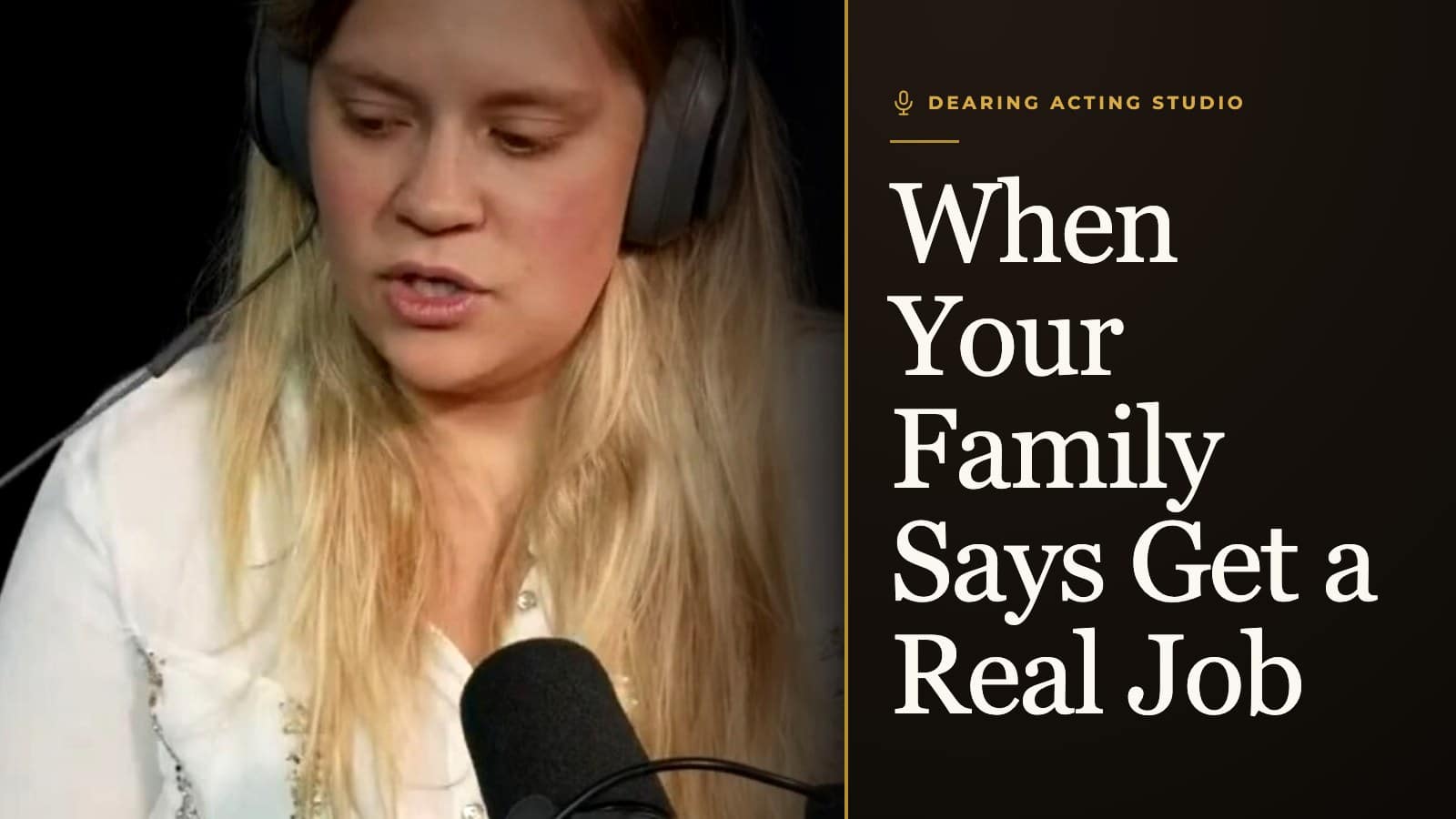
Amanda Priska came to us the way a lot of working actors do: her agency sent her to an audition here, she liked the room, and she stayed. A year in, her question wasn’t about technique. She grew up in Indonesia, in a culture built on what other people think, and she still can’t tell her family what she does without hearing get a real job. She was about to fly home and see all the relatives. So we answered the question they were going to ask, right there on the show.
What do you do when your family doesn’t take your acting seriously?
Three things. First, stop putting yourself in the pain. Our Labrador eats food off the counter; he’s twelve and it isn’t changing, so we love him and we put him outside at dinner. If certain people are going to make you feel bad about acting every time, stop bringing it up with them, and love them anyway. Second, when they ask what you do, say I’m an actor, and have the next sentence ready: I’m training, here’s what that looks like. Third, and this is the one that actually fixes it: work as hard as you would if you were in med school. Look up the hours. Read as many books as a doctor would, on acting. Schedule your week hour by hour. When you know for a fact you’ve put in the work, you walk into any room, including your family’s, and it’s impossible to care what they think. You’re a working actress. Not because you got a gig. Because you work.
Prefer audio? Listen to the episode.
What is in the episode
- 02:42 · The struggle. If my own family can’t accept what I do, how do I expect anyone else to?
- 03:38 · Why acting has a stigma, and why it’s earned. People have watched others come in and out for the wrong reasons. Training to be a nurse gets no judgment. Training to be an actor does.
- 05:26 · The Labrador and the counter. You can’t train it out of him, so you protect the dinner. Same with people who are going to say the thing every time.
- 06:22 · What do you do? I’m an actor. We answer the relatives’ question out loud, and why the hard part is that we judge ourselves too.
- 08:06 · Where have I seen you? The follow-up nobody asks a student nurse, and how to arm yourself for it.
- 09:00 · It’s on them, and my job is to love them. The people who love you most are the ones who do this, and they think they’re protecting you.
- 10:47 · Do you work as hard as if you were training to be a doctor? Her honest answer, and why that’s the exciting part: it’s the thing she can change today.
- 11:38 · There are no safe jobs. The safe job is in everyone’s imagination. In any occupation you get paid what you’re worth, and the surgeon who keeps studying gets paid more.
- 14:15 · The podcast pays zero. Two years, once a week, never missed, no money yet. I expect to do the work; when I get paid I’ll be grateful. Four a.m. adjusting lights.
- 15:06 · It’s impossible for me not to be successful. The sentence you earn with work ethic. The only thing you don’t know is the timeline.
- 16:49 · Don’t tell them about the gig. Land the commercial and be on to the next thing. When they finally ask, it’s just what you do.
- 19:22 · What does an actor’s day look like? The schedule from the book, hour by hour, so the next time someone asks, you can tell them.
- 20:14 · Your job is the in-between. We’ll make you better in the room. The giant leaps happen between classes, and that’s on you.
- 23:35 · Schedule your week tonight. Hour by hour. Working out, family, acting, journaling, sleep. Wake up at a time that isn’t comfortable. Clothes out the night before, like a trip.
- 25:16 · Are you maximizing you? Not what you do. Whether you got the most out of yourself today, and you’re the only one who knows.
- 26:09 · Shea’s text. Everything she got done before eight in the morning, and what a maximized morning does to the rest of the day.
- 27:03 · Earn your pillow. Hours in bed are not sleep. Run the engine until it’s tired, then listen to it. A nap every day, and day two of every day.
- 29:37 · I’m going to work. What I say when I leave the studio for home, and why my family deserves the same energy the students get.
- 32:10 · Coffee, and accountability. Why I don’t preach what I haven’t done, and why knowing that where you are is your choices gives you the power to change them.
The pitch, honestly
Nobody here promises you a booking. What we promise is that if you’re not getting better in this room, you should leave it. Amanda’s confidence didn’t come from a better answer for her relatives. It came from deciding, that morning, that every day was important, and then living like it. That translates to every room she walks into, and it will for you, whether you ever act or not.
Full transcript
5,945 words, transcribed from the recording on this side of the desk. Names corrected. Part of the recording is left out of the written version.
Read the whole conversation
Welcome to Mornings with Matt, personal and professional development training that connects the art of acting with critical life skills and self-mastery. Presented by the Dearing Acting Studio. Okay, good morning. Thank you, Joey. What a nice introduction that was. Welcome to Mornings with Matt. Today we've got Ms. Amanda Priska on the show. Good morning, Amanda. Morning. So, you said in your notes here that you're going through some sort of transformation right now. You want to start by talking about that? Yeah, it's been like about two years, find myself as well. Yeah, pretty much just self-love. Okay. Well, that's obviously good.
That's great. So, you're on this journey, this process. How long ago did you make it over to Dearing Acting Studio? About a year ago. Okay. And what brought you in the door? I was already signed with an agency, with my agency. And then they told me to do an audition at Dearing. And then I came in and like the vibe is just so welcoming. So, I thought, I'm going to try to take your class. So, and it's been great. Awesome. Awesome. I'm so glad. So, let's go into your journey and where you are right now and what you might have some questions on.
Yeah. To tell a little story about me, obviously, I grew up in Indonesia and it's a totally different culture. I grew up, I was raised to actually like care about how other people think. And I was like compared a lot to other people. That's like my main two things that kind of like made me the way I am today, I guess. Like I used to compare myself to other people. Like it's, it was pretty hard. Um, but it's been, it's been good now though.
Okay, good. So, so where, where are you at? Where's the struggle right now? The struggle is, um, sometimes I feel uncomfortable telling people that I want to be an actor or like I do acting. Um, just because like, I don't really talk about this to my family. And when I do, they always tell me like, just get a real job. Um, so yeah, I think my thought process is like, if my own family can accept me the way I am, like what, like how do I expect other people to stop me? Sure. Yeah. So, so acting has a stigma around it. And I'd say probably rightfully so because a lot of people who get into acting end up just sort of being, they're going to come in and out and they have, and they're doing it for the wrong reasons and that's not you. So what's weird is when you're training for some other profession, if the training process takes a long time, you don't tend to get judgment, but with acting, you tend to get judgment. And I think the reason is because people have seen others who give up and then, you know, and, and they've seen like a negative path.
And so there's this, there's this idea of some people just believe you can't do what you love and get paid for it. That's just, it's too good to be true. Yeah. So my recommendation is that you, if you are getting that kind of feedback from certain people, just stop talking about that with them. That's my thought. And I know that's hard because you're saying, you're probably going to say to yourself, well, acting is a big part of my life and I want to share that with them. And you're, and you're right. And you should in some way, but knowing that, that they are the way they are right now, maybe one day they'll, they'll change, but you can't affect them changing.
Right. So the idea is, is how do you, how do you deal with people and the way they think about you or how do you get over that? And my thought is don't keep putting yourself in the pain. So my example is, is our dog, he will eat food off the counter. It's his big flaw. He's a big old chubby Labrador and he, he loves food. Other than that, he's a great dog. So we have not been able to train it out of him. He's 12 or 13 years old. It's not going to change. So we love him anyway.
But we know that if we leave food on the counter, he's going to eat it. And it's painful for us. If we, if we cook a nice meal or we order in and it's like, we're looking forward to it, it's out on the counter and you leave for one second to grab one of the kids and the food's gone. Bummer. So what do we do? We have to protect ourselves to the best of our ability. We have to put the dog outside when it's time to eat. That's the only way to protect ourselves. So for you, you know, if I tell certain people this information, they're going to be negative. They're going to make me feel bad.
They're going to say something, even whether they mean it or not, they're going to say something that makes me feel bad. Therefore, the only way to protect myself is to not talk about that particular thing in front of them. Right. What if they asked me though? Like, honestly, like, I mean, before this Corona thing happened, I was planning to go back home. But one of the things that I'm scared about is like meeting like all the relatives and they're going to ask me, like, what do you do?
And I'm like, um, like, I don't know what to answer to that sometimes to think about it. Okay. Well, let's, let's answer it right now. What do you do? Um, an actor acting. Perfect. I'm an actor. Okay. So I think, I think the hard part is we judge ourselves a little bit too. So, so they're going to, and they might, what are they going to do? Maybe they go.
Yep. Maybe, you know, that's like usually what I get. Yeah. Yeah. So, so how else can you frame this too? So what, what are you doing right now as an actor? Um, what do you mean? Like, how are you, how are you progressing? Yeah. Yeah. I've been like training, um, more and just kind of like, I mean, obviously like I have to work on my personal stuff as well to be able to feel the confidence and everything.
Yeah. So I'm taking like one step at a time. Yeah. So, so, so you have this, you have this answer behind it too, where you're not trying to be more than you are. And I think that's one of the other things that people get stuck with because there's this, there's this weird thing where they'll say that the followup question is, Oh, what have you been in? Or, you know, where have I seen you? Or something like that. And it's awkward because in other professions, they don't ask that.
If you said, I'm a nurse and they're not there, or I'm training to be a nurse, they go, Oh really? What, what hospitals have you worked in so far? You know, like where have I, where have I seen you? Have you, they don't ask you that question. They're just like, Oh, okay. You have, you have a path. So you want to, you, you basically just want to arm yourself with all the information. So you might even, depending on who you're talking to, you could even say, I'm in entertainment.
You know, I mean, you can always frame it however you want. You can say, you can say, I'm still training. I'm studying. Oh, what are you studying? I'm, you know, acting. I mean, that's fine too. But I don't know. They're, they're going to, if they're going to judge you, you, the other thing you have to realize is it's on them. And I don't think people realize they do it. It's usually the people that love you the most are the ones that do this to you. That's the craziest part.
Yep. Somehow, some way they think they're protecting you though. So that's the only, that's what you have to wrap your mind around is you have to say, I'm doing what I know I'm supposed to be doing. Cause my heart tells me, my spirit tells me, I know. The person who is hurting me, the person who is saying these things that is damaging, my job is to love them.
And that's hard, but my job is to love you. Even though you keep eating the food off the table, my job is to love you anyway. And, and, and that's a part of that self-love because when you love you so much, you're not, you, you can't, you can't get as damaged by other people. So why do you suppose they're saying it to you? Um, obviously they don't really want me to struggle in terms of like financial, I think.
Um, and it is not an easy or I feel like they think it's easy. That's why it's not like, it's not as cool as being like a doctor. Yeah. You know, especially being an agent. So let me ask you to hold yourself accountable. Do you work as hard as you would if you were training to be a doctor? Um, probably not. So that's, that's something that you can grow in actually.
And that'd be exciting. So you can say, this is my profession. I'm going to be studying and working as if I were going to med school. So what does that look like? You look up the hours. How many hours does it take to become a physician? How many sleepless nights? How much do I have to invest in schooling, et cetera? And you go, okay, let me just do that.
And there's no, I mean, I, I promise you, if you, if you live that lifestyle, you read as many books as you would have to read to become a doctor. You just read them on acting. It's a guarantee you're going to be successful anyway, but it's a guarantee you'd be successful faster. Okay. Cause you'll just get better. I mean, there, there's no, there's no way around it.
And, and, and this is, this is a way for, I don't like you having to defend yourself to other people. It bothers me. So I'm not even going to, I'm not going to teach you how, because I don't, I don't believe in it. But I, I think to defend yourself to yourself, the thought process is going to be right now, for instance, the safest jobs are going to be in healthcare and the, and the grocery store.
Other than that, nobody's safe. Nobody, I don't care what job you have, like everybody's at home. So all of a sudden that safe job, it really doesn't exist. It's, it's a, it's every, it's in everyone's imagination that there's something that's just guaranteed to be safe. So you can, you can wipe that off the table and then just understand that no matter what your job, let's go back to being a doctor.
No matter what your job, the better you get at it, the more you get paid. And if you quit, you don't get paid anymore, nor should you. So, so let's say, let's say you're going to school to become a doctor. If you don't follow through and get all the way to the end of the process, you get paid zero. That's a big risk. That's eight years in maybe, and then you quit, you're, you're done.
You get zero dollars. And I paid a lot of money too, so. Okay, that's right. So now we get through that. Okay, let's say you become a doctor, right? Okay, great. Now, a year in, if you stop studying to become a doctor and you don't know the latest trends in medicine, if you don't understand, if you haven't kept bettering yourself, you're going to hurt somebody and you're going to get paid zero.
You're probably going to end up getting sued and you're going to end up in the negative. Nobody wants to be with a doctor that doesn't know how to do the latest thing. If you become a doctor and then you keep going to school and become a better doctor and you become like a specialty surgeon, you then get paid more. If that specialty surgeon keeps studying, keeps growing, keeps studying, becomes one of the best surgeons in the world, they get paid more.
So everyone in any occupation will get paid what they're worth. That's how that works. So I'm growing and developing personally, let's just say as an actor and an acting coach, the amount of hours I put in and certain things help determine what my rate is and whatever, right? So as we're growing and developing our podcast, guess how much we get paid on our podcast? Zero. Guess why?
We started a couple years ago. And we do it once a week. We don't miss. I mean, we're consistent, different things. But with that being the case, I don't expect to get paid. I expect to do the work. And when I get paid, I'll be grateful. And I'll know, I'll understand that as I get better, as I produce more, as I figure certain things out, the money will follow.
And I know that to be sure. But the amount of work that it takes is unbelievable. Like, we were set up last night for class. Brian was teaching last night. This is an example. I watched the tape. And before our thing this morning, I was in here at 4 a.m. Adjusting lights, adjusting cameras, and I'm unhappy with how it turned out. It's fine. But I'm trying to make it better, trying to tweak, trying to grow.
And I'm going to be doing that every single day in some area. Whenever I'm not in play, I want to be in some kind of a work and a progression. And if you're in that space, I promise you, you will not care what other people think because you'll have this insatiable confidence that says, here's what I want you to be able to say to yourself. But you've got to earn this.
It's impossible for me not to be successful. The way that I work, my work ethic, it's impossible that I'm not crazy successful as an actress. The difference is I don't know the timeline. But if I know, I guarantee, it's impossible that I'm not successful within, say, 12 years. So let's just say tomorrow I decided to pick up becoming a surgeon. Well, that's going to take 12 years from beginning to end.
I know if I work at this level, there's no way that I'm not crazy successful by then or before then. There's no way. And then you take away this, like, trying to get a job quicker or something just to make mom and dad happy. Because that's the other problem is you land a gig, you land a commercial or something, and you want to tell them so that they'll get off your back.
Yeah. You don't even, I would suggest don't even, don't even do that. You know, you should already be on to the next thing. And then when they, when they say, you know, what are you, what are you doing? You're like, I'm acting. Well, what do you mean? Is that even, is that even like whatever? And you're like, oh yeah, I landed, you know, I, I got a commercial last week.
I got one the month before and they're like, you did, you didn't tell me. And I'm like, oh yeah, well, it's just, that's my work. I'm not excited about it. It's just like, that's what I do. And then they're going to go, oh. I actually did that. You did that. That's great. Yeah. I did that actually. It changes the game completely. So, you know, part of it is in your own head and part of it is going to be just this, this crazy insatiable work ethic that that's to me, that's what gives me the confidence.
When I know for a fact I've put in the work and I've grinded away, I can step into the room and go, you know what? I, I, it may not be perfect. It won't be perfect. That's a guarantee, but I'm prepared. And I, and I feel very confident to be in the room and you can have that today. That's the other cool thing. I mean, everybody can have it today because it's all about, are you getting better?
All right. What else you got for me? I mean, um, what were you going to say there? I cut you off. You, you had a thought. Yeah. Well, I kind of forgot myself. Um, what, what is your, let me ask you this then. What, what does your work ethic look like? Um, I try to like do, so I do something else too. Like I have, I've been kind of like going back into like doodling, um, like drawing and stuff.
Um, before the quarantine starts, like I was pretty busy actually. Like I got more shoots, like three, like three times a week, pretty great. And then I, I did an audition for a pretty big company and like my agent actually called and asked me if I'm still available because the casting director asked. Um, and I was like, yeah, sure. Like I'm still available. Like did they pick anybody yet?
And they're like, oh no, but it's definitely good news. Um, because. But what are you doing to get better? Um, I've been practicing like diction. I been taking like more like vocal lessons, like you said. Um, just pretty much like vocal. Did you, did you read the book yet? The acting is my day job book. Okay. So you read in there, you need to have a crazy disciplined schedule.
Yeah. So when I ask you next time, if anybody asks you like, well, what do you do? What does that mean to be an actor? And you go, here's what it looks like. I get up at 5am from 5am to this time. I do this from this time to this time. I do this from this time to this time. I do this. Then if I have an audition, I go there.
If I don't, I do this. Here's where I take a break. Here's where I take a nap. Here's where I wake up and connect with family. Here's where I go back to grinding. And then I do this and I do this. And if I don't have an audition, I go find an audition. And then I do this. Then I do this. And then I go to bed thinking about acting and meditating about acting.
And I wake up and I repeat. And they're like, dang. You're like, yeah, that's right. I work. I'm a working actress. Not because you got a gig, because you work. That's the difference. And when you develop that type of habit, that type of schedule, that's how you can 10x in the classroom. When you come in to see us, wherever you are, we're going to make you better.
So it's up to you to make the giant leaps on the in-between. That's your job. Our job is that if we're not making you better, you've got to get out of here. So we push ourselves to make sure that we're always grinding ourselves so that we can keep making our students better who are with us for a while. So you're going to be one of those people, and you're going to have to push yourself to push us.
That's your goal. And then when you work at that level, the amount of confidence is unreal. And this whole self-doubt thing, it goes away because you don't have time to think about it. Where do you have time to worry in that schedule I just created? There isn't any. I'm on a schedule, baby. I'm working. And this is the way I look at it, too. The gig that you land, the audition, the whatever, that gets in the way of my schedule.
I like it. I'm appreciative of it. But truthfully, that means I've got to wake up an hour earlier tomorrow to make sure that I'm disciplined and I stay on track. So it becomes a point where the gig, it just becomes a distraction that you're grateful for, that helps you pay your paycheck and whatever. But the actual work that you do is your grind, your progression. You fall in love with that process of just getting better in every area.
And the hard part about being an actor is you have to get better in every area of life. You've got to work out. You've got to work on your voice. You've got to read books. You've got to read plays. You've got to create characters. I mean, there's a lot of work to be done. And so you just sort of slice out different things. And that's why it's a lifelong process and you'll never be done.
The greatest of all actors are still training. And that's why I'm in love with the process of acting because it's so connected to a next level life. So for us, we love helping actors become better people, help you connect into self-confidence. And we love helping anybody else do the same thing. Whether they like acting or not, we can use the tool of acting to boost your confidence.
Right. That makes sense? Definitely like the scheduling is like something that I'm lacking off. There you go. So, so, so, so don't anymore. Get on it. And right now is the best time because you have, you have every excuse not to. Therefore, it's harder. Therefore, if you do it, if you find a way to become very disciplined, very focused right now, it will then become easier later.
That's what, that's what drives me right now. What drives me is the fact that I know that it's harder. So I get excited about that because I realized what it's such a huge opportunity. There's a lot of other people who are slowing down. I'm speeding up. I'm putting my foot on the gas pedal on purpose. And you can do it. You just have to make the choice.
For sure. So you take, so do this, take the rest of today and it's going to hurt your brain a bit, but schedule out your week. Every day, hour by hour, schedule out your week. Put time in there for working out. Put time in there for connecting with family. Put time in there for acting, but put in specific things you're going to do. Put in time for journaling and track your sleep and hold yourself accountable.
And you need to set, I don't care what time it is, but you have to set a time that, to wake yourself up that, that isn't necessarily comfortable. So if you normally get up at nine, get up, get up at seven. If you normally get up at eight, get up at five. You know, just push yourself to something that's going to like shock your system and get excited about this.
Like, okay, I know what to do. The problem is you don't, if you don't know what to do, you're kind of like, well, should I work on my monologue? We'll do this or that. And then it's stressful just even trying to figure out what to do. You should put your clothes out the night before. Just like you're going on a trip. Because then you wake up and I don't have to look at the closet and decide what to wear.
Yep. That's what I did last night. Good. Yeah, why? For this. For this. Right? So what happened was you made this important to you and you wanted to make sure you were up, that you knew what to wear and it was easy. You do that every day. Every day is important. As long as you decide every day is important, then it's important. As soon as you decide the night before that tomorrow is not that important, it gets really hard to get going.
And then maybe sometimes you get going toward the afternoon, but you look back and you still feel upset. Why? Because you know you didn't maximize what you're capable of. It's not about what you do. It's about are you maximizing you? And you're the only one that knows. Totally. That's all right. All right. What else can I do for you? You feeling motivated, excited, a little scared? Yeah, everything actually.
Like I was kind of, I was really nervous just coming in here. Yeah, I decided to like wake up at five and like just preparing myself, but it feels pretty good actually. I'm going to read you a text message. I don't think she'll mind. Did you see Shea on our Instagram yesterday? She sort of, she sort of just like laid out the day for everybody. It was really cute.
Yeah, I think so. Yeah. So she, she wrote me this, she wrote me this text message yesterday because I had encouraged her to wake up and, and, and do a similar thing to what we're talking about. And she writes, yo, yo, yo, exclamation point. Sat outside of my patio and filmed the morning Insta story for Dearing. Had a great chat with my mom. Cleaned my kitchen. Listened to mornings with Matt.
Sent out communications for classes. Went through emails. SEO'd the morning with Matt podcast for Joey. Started creating a new page on our website and created a guest, a sign up for guests. And she goes, and now I'm about to work out before our meeting with Joe and Josh, which is at 930. And she writes woo and a ton of exclamation points afterward. She got all this done before nine o'clock.
But I know because she was about to work out. So this was before eight o'clock. She got all that done before eight o'clock. So now all of a sudden you'll realize, oh my gosh, I have all this time. If I can maximize my morning, it makes my afternoon so much less stressful. And all of a sudden I'm getting more done in one day than I used to in one week.
And then you start doing the math and you're like, if I keep progressing at that rate, just imagine how successful and happy I'll be and how energized. Because you do, you feel less stressed out. Can I ask you something? What time do you sleep at night? Yeah, good question. It depends on the day. Okay. Yeah. So last night I got to bed pretty early. I was in bed I think by 9 or 10.
Okay. And so then I was up at 3. So that's pretty reasonable sleep. Sometimes it's 10, 11. That's kind of pushing it. But I nap every day. The difference when I changed my schedule, what happened was, I don't know about you, but I used to, my old lifestyle, I would watch TV at night. I wasn't always eating or drinking healthy right before bed because I would get restless or whatnot.
And then I would get nine hours of sleep, eight, nine, ten hours of sleep. But it wasn't really sleep. It was just those were hours in bed. It's a difference. So people are like, oh, I need eight hours. No, you don't. You need to be, you think you do because you don't really get good sleep. When I was less healthy and I wasn't 10Xing my life, I'd roll around in bed a lot.
I would be in and out of sleep. So I wouldn't get the deep sleep. Now I tell myself, you got to earn your pillow, pal. So when I go into bed and I put my head on the pillow, I'm out like a light. And I wake up restored. And then the same thing, you can feel how excited I am right now just to be alive. Like it's in my body.
So I'm going to run at this level. I'm going to push my engine until my engine's tired. Then I listen to it. That's the cool thing. And that's a nice thing for you too. Every actor is an entrepreneur. So you run your own business. So you get up and you run your engine until your engine feels tired. It'll tell you. And then you just listen to it.
So then it's like, oh, you take a nap? Yeah, I get to nap every day. You just tell everybody that. And that's what I do. I take a little siesta for two hours. It's either here or in my house. And I really do. And I do the same type of thing. I meditate on positivity. I meditate on how to feel good and whatnot. And then I'm in at a deep sleep.
And then I wake up and I get day two of every day. That's the way I look at it. And you can ask the guys here, Joey. Click over to you real quick so I can talk to you. Okay. What do I say when I leave here and I'm going home? I'm going to work. I say I'm going to work. Because the idea is for me, when I go home, it's just as important.
It's more important for me to be on my A game, for me to have this kind of energy. It's not okay for me to run my engine super hard and then go home and be like, oh, guys, I just need it. That's not okay. It happens sometimes, but it's not okay with me. So I have to hold myself accountable to saying, all right, you need to know when to transition, when to rest so that these people get your maximum, you know, high level, whoever you are, and they deserve it too.
So that's the way I think about it. And I don't know. I just really like it. I try to share with other people the same idea. And for every person, it needs to be customized. That's why I say, don't follow me, but follow your own heart. And I promise you, what will happen is you'll start to, as you start to plan your day the night before, God will wake you up.
The alarm, you'll set the alarm, let's say for six and five o'clock, you'll be like. And what happens is you think to yourself, you're like, why am I awake? And you look at the clock. And then for whatever reason, a lot of people just decide to go back to sleep. God just woke you up. So now you get to get up and you get to go, all right, why?
What am I supposed to do? And it's in that gray space that God talks to you and connects to you. And that's where you're most creative is right in that time. So that's why I say the morning is important, but it's not, it's not my time, my morning. It's yours. It's where you're at. And as you grow and develop and change, your life changes. So if you were on a particular work schedule where you either had to work at night or, you know, you were communicating with somebody overseas.
So, so you had to adjust your schedule. That's great. So, so your 6am or your 3am might be 3pm. It doesn't matter. It's all about like, you know, you and you know, are you maximizing your engine? Are you, I mean, some people blow their engine out. I don't believe in that either. You know, you, you have to sleep. I believe in sleep. I believe in healthy eating.
You know, I, I, I try not to preach things that I, that I'm not great at. So I don't talk a whole lot about eating habits because I'm still, that's something I'm still working on. But I like, I cut out alcohol. I cut out soda. I cut out a lot of things. I did not cut out caffeine. I, I drink a lot of caffeine. I like, I like coffee.
So right now that's still one of my vices. So I wouldn't, I would never recommend you cut out coffee because I, I can't speak into it. Now, if you, if you asked me, do I think that's good for you? I'd probably say, yeah. And you say, why, why, why haven't you done that? Well, that's because you're, that's why your skin tone is so great. See? So, so you asked me why, why do I drink coffee and why?
Because I'm addicted to it. That's the truth. I like it. I'm addicted to it. I don't want to quit. So if I wanted to quit, I could quit. And I, and I know subconsciously I should quit. Probably drinking just water alone would, would, I would feel better, but it hasn't become important enough to me. So me being honest with myself in that way, I, I'm not, I, I know where I am is my choices.
And that gives me power. So for you, same idea, you know, where you are as soon as you take accountability for it, then you say, I know where I am because of my choices. I can always change. I can always decide to stop drinking coffee. If I wanted to, if I felt like in some way it was holding me back from some part of my life, I could do it.
So if you, if you decide, Hey, I want to get up earlier, I want to do a different schedule. You have to want it. You have to decide it's important and know exactly what's going to happen if you do do it and what's going to happen if you don't do it. And then you make the decision. It's your choices. It's not anybody else. And you'll be confident.
I promise. I just got to fight. That's exactly right. Yeah. Well, it was awesome having you on today. I appreciate, appreciate you being here, waking up early and hopefully you go out there and you grind it today. Thank you so much. Yeah. I'm definitely going to do it. Feeling motivated. I'm excited. Thank you so much. All right. Take care. Have a nice day. You too. All right, everybody.
Thank you so much for watching mornings with Matt. We'll be here tomorrow. We're here every day at 7 a.m. Have a great day. Thanks for listening to Mornings with Matt. Please like, subscribe, and follow us at Dearing Acting Studio to keep up with the latest content. For more information on classes, private lessons, or professional development coaching, visit www.dearingstudio.com. Have a Dearing Day, everyone.
Your next step
Work like you mean it, in a room that pushes back.
Adult Script meets Monday and Tuesday evenings in Phoenix, script in hand and on camera. Working actors, nurses, and everyone in between, on the same curriculum.
See Adult Script All classes, ages 5 and up