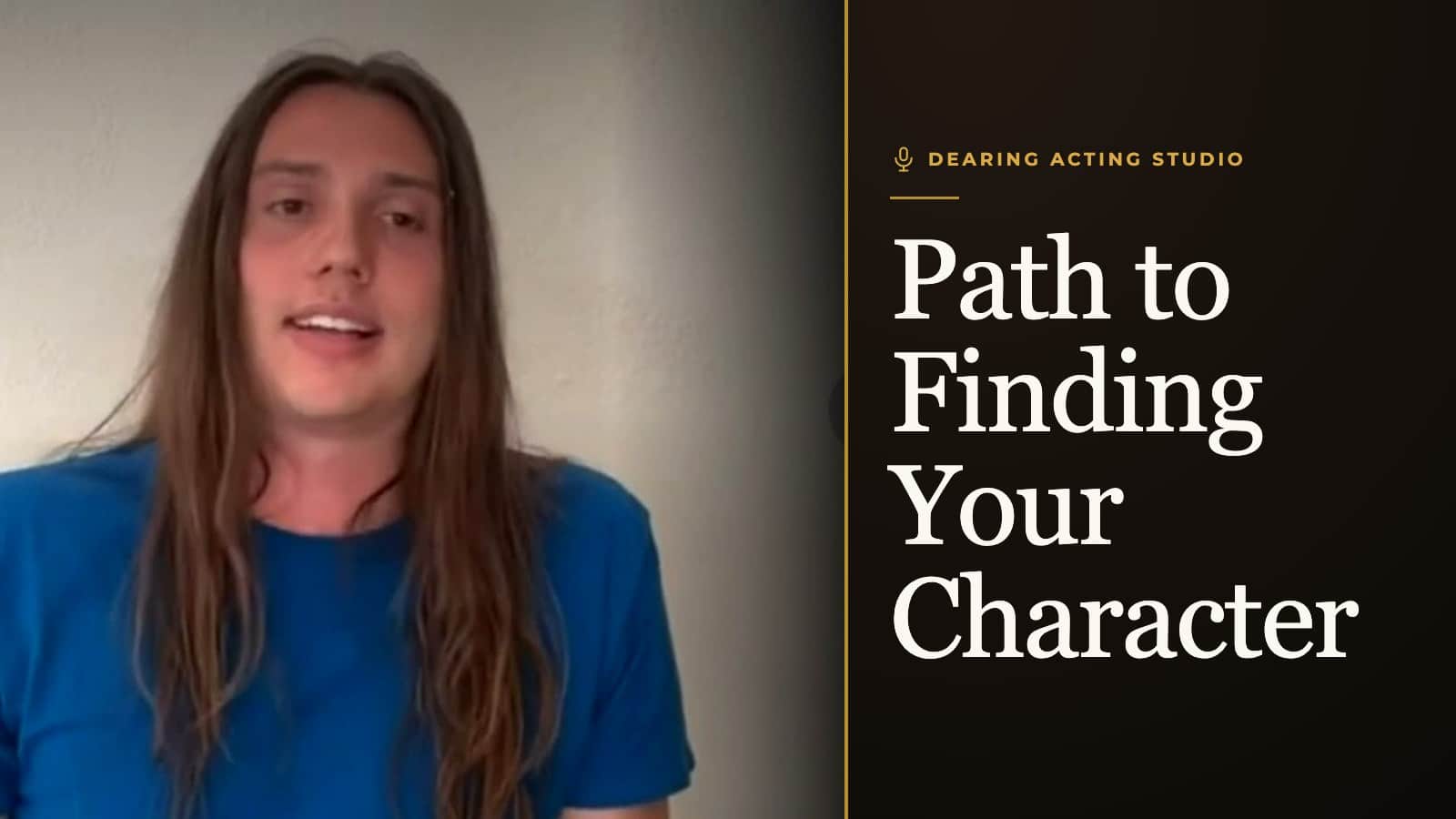
Ariella came on with a bird outside her window and a real acting question: how do you become your character? She had done the 50 questions for her scene and had a page of facts she did not know what to do with, and she worried that seeing every character as a version of herself was limiting her. Brian was on the line too. This is a craft episode, start to finish, with the backstory I built for the darkest character I have played here.
How do you find your character?
The 50 questions are a beginning, never a finish. Answer them, keep asking, and be willing to change the answers all through rehearsal, because finding a character is a process that does not end. You will be part of every character you play, and that is not a limit; what you may need is to believe more of what the character is going through. So take one question and write the short story under it. Not what is her relationship with her father, but what does he look like, what is his job, what happened the last time they spoke, which of his girlfriends did she like and how did it feel when he dumped her. I am usually hunting for the key to a line, because no fight makes sense without the context underneath it, and a fight is almost always about survival. That is the inside. Then work outside in: find the animal, find the physicality. When a character does something you could never defend, build the world until you can. I played a man who shot his father over a remark about his hair. By the time I had written his town, his drunk father and his mother’s hands in his hair, I understood him, and I could love him. You have to love your character.
What is in the episode
- 02:33 · How do you become your character? Ariella’s question. The 50 questions give her facts she can’t use, and playing every part as a version of herself feels limiting.
- 03:25 · The 50 questions are a starting point. You aren’t done when you’ve answered them. Come up with more, and keep adapting the answers until you find it.
- 04:08 · You are part of every character you play. That isn’t a limit. What you may need is to believe more of what the character is going through.
- 04:27 · Write short stories. Not answers, stories. We test it live: what is Stephanie’s relationship with her father?
- 05:13 · You made that part up. Good. The divorce, the move across the country, the dad who was there but not there. None of it is in the play, and all of it is hers.
- 05:56 · What does her dad look like? Not sure yet, and that’s the next question. His build, his job, the last time they spoke, his girlfriends and which one she liked.
- 07:32 · The key to a line. What am I going for? Something that opens a line I have to say. If she says you don’t know me, what is she referring to?
- 08:22 · No fight makes sense without context. Every human fight looks crazy from outside. Paint the context underneath so her temper is justified.
- 09:13 · Outside in: start with an animal. Once the inside is built, find her physicality and work it from the outside.
- 11:12 · Tell yourself stories until it makes sense. Paint yourself into your character’s shoes until you would do that thing too.
- 11:26 · We are all capable of every emotion. Every sin too. Under the right circumstances, any human being can become something.
- 11:54 · What if you can’t justify it? Ariella asks about playing a serial killer. Depending on the role, you may have to give the character something broken in the mind, which is probably accurate.
- 12:15 · A dark Irish comedy. My character shot his father point blank in the living room and got away with it. I had to find a way to love him.
- 13:21 · Build the town first. Fifty people, half a day to the next town, no law. Why is the town okay with this? Then back into the character.
- 15:09 · He made fun of his hairstyle. The play’s reason for the murder. A challenge, so I went backwards to his mother.
- 15:30 · The last memory of his mother. Her hands styling his hair in the kitchen. He has worn it that way ever since. It still makes me emotional.
- 16:55 · The straw that broke the camel’s back. Add up every circumstance and the impossible act becomes possible. That’s what fueled the moment.
- 17:15 · Scary and funny. When someone says you did that, my character says that’s right, and I’d do it again. My character knows not what he does.
- 18:33 · Donkey to elephant. Brian on adapting as you discover: his character’s animal changed in rehearsal, and it changed the performance.
- 20:24 · A nervous teacher. Teaching a masterclass in a new format, and the first question I asked: how does every student get ten times the value?
- 22:02 · What is the essence of the story? What is the playwright trying to teach the world? Hold that, and you can change the form without losing the play.
- 23:14 · Weights around my ankles. Ask what the unique challenges are and how they make you stronger. Take the weights off and you’ve jumped forward.
- 25:19 · Compare yourself to yesterday. Our low is other people’s high, and we still don’t compare ourselves to other studios. Only to yesterday.
- 26:07 · You are an artist. You are making something meant to move people, and you have that responsibility no matter the circumstance.
- 33:04 · This is not my microphone. Not my wife, not my kids. Release the ownership and you’re free of fear, through faith.
What this has to do with the class
This is the script work. Every scene in Adult Script starts with the 50 questions and then goes past them the way this episode does: write the story under the answer, find the key to the line, build the context, then find the body. You do it on camera and watch it back. Ariella was a student when she asked this, and the answer is the same one every student here gets.
Full transcript
4,350 words, transcribed from the recording on this side of the desk. Names corrected. Part of the recording is left out of the written version.
Read the whole conversation
Welcome to Mornings with Matt, personal and professional development training that connects the art of acting with critical life skills and self-mastery. Presented by the Dearing Acting Studio. Okay, good morning everybody. Welcome to Mornings with Matt. Today we have got Ariella on the show. Welcome Ariella. Thank you for having me. I'm so excited to be on with me and talking this morning. Absolutely, me too. It looks nice and chirpy over there.
Yeah, it is. I woke up really early and it was just like, there was this bird outside my window all night. Really? Apparently, yeah. And now it's up in the sky and making noise still. Did you see the bird at night or just hear the bird? No, I just heard it. That's got to be some kind of sign, I think. I know, isn't it weird? Yeah. I mean, I think that's a good thing. Birds are definitely good. Good. What do you think it means? I don't know.
We should think about it. So, if there's a bird outside your room all night, what does that mean? A portion of the night. Well, it wasn't all night? It left at one point? I think so, yeah. I woke up around. And another thing, I woke up at every hour and a half. So, I went to sleep at 12. I woke up at like 145. Oh, it just flew down really low. Okay. I woke up at 145. I woke up at 145. I woke up at 230. And then I woke up at like 409. And then I woke up at five. And like five is when my alarm went off. So, what did you do every time you woke up? I was just like, okay, I have until five.
So, I think maybe you were just hoping not to miss your morning? Yeah. Interesting. Yeah. And honestly, like I've been sleeping through my alarms a lot lately. So, I had to like change the song like today. So, it was like really like jolting almost, but it didn't like trigger me. Yeah. It's like this weird in between. Yeah. Yeah. What'd you choose? I chose Rough Justice by the Rolling Stones. Okay.
They're my favorite band. So, it's rough enough, but it doesn't throw off your day. Yeah. I like it. All right. So, we got, I think we have some acting questions today, right? Or at least one? Yes. Let's talk about that. So, yeah. My question was, how do you become your character? So, for me, the 50 questions doesn't really do too much. I mean, of course, it does give me information, but I don't really know what to do with it. And I see my characters as a version of myself.
So, sometimes when I'm thinking about or doing the script analysis, sometimes it harms me because I feel like I'm limiting it to myself and I'm not like expanding beyond like what their thoughts are, not necessarily what mine were in that sense. You know what I mean? Yeah, for sure. We got Brian here on the show too. Say hi, Brian. Hello. Hi, Ariella. Hi, Brian. You won't be able to see Brian, but you can hear him. So, he might pipe in here a little bit on the character question. Okay.
So, okay. So, first of all, the 50 questions are what I believe to be a beginning, a starting point. So, it doesn't mean that you're done once you've answered all the questions. And you should be coming up with more questions, as many as you could think of, and then be willing to constantly adapt those questions and, or the answers to those questions until you find it. And even when you do, it's still going to be a process. Like it will be this never ending process. That's, that's first and foremost. The second part of your question was about you being the character and is that limiting? And I don't believe it is. I think that you're going to be a part of every character you play always. So, now, having said that, maybe you need to, you need to believe more what the character is going through. So, that, that might, it might help you to do some short stories. That's what I like to do.
So, rather than just answering the question, so let, let me ask you this. Um, what is your character's, what's your character's name? Stephanie. Stephanie. So, what is Stephanie's relationship with her father? Well, her father, her parents got divorced and her father, um, lives in Long Island, New York, and they kind of have a good relationship. Like they'll call and he'll offer advice, but he wasn't like a hundred percent in, he wasn't that type of dad. He's just kind of there floating about.
Is that in the play? No. So, you made that part up. Yeah. All right. So, so what, how'd you get to there? Well, I was thinking about, um, how Stephanie became the way she is because of, um, her relationship with Greg and why she kind of felt so insecure. And I made the choice that her parents got divorced when she was young and she was moved across the country and she was kind of, she was separated and her mom was kind of crazy and didn't give her the attention, whatever. And she jumped from husband to husband. And again, her father was there, but he wasn't really there. So that's kind of how I decided how she goes into relationships through her childhood trauma.
What does your, what does her dad look like? maybe not sure yet. That's okay. Uh, think about then. So these would, these would be questions where you can go deeper. So I just, I just picked the first thing. So you've definitely thought about it. That's great. So now you want to think to yourself, if I'm, if I'm not, if I feel like we need to expand on that, I'm going to ask myself more specific questions, for instance, what does he look like? Uh, what's his build? What's his job? Let me write out a story of the last time we spoke.
Let me write out a story of when he left and, and whether or not I was forced or, or I chose to live with mom or live with dad and how that went down. Um, let me describe some of his girlfriends that he's had since he left mom and how I feel about that. And which one was my favorite that he, that he dumped and then how that scarred me and how much do I like or dislike the one he's got right now and all those things, all those little details. And that's just one question that you can continue to dive deeper and deeper and deeper into this one thing. So on the 50 question sheet, it just says, you know, what, what's your relationship with your parents or something like that. So you can take that question and then you can expand on it and expand on it, expand on it till you find something. And what I'm usually going for is some sort of a key to a line that I have to say or get to say.
So if, if she said something like you don't know me or something like that, I would go and go, what does that mean? What is she referring to? And let me go deep, not just surface, but like way deep into, into her past. So she has this stuff with Greg, just like you said, and she's, she's dealing with, with all these emotions. And when you, when you start to find lines or you find triggers, when she's super upset, it's interesting because every fight that we humans have usually that it doesn't really make sense without context. So for her, you're going to paint all this context underneath and, and, and she has, she has a temper on her. She calls the cops. Uh, she gets the cops called on her because she's so aggressive with, with him. So again, looking into very specific storylines that justify that. And a lot of times it's, it's a fight for survival. So Steph is, is working through her own version of surviving and trying to find love and, and doing her best job at that.
And that's how I would go deeper into that. So, so then, so here's your character. That's the inside out. Then outside in, you need to find what I like to start with an animal, but what, what physicality does she have? And let me start to work that from the outside, outside in. Now let, let me, let's take myself into the, the shoes of my character and I tell myself stories until it really makes sense for me that I would indeed do that thing because we are all capable, I believe of every emotion. We are all capable of every sin. We are all as human beings capable of becoming something underneath the right circumstances.
Yeah. So, okay. You said something or you said you, you try to paint like what would make you as Matt do, you know, show up every day as Brian. Right. Now what in the case where let's say I'm playing like a serial killer and I cannot justify, um, you know, me killing somebody or I can't justify their actions. What do I do? You've probably in that case, and it depends on the role, but you've probably got to give yourself some sort of a mental illness, which is, which is probably accurate. So I, I played a character here at the studio. Has he, it's, it's a dark Irish comedy and, and it, we, it wasn't shown in the play, but it was, it was discussed in the play that my character killed his father with a shotgun point blank range. His dad in his own living room killed him.
Then got away with it. His brother covered it up because his brother was, was selfish and wanted all the insurance money that I did. Okay. So I had to find a way to still love my character and justify that me, Matt would be capable of doing that. So I had to go back way back and say, okay, where are these guys growing up? First of all, what's their origin? And they're in this really super small town in Ireland. And, and I'm talking small, small. So there's, you know, probably less than 50 people live in the town and the next closest town is going to be like a half day drive. So you never, you never go anywhere or do anything. There isn't, there isn't a dedicated law enforcement in the town. So people tend to do things and get away with things. And by the time the cops show up, the town sort of has figured out a way to keep going and sort of nobody cares in the one sense because they'd be worried about losing somebody as long as you're not like a total bad person. So then I'm going, okay, so why is the town okay with this? All right. I got to kind of figure that out to myself and then back into my character. Okay. So how do, how do I make myself capable of murder?
So I go back to the specifics with my dad and my character's dad was very abusive. Well, why? Well, he was already an alcoholic. He became a raging alcoholic. And this is actually proven in the play because he, he like runs around and talks crazy to nuns. It's like like a throwaway line. But I took that and I was like, Ooh, I'm going to, I'm going to, I'm going to make him crazy. So my dad used to abuse me and it was more like drunken hitting and neglect and things like that. Well, ever since my character's mom passed away, it's just been sort of torture a little bit, but we had family. We were together.
In this town, there's no way out. My only option is to go home. I'm a drunk too. These things are adding up now. Finally get to the reason he kills his dad. And this is in the play was his dad made fun of his hairstyle. Okay. Okay. Right. So I'm going that that's a challenge. So I go backwards and I go back to my mom and, and I was very young when she died. This is my backstory.
I was very young when she died. The last memory I have of her was her cutting and styling my hair. It makes me emotional thinking about it. And, and so we were in the kitchen and she was styling my hair and she did it this very particular way. And so since then I've been doing that while my dad's been abusing me and abusing my brother and you know, I guess trying his best in his own way, but he was crazy, like legit crazy. The whole town knew it.
And so that night we were all drunk, really drunk. He was beating me and, and, and yelling and this and that and, and doing what he normally does craziness. And he says something nasty and says something nasty and says something nasty. And finally he says something about my hair, which was him saying something about my mother. And I just in a fit of rage and drunk and not thinking, just grabbed the gun and did it.
And when I wrap my mind around that backstory, Matt Dearing's capable of that. Under all those circumstances, because I don't know this world, this world doesn't exist for me. If I, if I pick myself up and put myself in that character's shoes, he doesn't know my parents. He only knows that life from the very beginning. So if I add up all those things, I'm going, yeah, that could happen. If I'm not, if I wasn't in the right state of mind and this happened and this happened and this happened and this happened and this happened.
And finally, here's the straw that broke the camel's back. That could happen. And, and that's what fueled my character fueled that moment. And when it, when it comes up and someone says you did that, my character has no problem saying that's right. I did. And I do it again. And it made him scary and it made him funny. And it was, it was like, but, but that was just, that was my work to figure out how do I get me to the place where I could do this.
And not hate myself. Cause I can't, I gotta love my character. I have to understand where my character comes from. Cause my character knows not what he does. Okay. So what if the character, um, hates themselves? How would you, cause you just said you have to love, love your character. Oh, nevermind. Nevermind. I think I figured that out as I was asking. Yeah. You got a take on this, Bri Guy. Yeah. Um, my, my thing that about the 50, I used to have a lot of trouble with this also. And I think, I think you hit it really well and that you go really down deep into understanding. We talk about it a lot, the characters, why, like what led them to where they are. But then I think Ariella, the other thing is being willing to continue to dive deep into adapting as you're making discoveries. I think, uh, when we, when I pulled up 50 questions, like I write it all out and then we would start rehearsing or we'd start doing something and immediately things would start changing. So we go into animal, uh, which is outside 50 questions, but very close. Uh, and we originally had my character as a donkey, you know, and that's cause he was slow and sort of like sluggish and kind of there, but not. And, and it, it fit, but it wasn't perfect.
And then as we kept making discoveries, Matt sat us down and we went through and like really dove into animals and ended up finding out he was an elephant. And so in the same way, I think with character questions, you're really trying to just get into like what you're saying, Ariella, get into the headspace of that character because everybody has a reason for doing the things that they're doing. They have a history behind them that's led them to be capable of doing it. And so it's really about helping you discover what that might be. Does that make sense? Yeah, it does. It does. Thank you, Brian. Of course.
What else you got for me, Ariella? How's, how's the rehearsal going? It's going, um, the, the pacing is definitely a challenge, but, um, Joey's been really gracious with me. So it's, it's progressing. now I'm going like, okay, dang. And I'll tell you the truth, Ariella. I'm a little nervous to teach because I've never taught in this format. And I'm telling you, I've, you know how I am. I'm promising this class is going to be the best it's ever been. I'm, I'm laying that on the line. So I'm legit nervous as a teacher going, okay, I got to figure out this new formula and go, okay, how is this special? So what I'm asking myself is the first question was, how do I make sure that every student is taken care of and feels like they got 10 X value? So that was the very first thing.
I'm like, let me just knock that off and just say, I'm going to give everybody a free private lesson with me. Camera's rolling. Every angle is perfect. You know, we, we light it up. So you got that. So that's like, boom, taking care of your money's, your money's done. Okay, cool. Now the time investment, which is more valuable, how do we make this, this thing feel like an experience?
And so I'm wrestling with this and I'm still wrestling with it truthfully. Cause I'll be like right up until the day trying to refine the idea. But the point is I started thinking to myself, Ooh. Okay. Okay. So this playwright essentially would still have this story inside them would still need to tell the story. So what is, and this goes back to a really good question is what is the actual essence of the story? What is the core? What is the playwright trying to teach the world?
And if you get that and you go, okay, how do I take that idea and just make slight alterations and do this thing on my phone, do this thing right here, because I have to. And I think to myself, if, if that were the case, how would the playwright have written this play in that way? That's the first question I asked myself. Second question I asked myself was as a teacher, what are the unique challenges that this format brings up? What type of focus do I have to have that's different? What, what type of technical skills do I have to sort of master and work through and, and how do I need to listen at a different level and, and have, have a new sense of patience, etc.
So, so by asking myself that question, instead of, instead of going, okay, let's get through this, by figuring out what are the unique challenges that are actually going to make me stronger and better when I'm not up against the same thing. Now, all of a sudden it's sort of, I consider it like training wheels or, or, or weights, I guess, around my ankles. So then you put me back in the classroom, back to the, the setting that I'm used to, and hopefully I will have jumped and progressed forward. Well, that's what I want all the students to ask themselves as well. What are the unique challenges? What are the things that make this way harder? And how do I capitalize on that? How do I, and, and let's be honest with ourselves.
Yeah. More video table reads? Yeah. Do I think I'm going to land gigs that way? Yeah. Will I land an agent? Yeah. Do I need to know this skill? Very much so. So much like us with our online courses, we, we have, because of our attitude, Ariella, no joke. The Dearing acting studio has progressed probably two years worth of technological advances in about two and a half weeks.
Wow. The birds are chirping. See, we've got our, we've got, we've got lights set up differently. We went back into storage. We pulled out old equipment and we like where everything's like, you should see this place. It feels and looks like a TV studio, but it's, it's taken sometimes 16 hour days to recreate the thing. Cause I'm going like, how do we create an experience here? And we kept failing and failing and failing and our version of failing. Like we, we, we finished the kids class the other day and I was going, Oh, that was, that was brutal. You know? Cause I'm used to our standards.
Well, there was a new, a new student in the class from another state and they reach out and they're like, that was amazing. That was the best class. Like we're still looking forward to next week. Can't wait. Like they were so excited. And I was, I was ready to, I was ready to just give them like the farm, you know, but the idea was, was, you know, our, our low or other people's high. That's why we don't compare ourselves to other studios. We just can't, we have to compare ourselves to yesterday. That's the only thing. So that's the mindset. If I, if you can grab that mindset and I'm going to tell you right now, I don't know how, how your scene in particular is going to work out. Like you talked about the pacing, that pacing is going to be really hard over the phone, really hard. I get that. So now how do I get that, that idea across? Whereas maybe we can't talk over each other in the same way that we could in person, but we definitely still can interrupt in ways. How does that look? How does it translate to the phone? Because this needs to be a, it's gotta be a scene that gets the same feeling across. So you're an artist. You are, you are creating something that is supposed to be entertaining.
It is supposed to be moving. It is supposed to connect with people. And you have a responsibility to do that no matter what the circumstance, no matter if there's an audience here or a thousand I'm not going to say no to this. I'm going to say yes. And I'm going to find how to grow and, and push through it basically. So I'm proud of you. I'm proud of you for powering through and, and I'm proud of everyone who's powering through and in the class. And, and that's my, my promise is we're all going to grow. And either way, you're going to get your money's worth.
Cause I'm going to connect, I'm going to totally hook you up afterward, but there's going to be a way Yeah. And once, once you're there up here, it's a game changer. That's really inspirational Matt, because honestly, like I'm going to be, I'm going to be honest with you. I have been struggling a lot with that mindset lately because like the, the fire that's usually in my belly has, has definitely gone down and I'm struggling. It's like a new version of discipline.
Cause I already conquered that when I had like my normal, normal life, but now I have my own schedule and it's just a different version of that. So you just inspired me again and it's, it's igniting. So then it, then things become a little easier. Like, this is not my microphone. I don't, I mean, it could be taken from me at any time. You know, it's not my wife. These are not my kids.
And once you release the ownership and you say, okay, not even my own life is my own. There's a sense of freedom that comes with that and responsibility, but a sense of freedom where I don't, I don't have to be, I am free of fear is what it is. I can open myself up to the possibilities. And am I going to experience fear? Yes. But ideally through faith. And I, and I think that's, that's what's, that's what's so strong in, in me right now. And in a lot of people. And I think All right. Well, I'm going to let you get back to the birds of chirping and get you, uh, rehearsing. I'm sure with your scene partner at some point today, I look forward to class. It's going to be a lot of fun. We are going to make a memory for good or for bad. This masterclass is way to create something that is that, that we will never forget the rest of our lives. That's the goal.
I know, isn't it? It's crazy. Thank you, Matt. I really appreciate you. Absolutely. It was great talking to you. Bye guys. Thanks for listening to mornings with Matt. Please like, subscribe, and follow us at Dearing Acting Studio to keep up with the latest content. For more information on classes, private lessons, or professional development coaching, visit www.dearingstudio.com. Have a Dearing day, everyone.
Your next step
Do the work on a real script.
Adult Script meets Monday and Tuesday evenings in Phoenix, script in hand and on camera. Doctors, lawyers, actors and everyone in between, on the same curriculum.
See Adult Script All classes, ages 5 and up