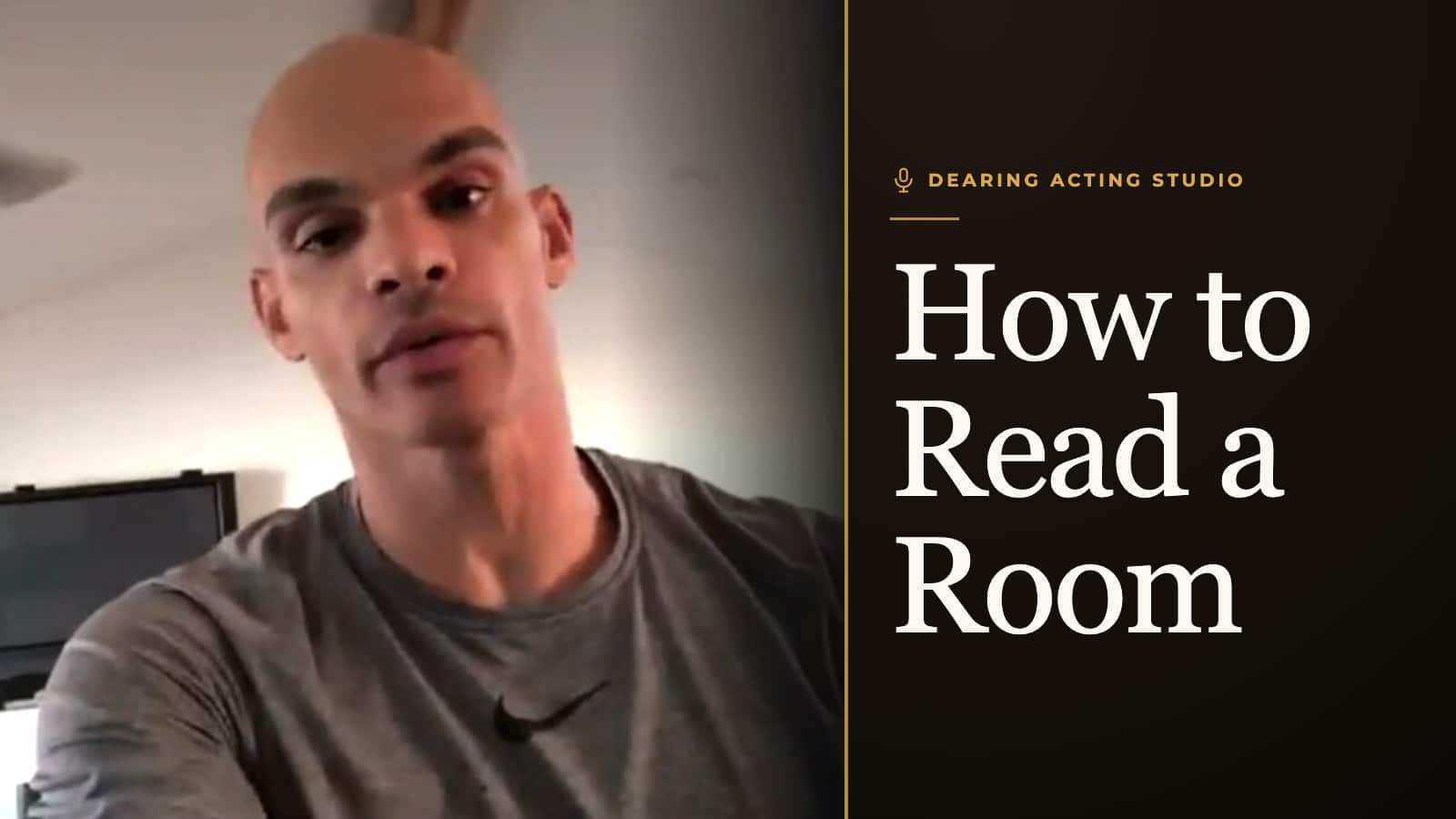
This one came out of a morning that went sideways for no reason. Joey walked in seven minutes before we went live, in a great mood, having the best morning of his week, and within a minute there was weird energy between him and me. Neither of us did anything wrong. He asked me about it that night, and what I told him is the thing I teach at the corporate level, in the audition room and to my own kids: read the room before you enter it.
How do you read a room?
Stop at the threshold and ask five questions before you say a word. What is the energy in here: upbeat, slow, serious, panicked? What state am I in, and what am I about to bring through the door? What do I want to accomplish in this room? Do I want to be seen right now, or invisible? And what is the most important thing happening here, and can I help with it? Then merge your energy with the room’s. That doesn’t mean killing your energy. Joey could have walked in, said I’m having an amazing morning, I can’t wait to tell you about it, how can I help, and the whole thing would have gone differently. The room tells you what it needs if you listen first.
Prefer audio? Listen to the episode.
What is in the episode
- 01:32 · Seven minutes before the show. Joey walks in on top of the world, Brian and I aren’t ready, and the energy goes strange. Nobody’s fault, and it still has to be fixed.
- 03:04 · Reading the room. Feel the energy of the space and ask how yours fits into it. The hidden expectation Joey walked into, and the one he had himself.
- 06:09 · Fit in, leave, or hide. If you can’t find a way to fit into a room, the honest options are to leave or to make a specific decision to be doing something else.
- 06:54 · The leader reads the room too. Where I failed the same morning. When you’re the one in a panic, reading the person who just walked in is still your job.
- 07:42 · The audition room. We cast through Phoenix Casting. The actor who does the same handshake and the same energy every time, and why it sometimes lands wrong.
- 09:15 · Play by their rules. Our castings are playful. Plenty aren’t. Read their room and adapt; the actor you are with us may not work down the street.
- 09:50 · Questions one and two. What is the energy of the room? What state of mind am I in? If you don’t know your own energy you can’t shift it.
- 10:20 · Question three: what do I want to accomplish? Leeann is one of the best auditioners I know. Her two goals in every commercial room: make them laugh, leave a lasting impression. Never the booking, never the money.
- 12:21 · Question four: seen, or invisible? When I’m consulting for a company I’m being paid to listen, so I want to be a fly on the wall. Other rooms want an entrance. Decide before you enter.
- 16:12 · Question five: what matters most right now? Coaching a high-level actor, watching them go dry, and setting a drink down without a word. Then: can I help? If you can, do it. Don’t ask.
- 19:16 · The threshold. Next time you cross from one space to another, slow down, breathe, ask the questions, and then merge your energy with the room’s.
Where you’ll use this
Job interviews. Auditions. Walking into your own kitchen after a bad day. A hospital waiting room where a family is scared and the person who can lift it is the one who read it first. Listening is most of what we teach, and it starts before the first line, at the door.
Full transcript
3,984 words, transcribed from the recording on this side of the desk. Names corrected. Part of the recording is left out of the written version.
Read the whole conversation
Welcome to Mornings with Matt, personal and professional development training that connects the art of acting with critical life skills and self-mastery, presented by the Dearing Acting Studio. Hello and good morning, everybody. Welcome to Mornings with Matt. Today we are going to be talking about active listening. You know what's really funny? I'm here with Joey, the producer here at Dearing Acting Studio, and number one, dude, I'm so pumped to have you because the last few days I've been by myself, and it's harder than Like, I came in here and had to rearrange all the chords and whatnot because, you know, it gets messy.
Like, you're here by yourself trying to keep up with all the hoo-hahs. So, welcome, Joey. Thank you for being here, sir. Of course. Thanks for having me. Alright, so today we are going to be talking about active listening. This is a huge topic and it's a big deal for actors, but it's a huge, huge topic for people in general. So, first of all, this is something that we teach at the corporate level.
This is something that a lot of leaders understand that to have good listening skills is going to help you with sales. It's going to help you with hiring the right people. It's going to help you with leading your teams and whatnot. So, we're going to dive into that stuff a little bit, but we're also going to talk about it as actors and then also as people. So, this idea came up just the other day and it was actually you, Joey, that inspired me to talk about the subject.
So, Joey came in one morning and he was in a great mood. Am I right? Yeah, totally. On top of the world. So, Joey's killing it, but he comes in about, I don't know, I'm going to say about seven minutes before this show starts and Brian was here and I was here and we were still kind of just setting up for the last minute stuff. And Joey walks in and just was, he was in a good mood, but he wasn't doing what I call listening to the room.
And then him and I just, it was a little tiny bit of weird energy and then he asked me afterward, he was like, so what was going on? I think you even asked me at night. You waited the day and sort of let things settle and then you asked me at night. Yeah, yeah. And to Joey's credit, he wasn't asking me to start a fight. He wasn't asking me to find out, you know, to get an apology, even though I think I gave him one, but he wasn't asking for it.
He really wanted to know, was there something he could do? Like, he really wanted the lesson. He wanted to grow. And so, uh, so what I told him was, I was like, Joey, tell me what's going on. And then he said, dude, I was having a great morning. Like I was killing it. I was rehearsing with my scene partner. Right. And you walked in and you had, you had just like, you were happy, right?
Yeah. Yeah. Cool. So, so what I told him was the big mistake was, and I was like, this is good for life for you to know. You want to read the room. And he's like, what do you mean? And I go, okay, well, so here's the deal. It doesn't matter how good your day is, how excited you are. You walk into a room and you want to feel the energy of the space.
What's the energy? What's the vibe going on? And how does my energy fit into the energy of the room? So in Joey's case, he's super excited. He's having a great morning, but he wasn't really connecting into the needs of the people in the room. So it's like, did he need to be there? No. But as soon as he showed up, we're used to you doing a few things.
We're used to you helping and, you know, arranging different things. And we were about seven minutes before the show, which means we should have already been done and ready and set and we weren't. And so there was this sort of hidden expectation thinking that you would be aware of time, aware of energy, and that you would connect in and just with like efficiency and, you know, quickness and urgency that you would be helping, would be setting up different things because that's what you normally do.
Yeah. Right. Now, your expectation on your end was you weren't even supposed to be here. Yeah. Right. So it's like, I wasn't even supposed to be here, you know, like, well, so what's going on? And so that, and that's the idea of reading the room. So what you do is you walk into the room and you kind of feel, where am I needed? How can I help?
What is going on in the room? So what I told Joey is I was like, if you come in and you share your energy, so if you tell everybody what's going on, but you don't force your energy upon them, okay, and this is a difficult thing because there's a fine balance. Like you want to find a way to lift people up, but not in such a way that is not representative of where they are or respectful of where they are.
So what I said is Joey could have bounced in the room and been like, what's up guys? And he could have patted me on the shoulder and gone, dude, I'm having an awesome morning. I woke up early. I'm crushing it. I can't wait to tell you about it. How can I help? And he would have known to say, how can I help if he read the room?
But because he didn't read the room, he's coming in with energy, maybe hoping, expecting us to be like, Joey, how's it going? What's up, dude? And then when we don't do that, then you get deflated and possibly negative. And now all of a sudden we're feeling weird energy with each other. And unfortunately, like why? Because we're panicky because we're not done with getting the show ready. Yeah.
Yeah. Which is not your fault. But now weirdly it becomes your fault and it shouldn't have been, but just because like we don't know where to place this energy and you come in and, and what's interesting is if you don't find a way, and this is for everybody, when you walk into a room, if you don't find a way to fit into the room, then you should leave or you should hide, or you should make a, make a, an actual decision to be doing something very specific.
So in this particular case, when you came in, Brian, I think took his foot off the gas. He stopped trying to work as fast as possible because he's like, Oh, Joey's probably going to take care of that for me. So then he started focusing on other things and my mind's just looking going, we're not going to be up in time. Like, there's no way this isn't going to happen.
And so all those things are racing around. And then before you know it, you and me have weird energy when we shouldn't, like it has nothing to do with you and me. Yeah. We've done nothing. You did nothing wrong. I did nothing wrong. Like, there's no reason for us to be weird in any way, shape or form, but that's what happened. Yeah. Now this goes two ways though, because I, you know, so I didn't mention this to Joey the other day, but I'll, I'll mention it to him now.
I'm also responsible for reading the room. So when Joey comes in and, and it's hard, like it's really hard when you have the, the stressors going on and you're, and you're in a panic mode. But I talked about this yesterday on the show when I brought the family in, how, when you're the leader in crisis, you really got to find a way to be calm. And so if we're in this like state of like trying to get everything ready and it's feeling a little stressful, I have a responsibility to read the room.
Also, I got to be reading Joey's energy when he walks in, if I'm not doing that, then I'm not being a good leader. So in my case, I failed as well. Now it's harder for me though, because I'm not the one that walked in the room. You walked in the room and basically injected your energy into our space. Yeah. Yeah. And that's why I'm the, what I want to say today to everybody.
And, and here's how this connects to acting. If we do this every time we audition, every time you walk into an audition room, you, you have a responsibility to read the room. Now we do a lot of castings at our place. We own a company called Phoenix casting and you know, we cast all kinds of stuff and actors will come in the room. Um, and it's so funny because some of them do the same things every time, like they'll come in and no matter what our energy is like, they want to come in and be like, Hey, how's it going?
And like, want to shake your hand and be like in your face. And sometimes we don't want that. Why are we, do we not like shaking? We love shaking hands. Like we love all that stuff, you know, not anymore, but, um, but, but when no, for real we do like, we, we enjoy that. But in that, on that particular day, what if we're 15 people behind, what if, you know, we just got chewed out by one of the agents or, you know, who knows?
Like there's something going on in the studio and we're trying to be really efficient. We just want you to come in and do your job. Other times we're playful and relaxed and all this. And so you want to read the room. And also, by the way, we're most of the time playful, most of the time, super fun and energetic and outgoing at our studio. Cause we try to set the actors up for that at other casting places.
It's not that way. Well, that's okay. Like those people are not bad people. What you do is you walk into their room and you've got to read their room and you got to sort of play by their rules. And if you do, you can kind of fit in. But if you try to, if you try to be the actor, you are at our place at a different casting director, it might not work very well for you.
So read the room. You walk in, you feel the energy. I've got a few questions that I believe everybody should ask themselves when they are walking into a room. Okay, here we go. Number one, what is the current energy of the room? Is it super like upbeat and outgoing? Is it, does it feel sort of slow and lethargic? Does it feel very serious? What is the energy of the room?
Ask yourself that question. Number two, ask yourself, what state of mind am I in right now? So what am I bringing into the room? If you're not aware of your own energy, then you, you won't be able to sort of shift and adapt to, to best fit into the room. Okay. Number three is what do I want to accomplish when I walk in the room? You should always have a goal of some kind.
So, so if I walk into any space, I'm going to go, okay, right now I want to accomplish X. So I'll use an acting example here. Leeann, my wife, Leeann Dearing, she is a fantastic actress. But, but beyond that, she's actually one of the best auditioners that I, that I know. So that's why she teaches like the commercial acting and teaches our, our audition courses, at least she used to.
And she teaches the, the online version of those as well. And the reason she's so good at auditioning is she finds a way, somehow, some way to connect with the people in the room. She's really, really good at that. And usually when it comes to these commercials, she has one goal in mind. Absolutely. Once she knows what she wants to accomplish. And that is, I want to make the people laugh.
I want to leave a lasting impression. Those are, those are the types of goals that she sets for herself when she walks into the room. She doesn't say, I want to land a gig. She doesn't say, I want to make the money. She doesn't say, I want to become friends, right? She says, I want to leave a lasting impression and I want to make them laugh. Well, guess what?
You can't come in with a preconceived choice, automatic, and make the room laugh. You just cannot do that. You have got to be improvisational when you walk in. You got to be loose. You got to find a way to connect with these people and see how is it that I can connect with them today to make them laugh. And, and I mean, this is so big because as an actor, you got to realize when we're casting somebody, sometimes we've already seen 30, 50, 60, 80 people do this exact thing that you're about to do and it becomes very monotonous.
But the actors that really get it, the actors like Leeann, when they walk in the room who really understand how to feel the space, she'll come in and she connects with the room and then uses that connection to fuel her performance. And then she finds a way to build this relationship with you and, and adapt her performance. And, and it's like, it's like magic. So, um, so that's what you want to do.
Okay. You're going to ask yourself, what do I want to accomplish when I walk into the space? All right. The other thing you want to ask yourself is, do I want to be seen this come? This is a little bit more back to, um, just the people thing. Sometimes when you walk into a room, you want to be seen. Sometimes you don't want to be seen. Sometimes you want to be kind of invisible.
So I'll give you an example here of a time that you, that I'd want to be invisible. I do, I do a lot of consulting work for corporations. And when I show up to, um, someplace, oftentimes I'm being paid to listen. I'm being paid to connect and see who, who's standing out, you know, who doesn't seem to really quite know what they're doing, who, um, who needs a little help in this area or that area.
And I, and my job is to listen. So I want to come in the room and I don't want to make everybody nervous. I don't want them to think that I'm there to judge them. Uh, you know, I, I don't want to bring any attention to myself. As a matter of fact, I want to be a fly on the wall. I want to walk in the room and just be sort of invisible.
Other times I really want to be seen, you know, you, you, you walk in and you're supposed to make an entrance of some kind. You're supposed to be noticed in some way. Um, so knowing that again, it all, you can't do it the same way. You have to adapt yourself to who's in the room, but you should know ahead of time, whether you want to be seen or not seen.
So if we go all the way back to Joey's example here, when he walked in the room, if we were in state and he read the space and could see that like, okay, they're about, and he, and he's aware of time. Okay. They're about five minutes till I see this and this, all those things are check marked. Maybe he says, uh, Hey guys, if you need me, I'll be back here.
And he disappears. That's actually better. It's better to be not seen at all and kind of disappear than to be kind of lingering and looking and, and, and us now wondering, like, are you going to help or not help? Like, we don't know. But if he comes in and says, essentially, I'm not planning on helping. I'm here, but not here, you know, this, this idea of being invisible is a, is a, can be very, very powerful.
Sometimes, I mean, like, and let's use the energy example. If we go back to that really quick and I'm, I'm going out of order for Joey, he's going to kill me. But, um, if I go all the way back to the energy part of when, when you walk into a room and feeling the energy, a good example for that would be if, if everybody's, um, you know, mourning somebody who, who just died or they're in a hospital, um, waiting room and somebody's in critical condition, you walk in and you feel the energy and you have a responsibility to adapt into that energy.
Now there are the people who walk in and they find a way to crack a joke. They find a way to lift the spirits of everybody in the room, but if, but, and, and it can be done tastefully. But there are other people that walk in. I just feel sort of aloof to the whole thing and, and, and are not, even if they're not being loud, you just feel like, why are you here?
You know, you ever had that feeling when you're, you're in a crisis situation with your family and somebody's around and you're like, why are you here even? You know, and, and you shouldn't feel that way, but you're feeling it because you're sad. And why are you feeling that way? Because they haven't found a way to adapt into the energy of what you got going with your family.
So, so that's the idea with the energies. You want to find where, where does that, where's the energy at right now? And how can I use my talents, my skills to come in and enhance the space? All right. Okay, good. So then, then when you, when you walk in and now you've known, you know, the energy, you figured out what's going on. You decided whether or not you want to be seen or not seen.
The next question you're going to ask yourself is what is the current situation in the room? Like, what is the most important thing right now? And if you can look and, and just sort of assess that, it's interesting. I, I've coached some really high level actors before and sometimes the best thing I can do, the most important thing I can do is go get that person a drink.
Like, I could be listening and I've already done the coaching and I'm looking at everything and, and everything's just right. I've, I've heard their performance. I've given my notes and I'm paying attention. And because I'm listening really, really deeply, I could see them just go just like that. They go subtle. I would disappear. I would be invisible. I would disappear. I would swoop behind them and I would just lay a drink down and then I would disappear again.
And it's, and it's, and it's, what are the drink of us? Magic. Well, just listening to the room. What's the most important thing? What is, what is most urgent? So then you look at, say, like this scenario here. And if, and if we go to like, what's most important, it's probably just making sure we have camera and sound and, and we can go. Now, everything else, all the bells and whistles, like, that's great.
And we get all that stuff done. But the most important thing is, can we go? Like, can we actually hit the go button? Right. So you could come in and address what is the most important thing. After that, if you're on your A game, hopefully the most important thing is to grab a drink, is to check your notes, you know, whatever. But just assess what is the most important thing.
Okay. And then the last question you're going to ask yourself, how can I help? Can I help? Maybe you can't. And if you can't, that's the time to be invisible. But if you can help, find a way to help, ask how you can help, and then, and then be very present. And if, and if you know how you can help and it's appropriate, just do it. Don't ask.
Just go up. I'm assessing the situation. I see a need. I'm just going to do the thing. Like, I didn't ask permission to go get a drink for some of my clients when they needed it. Because sometimes people will be polite. And they'll be like, oh, no, I'm good. But that's a lie. I mean, I know you're thirsty because I'm listening to the room and I saw you do the thing.
And so, like, you're thirsty. So rather than me asking you, do you want a drink, I'll just disappear. And hopefully, if I know you well enough, reappear with your favorite drink. And you just go, dang, like, I need to have that guy on set more often, you know. So that's the idea. It's just asking, how can I help? You feed that in, all right. So today's episode is all about active listening.
How do you come into a room? How do you read a room and actively listen and adapt yourself to different situations, okay? So here's what I want you to do. I want you to, next time that you cross the threshold from one room into another, from one space to another, when you get out of your car and you're walking up to a building and you cross through the threshold from one space to the next, take a second, slow down, breathe, assess the situation, and ask yourself these critical questions.
Then start to actively listen and connect into the space. And you can then merge your energy with everybody else's energy. And this does not mean kill your energy. This does not mean that your energy is going to go away. It just means you're going to merge your energy, and then you're going to find the appropriate time to bring up whatever you have going on. Alright, so this is active listening.
It's going to help you with your job interviews, help you with your acting auditions. Active listening will help you with your parenting. There's so many ways that this will connect and help you in your life and in your career. Thanks so much for watching. This has been Mornings with Matt. We will see you next time. Thanks for listening to Mornings with Matt. Please like, subscribe, and follow us at Dearing Acting Studio to keep up with the latest content.
For more information on classes, private lessons, or professional development coaching, visit www.dearingstudio.com. Have a Dearing Day, everyone. Thank you.
Your next step
Practice listening on purpose.
Adult Script meets Monday and Tuesday evenings in Phoenix, script in hand and on camera. Every scene starts with reading the person across from you.
See Adult Script All classes, ages 5 and up