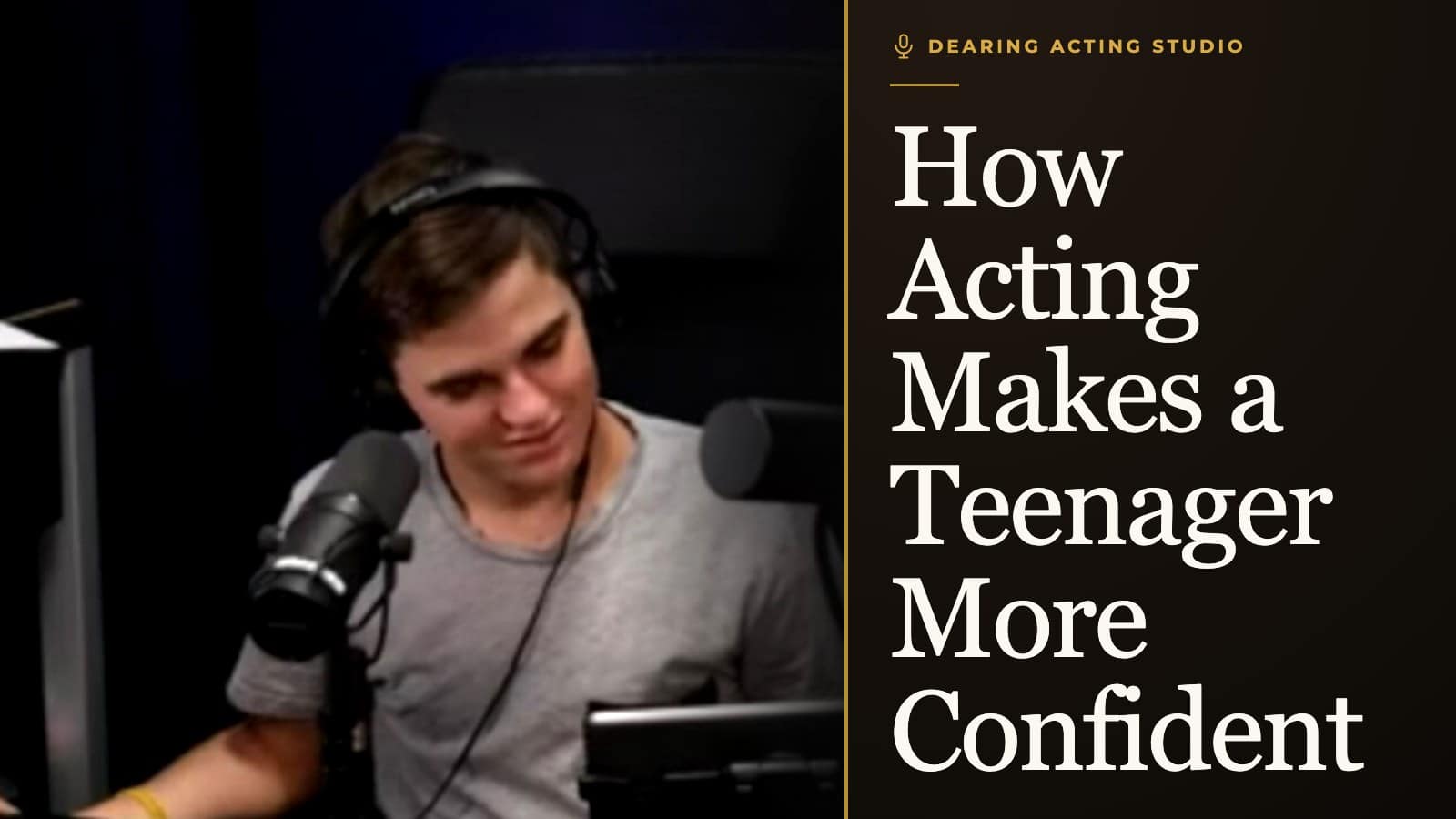
Brian and Joey ran this one with two of our teenage crew members, Wyatt and Courtney. Both had come into the adult class a few months earlier, both had made it onto the Chaos Comedy stage, and both were interning two or three days a week: wiping the popcorn off the tables, running cameras, doing the work nobody claps for. I asked to have this one written out because Courtney explains what changed for her better than the brochure does.
How does acting make a teenager more confident?
By making them listen. Courtney’s own words: she used to hear people in one ear and out the other, and now she pays attention to what someone is saying and to their body language, so she can walk up to anyone and carry the conversation. Wyatt was the quiet one at school until he’d spent a few months in a room where making a bold choice is the assignment, and one night he pulled a Southern accent out of nowhere for a commercial read he would never have attempted before. Confidence isn’t taught as a subject. It’s what’s left over once you’ve practiced being seen and heard, week after week, in a room that wants you to.
Prefer audio? Listen to the episode.
What is in the episode
- 01:30 · Wipe the table again. Kids spill the popcorn, you wipe it. Teens spill it, you wipe it again. Nobody will ever know, and that’s the point.
- 03:31 · A Southern accent out of nowhere. Wyatt’s first adult script class, a commercial pulled from the bucket, and a choice he would not have made four months earlier.
- 04:52 · The wrong choice we never forgot. Joey on an actor at one of our castings who made a bold, completely wrong choice, didn’t get the part, and has been called back for every role since.
- 06:12 · What changed at school. Courtney on listening, body language, and walking up to a stranger without being awkward. Wyatt on being the quiet kid until he wasn’t.
- 07:00 · Mentoring younger kids. Courtney’s work with the Swift Youth Foundation, and how you figure out what each child needs by paying attention.
- 08:13 · Leading is listening. Joey on going from the bottom of the totem pole to leading the crew, and why barking a lesson at someone who isn’t there yet does harm even when it comes from love.
- 10:57 · Praised in the light for what you do in the dark. A line of mine Brian quotes: what you do when nobody’s looking is what you get credit for when they are.
- 11:38 · Being a teenager right now. Cameras everywhere, being kind looked down on, and the comparison factor that social media only drives.
- 13:07 · Find your people. Courtney on the eighth-grade friends who were wrong for her, and why it’s cooler later to have been the one who said no.
- 15:35 · One hand. What my dad told me about real friends, Courtney’s inner circle and outer circle, and why six people you can fully trust beats thirty you thought you could.
- 17:30 · Their biggest actor struggle. Wyatt on knowing he wasn’t bold enough and deciding to walk out anyway. Courtney on getting in her own head, and Shea’s note: find the grace in every situation.
Why the teens and adults share a room
Wyatt and Courtney were in the adult class, on the same curriculum as everyone else, and it shows in how they talk. We don’t water it down for teenagers. Truth is truth, the scenes are real, and a sixteen-year-old who is trusted with real material starts trusting themselves. Confidence built in this room translates to every room, and these two are the proof I’d point a parent to.
Full transcript
3,781 words, transcribed from the recording on this side of the desk. Names corrected. Nothing else changed, so it reads the way we talk.
Read the whole conversation
This is the Dearing Acting Studio Teen Podcast, where we discuss the connection between life and acting. Hello, everybody. Welcome to the Dearing Acting Studio Teen Podcast. I am here with my little bro, Joey Sweeney. We've got two special guests for you guys today. We have Wyatt and Courtney. Hey, guys. How are we doing? Hello. How are you? I'm great. Did you just answer yourself there? Yeah. He realized he had responded, but also with the question, but he still needed to answer the question.
It was pretty great. Hello. How are you? I'm great. That's how conversations should be. Just to yourself? You in the mirror psyching yourself up is what I saw there, that kind of moment. I mean, I've had plenty of those moments in my life. I think everyone has. So you guys are on the crew. Yeah. K-R-E-W. Woo! So tell our listeners a little bit about what that's been like.
Well, we're here two to three times a week, sometimes more if we're lucky. Yes. And we help around at the studio, which has been amazing. We've learned so much and grown in the past few months that we've been interning. Yeah. And just being close with everyone here has just been so amazing. And I just have a lot of trust for you guys now, which is so great.
That's awesome. So when it comes to what we do here, a lot of people from the outside, it's hard to see or experience it unless you come in or hear it from somebody. So having been in and doing the internship, what's one thing that each of you really have learned? Just being in and seeing what we do behind the scenes. Oh, boy. I'm like experiencing it. There's a lot that goes in behind the scenes.
And no one really notices, but the little things are the things that matter. Mm-hmm. Definitely. So like I will wipe the table and then the kids will come in and spill popcorn all over it and I'll wipe the table again. Then the teens will come in and spill popcorn all over it and I'll wipe it again. But it's just, that's what matters. And we like have learned that like it's not about being like praised for doing these nice things.
It's for people. So we should just do it. That's right. Because no one will ever know. Yeah. Like literally no one would ever know that you wiped that table a bunch of times. Yeah. But you would. If I didn't do it, someone would have noticed. Nope. I guarantee you, like probably not. Unless it got really bad and got super dirty, then all of a sudden someone would notice.
Yeah. But there's this thing, like they don't think about it. It's just a part of what they're used to. Yeah. And it's loved it. Like you don't think about it until you really like get into it about how, what Disney does to make Disney, Disney. Mm-hmm. But there's a lot of work that goes into it. You had something there, Joey, with that. I, I, you stepped on it and I forgot it.
Oh, gotcha. Okay. So bluntly, I, I don't know what I was going to do. That's called Dark Delight, what Joey just did, which is super cool. That's just like when something happens, you just bring it up right away and speak on it. So what would you say is your biggest skill that you've learned so far? Trust. Trust. Okay. And being vulnerable. That's a big one. I came into this like kind of scared and not knowing a lot and I'm not that like talkative and being able to come here and like know that I can trust all of you guys is great.
For me, it's just stepping out of my comfort zone. The other night, actually, I was at my first, um, adult script class and we were, and that was both you and Wyatt did that as well, right? No, I'm starting. Wyatt starts next week. Oh, it starts next week. Yeah. So we were doing our, um, tapes for the beginning of the month and I pulled a commercial out of the bucket and I just whipped out a Southern accent out of nowhere, which I would have never done four months ago.
It's just crazy how much I can step out of my comfort zone. Well, what's so interesting though, is that made you stand out in a huge way. Like it just does the willingness to be bold and to jump out and go like, I'm going to make a choice. Maybe it ends up being the wrong choice. I don't know, but I'm going to make one. I'm going to do it.
You got a huge reaction out of the whole audience because they've been hearing commercial, hearing commercial, hearing commercial, and then boom, you bring in something different that freshens up the room. It's really powerful and powerful for actors out there with castings too. Like it's the same idea. Joey, uh, and I, and, and the whole team here ended up doing castings a lot and you're in the room a lot, Joey.
And it's like, you see the same thing over and over and over again. And so when someone brings in something fresh, it's like so cool. Yeah. Yeah. It's a, when, if you can make yourself stand out and it becomes something where it's like you are remembered, whether it was good or not. So one of my favorite stories is somebody came in for one of our castings one time and they made this crazy bold choice and it was totally wrong for the script.
So they didn't get cast, but the thing is, we'll never forget their name. And so we've called them back on every single role that they've ever even been close to fitting every casting since because he was so bold when he came into the room. And, and that's the stuff that, that makes you stand out when you're able to be yourself, but make those scary, bold choices. Like you end up, uh, making yourself look so much better when you do it in a positive way.
For sure. So dealing with that, like for you guys, you and why it's specifically on this one, like you've talked a lot about how it's helped you with trust. Right. So how has that helped outside of acting? Oh, definitely. Um, so in school, I am still kind of quiet when I'm like not around my friends. So being here, I learned like how to communicate with people through like being in class and being with you guys because you guys are just so inspirational and especially like when you guys talk, you talk so positively, which has impacted my life.
I think it's awesome. Awesome. What about for you, Courtney? Um, wow. There's a lot. I can't put my finger on just a specific example, but I've just noticed I'm more confident. I'm, I'm more willing to walk up to someone and start a conversation with them because I know how to carry the conversation just because I'm not as awkward anymore. I can pay attention to body language. I listen, um, which I used to just listen in one ear out the other would not pay attention to what someone would be saying.
And so now I actually pay attention to what they're saying and I've found it a lot easier to communicate with people when I'm actually paying attention to that. Now I have a question for you. You have a, uh, a foundation that you work with a lot. The Swift Youth Foundation. Is that right? Yes. So, um, with communication and dealing with that, has it helped you inside of that area as well?
Oh, yes. A hundred percent. So I'm, do you want me to just tell me about the organization first? Swift Youth Foundation is a nonprofit organization that works with youth in economically disadvantaged situations. And so, um, our mission is to create the path from present to potential through peer mentor relationships. So basically it's just a bunch of teen mentors in high school that are paired up with these elementary school kids.
And, you know, these kids, a lot of them are lacking some social, some social graces. Is that what you'd call it? Like, like, I'm not sure. I don't know what the word is, but some of them, they're just social skills, social skills. Yes. Yeah. Yeah. Yeah. So, um, you just kind of, you need to get down on their level and realize what they need. And some of them just want to sit quietly and play a game and others want you to reach out to them and others just need someone to listen to.
So it's really paying attention to that and figuring out what each kid needs specifically. Yeah. That's one of the coolest things that I've learned in the past couple of months, like, like with having you guys on as crew, uh, I've, I've been able to practice being a leader and like being exposed to that because I was in your position for a really long time. So for a long time, I was the bottom of the totem pole.
And, and you guys know here, uh, I was never treated like that. You guys are never treated like that, but, but that's the fact of the matter is like, there's always a pecking order, you know? And so I was, I, I was always the intern level and then I moved up and then I moved up, but I was still like the lowest on the guardian team to begin with.
I was the youngest. And so I had a lot to learn. Uh, so having you guys in and learning those leadership skills, I've been able to understand that even more too. Like, because sometimes it's more important to listen and pay attention to where somebody's at than to bark a lesson at them or reprimand them. Like if you're not listening to where somebody's at, you don't know what they're going through at the moment.
And you're going to, even if you were doing it out of love, if you were trying to give a lesson, you can do it in a harmful way. And, uh, and that's a big thing that I've been able to learn through you guys being on the team. And, and yeah, it's been really cool. Yeah. And you've done such a good job. Like you've grown so much in being a leader.
It's crazy. Thank you. Thank you. Well, leadership is, it's hard. It's like so hard. Like there's, there's one of those things like, like anybody can, can jump into a job and do the job when it comes to a standard skill, like whatever the job is, whether it's like running a camera, editing, um, teaching anything really. But when it comes to leading, leading something that you really have to develop a skill for in a way where it's constantly growing and you're managing other people.
So it's so hard. It's so hard. Um, and it's just been cool, honestly, to watch that happen for you, Joey, too, and watch you come into your own recently. Like Joey started teaching as well, which has been really cool. Um, yeah, super awesome. Like such a testament to you can just make a decision to change. Right. And for you guys, I've noticed the same in you as crew.
Like recently we just had a, a, a discussion not too long ago about how we have to come in with a certain attitude and just create something in this space and be leaders for the other teams, for anybody else seeing you and that we're always on, we're always on no matter what. And it kind of goes back to the table thing, like cleaning and doing things like people don't see you doing it.
You don't think, but like you need to be that kind of leader, even when someone's not watching and always when they're watching to be that way so people can see, okay, this is, this is what I should mirror. Yeah. Right. Matt says that a lot. You, you get praised in the light for what you do in the dark, you know? So, so what you do by yourself is what you get praised for around other people, you know?
And that's a really cool concept. I think just the idea of like, it's what you do when no one's looking. And that's something you guys have been really, really good about. Thank you. Absolutely. Thank you. So we talked about this on the last one, but I'd love to give your guys' take as well on this. Get it. Excuse me. With, with right now and everything, how things are going in, in teen culture, like tell me about what it's like to be a teenager right now for you guys.
It's crazy, um, cause everything you think to like, like be nice, like all of these crazy things can be like looked down upon. Like being a normal teen, like consists of like being rude, doing all these bad things. And it's so hard to like be able to just be a genuine nice person without being like looked down. And your whole life gets put out on social media, whether you want it to or not.
You're, there's cameras out everywhere you go. So you really have to make sure like you just have to be aware and conscious about the actions, your actions and everything that you do and say, because it will end up on film or someone, it'll get back to you. So you really got to be careful. Yeah. And, um, also like the good part of like technology these days is I feel like our generation has kind of been like learning a lot more.
Like after we do all these like bad things, it's like, it's a good growth. And I feel like we can all feel that. That's right. And I was just curious actually mainly because it's fun to watch you guys at your light years ahead of where I was at your age, like light years. Oh, a hundred percent. Me too. Me too. It's crazy. Like Joey was even at least a good kid.
I was a bad kid. Like I was a bad teenager. I made a lot of bad decisions. And so it's, it's hard to be the, and I'm sure you could speak into this too, Joey. It's hard to be the person who's opposite that, who's opposite of what culture is doing. Yeah. A hundred percent. I can't even like put words on it. And I was just at the beginning of social media, so I can't imagine what it's like now.
Yeah. Well, oops, sorry. No, go ahead. Go ahead. I was just going to say, um, in eighth grade, I was friends with not the right people. And I did go through not the best phase. And so it's just, I realized like, I really don't want to go down that path. And so ever since then, I've just worked my way up. And now, like I can truly say, I, I'm just so lucky to be in the position I am now because looking around me, there's so many people that are stuck in positions that they shouldn't be in.
And it makes me sad because kids my age shouldn't be worrying about that kind of stuff, you know? Yeah. So speaking into that for, for someone who might be going through that, what would you encourage that? How would you encourage them? Like, how did you get through that and come on the other side and decide, no, I'm not going to be that way anymore. Like what sort of encouragement could you give to someone who's literally in that situation who might be listening?
Um, I think that later you will realize that it's cooler to say no and state like stick your ground instead of going into all of, all of those bad things. Cause you're gonna like be known as more of the mature one out of everyone in like your grade or like anyone, you know, and find your people, find the people that listen to you and understand you and won't pressure you into doing something you don't want to do.
Because in the long run, those are going to be the people that stick by you. The people that are trying to convince you to do something bad at a party are not going to be the people that you're going to want around you when you're older. And, and, and oftentimes they do it to justify the decisions they're making, you know, cause it feels not as bad when everybody around them is doing the same thing.
Yeah. So that's the big thing. It's the comparison factor. And I think that's part of the biggest difficulties of being a teen now is less it social media is a vehicle for it, but it's more about the comparison to one another. Yeah. And it's, it's also like going back to like trust, find people that you can trust, like that you can stick around knowing 100% that you're, you're safe with them and that nothing can throw you off into a bad position.
Yeah. Which I think is important. That's huge. I can't remember who said it, but I, I know, um, Matt's dad would tell him growing up, um, that you can count your real friends on one hand, like one hand, you can count them on one hand. How many, how many people can you count on one hand? I know, I knew he was going to do a finger joke there, but, um, for real, like you can.
And so there is so much to that. That's, there's a lot of wisdom in what you guys are saying. And so I hope that the teens out there listening can receive that. And it translates also directly to the acting world because it's, it's a tough world. You know, there's a lot of comparison, a lot of like, no, no, no, no, no. And if you've got the right encouraging people around you, they're going to challenge you to just keep getting better, not be discouraged, but look for the growth.
Yeah. And it's, it's funny this month I've realized like the keeping your like real friends close. Um, I kind of thought to myself like, who is there for me? And it's kind of come down to like, maybe like six people in my grade. And I feel, I don't feel sad about it. I feel so much better that I have six people that I can fully trust. I mean, I can still like be friends with other people, but I feel like it's way better than like last year.
I had way more people that I thought I could trust. And it just wasn't right. My mom, um, always tells me that you have your inner circle and you have your outer circle and your inner circle. People are the people you want with you till the day you die and you can count on them for anything. And then kind of like, as you go further to the edge of your inner circle, they're, they get less and less trustworthy.
And then your outer circle, you can still be friends with them. You can still hang out with them. You just don't trust them with everything. Like they're still there and they're still fun to be with once in a while. It's just not your ride or die people, you know? Yeah. Yeah. That's a big deal. That's huge. Got to surround yourself with those ride or die people. Oh yeah.
So before we wrap, I would love to hear from each of you as actors, uh, something that you have overcome in your acting, like your biggest actor struggle to this point and like what you've learned from that. Okay. So maybe a couple months ago, I knew I wasn't bold enough and I wouldn't go out on the stage as much, but it wasn't like I didn't know. I knew it.
I was just too scared. And now these past shows, I've really been trying to be bold and go out there with no idea. Just be comfortable out on the stage. I'm going to just round it up. For real. Yeah. That's awesome. That is huge. Seriously. Like, uh, I remember just like the first week you guys were in the adult class to now is just so crazy. Like you've made it onto chaos.
Now you're crew members, like you've come so far and, uh, and, and your scenes have been fire lately since probably since that switch flip, you know, the last couple of shows I've seen, like you've been hitting the stage, you've been doing that. So it shows and that that's awesome. I'm glad you were able to share that. Yeah. Thank you. Courtney. Um, for me, it was just, I would get in my own head.
I would, I would perform a scene and it would be great, but then I would get off stage and I'd be like, Oh, I didn't do this. I didn't initiate it correctly. I didn't form a relationship. Um, but recently, actually a couple of weeks ago, I was talking to Shea and she told me that you need to find the grace in every situation. And so lately I've been trying to do that even with just things in my like outside life, not just acting, but instead of picking out the bad things in the scene, I've decided to pick out the good things like, Oh, Hey, this was good.
That was good. And just learn from what I did. That's awesome. Well, thank you guys. We really appreciate you guys coming on. It's been, uh, so awesome. And we're so glad you're on crew and, and, uh, keep listening, uh, and keep watching out for these guys growth. Cause it's just going to keep growing and keep growing. So thank you. Thank you. This was the Dearing Acting Studio Teen Podcast.
Have a Dearing day, everybody. Have a Dearing day. Dearing day.
Your next step
The room Wyatt and Courtney trained in.
Teen Improv and Teen Script, ages 11 to 17, in Phoenix, on the same curriculum the adults train on. Listening, bold choices and being seen, every week, on camera.
See the teen classes All classes, ages 5 and up