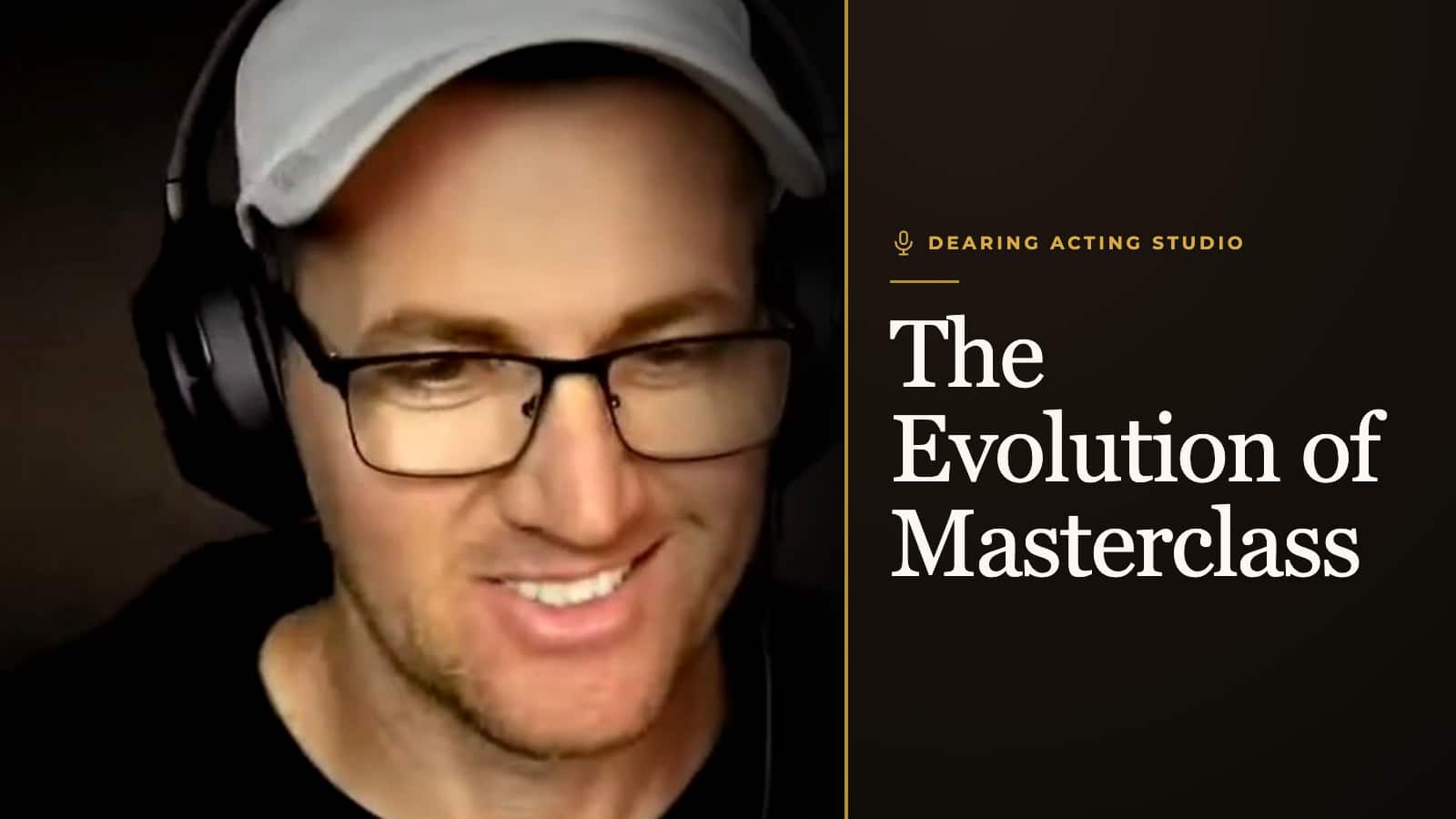
Joey opened this one by admitting he’d set his alarm for four in the morning and woken up before it went off, terrified, because he’d finally found the right why. Then Bebe Katsenes walked in. She grew up in our program, interned here her last year before college, and was home from USC for the holidays. What she told us about her first masterclass, at sixteen, with her mom in the room, is the best description of what that class is for that I’ve heard from anyone, including me.
What is an acting masterclass for?
To show you truth on a stage so you can never un-see it. Bebe had done years of youth theater, all of it presentational, playing a character. Then she sat in the back of masterclass at sixteen and watched scenes from Pulitzer and Tony winning plays, sensitive material, actors telling the truth, and it gave her chills. She walked out and her mom said: you have to take that class. Once you’re exposed to truth you either want it or you pretend you didn’t see it, and either way you’re held accountable to it from then on. That’s the class. The format changes every year; that goal never has.
Prefer audio? Listen to the episode.
What is in the episode
- 00:53 · Four in the morning, and the right why. Joey on the morning he finally got up when he said he would, and why it took the right reason instead of more willpower.
- 03:46 · Momentum, and losing it at college. A BA program with no structure, a great semester that still felt like drifting, and my advice: attach your why to something that isn’t you.
- 07:33 · The audio drama. Bebe wrote a pilot for a podcast class, cast herself, cast her friends, and directed it, and found out what it feels like to give an actor room in your own script.
- 11:26 · We versus me. A pillar of the next book. A director with an idea and an actor with an interpretation can make something better than either of them had, if both are willing to be wrong out loud.
- 13:23 · Masterclass at sixteen. Why I was worried about a teenager in a room working dark, sensitive material, what she saw from the back, and her mom’s verdict on the way out.
- 16:03 · Larry Moss. The same thing happened to me the first time I sat in his class. I thought I didn’t like theater. I’d never seen good theater.
- 19:11 · Weekly became monthly, then four days. Why the class changed shape: more work for me, not less, and a format that attracts the better actors because it’s harder and there’s no next week to hide behind.
- 22:57 · The tears came at the right moment. Bebe’s scene from the Jodie Foster film, the arc that never happened in rehearsal and then did, because she’d done the work and trusted it.
- 27:21 · What’s your why? Her first stage kiss, the forty-minute walk before she’d agree to it, and my only answer to any hard scene: walk into the fear, once you know why.
Why the class keeps evolving
Every version of masterclass has been built to do one thing: put truth on a stage in front of people who’ve never seen it, and then make them responsible for it. Weekly, monthly, four days straight, online from around the world, it’s the same room. The format follows the students; the goal follows nobody. If you’ve seen it once, you already know whether you want it.
Full transcript
7,046 words, transcribed from the recording on this side of the desk. Names corrected. Nothing else changed, so it reads the way we talk.
Read the whole conversation
Let's do it. This is the Dearing Acting Studio Podcast, where we discuss the connection between life and acting. All right, welcome back everybody to the Dearing Acting Studio Podcast. My name is Matthew Dearing, here with Brian Sweeney and Joey Sweeney. What's up, gentlemen? Having a great day, my friend. What's up? Tell me about your morning, gentlemen. It was so great. My morning was awesome, dude. I had a great talk with you yesterday about just trying to get better at switching my mindset.
And so I'm trying to get up earlier, and it's super, super hard. It's been super, super hard for me. And you really helped me last night to figure out that I can do it if I find the right why. And so this morning, the time that I picked was 4, and I was like terrified. 4 a.m.? Yeah, 4 in the morning. That's crazy. Which still is nowhere near your amazingness.
No, it's not. Here's the thing. It's not about that. But here's the deal. Like, that's a crazy number, especially for you, knowing where you were. Yeah, yeah. Okay, so 4 o'clock. So 4 was the time I was going for, and I woke up, and it was dark. And so when I was sleeping in before that, it was still dark. And so I was, like, terrified. I was like, no, I did it again.
Like, I didn't make it. And then I looked at the clock, and it was 3.58. And I woke up before the alarm. Where's the round of applause, Joey? Come on. Oh, okay. Sorry about that. So you wake up at 3.58, no alarm, on your own naturally. How'd that feel? It felt amazing. It was like this jolt of energy because I realized the power in it. I realized exactly what you were saying was so right.
I just didn't have the right why. Like, all of my whys were completely selfish and self-motivated. And because of that, I wasn't able to do it. And so, like, being able to wake up that, it just felt so amazing because it was this thing that, like, yes, you can. Like, all the lies you're telling yourself, they're BS. Stop lying. Well, speaking of powerful, because that's a powerful story, we've got a powerful actress here in the studio today.
Woo, baby. Bebe Katsenes is back in town. So, baby's a long-time student and has ventured off to USC to train. Yes, yes. Unless you're playing us, then we'll, you know. Then don't fight on. But yeah, so. I mean, I had to do it because you said they're playing us. You have to, exactly. So, Bebe, tell us about college. I mean, you ventured out. You're studying acting, yeah?
Yes, I am a theater BA, currently at USC. Is that like a bad A? I feel like you're, like, a theater. No. Okay. No. Oh, Bachelor. Got it. Bachelor of Arts. It was a little late. Yeah, you got to get on the soundstage. Stay present, man. Keep your hands on the buttons. I keep, I'm so scared to press the wrong button. But be ready. You're not ready.
That's the problem. Okay. We're going to say funny things. It's going to happen. You got to hit the ba-bum-ch when it's time. And the applause. Understood. Okay. Here we go. Go Devils. Anyways. No, I'm. Oh, I'm sorry. Did we interrupt? Yeah. So, you went off to college. You're studying acting at USC. Fight on. Go ahead. Yeah. No, I'm, I love being there. Like, it's, it really is my place.
I will say, it's hard coming from a place like Dearing and just, and transitioning and going to college classes and life in college because I found that I had a lot of momentum here and there's a lot of great, intense, high-level training here. And then you, you go and then, like, I went over there and I just found that, like, it's really hard to keep the drive and the intensity.
And especially in a, in a BA program, which is not, um, as structured as, like, say, a Bachelor of Fine Arts, um, you really have to hold yourself accountable to, um, you know, reaching your goals to, to, for me personally, I had to hold myself accountable to, um, the same standard that I did here and that, that you guys hold all of your students, students to and each other and yourselves.
Um, so I did struggle with that a lot during the transition. I remember calling Joey about it and being like, I feel like, I don't know what I'm doing here. Like, um, I did have, I mean, I had a great semester. I love my classes. I ended up having a really great time, but it was just the trend, it made the transition really difficult. So, you know, let me give you some advice here.
I think that going back to what Brian said to open up the podcast, if you can figure out your why and, and you attach it to not you. So, so literally Bebe Katzinas can come in and change the culture at USC. And I know that's crazy to think, but you can. So this is already a high level school. I mean, we're talking about USC, like they're known worldwide.
I mean, and obviously it's a great school, but you can't help, but you are a freshman, right? You're not a senior there. You were a senior here. So there's going to be something different about that. So you can go there and set a new example, set a work ethic, and it will be contagious. It will be contagious. Thank you, Joey. And well, he hit his own there.
Yeah, that was good. Well, you know, you guys told me to be more present. He was ready with the button. Right. It was good. So, so the idea though is, um, and then, and then as you're doing that, what's going to happen is the, the other kids who share that same work ethic and drive will be attracted to you. Yeah. And that's what I said before you left, because those are the kids you want to hang out with.
Like the kids who have, who share your drive, who happen to be filmmakers. It's like, those are the kids that are going to be making movies. Yeah. And you want to be friends with those kids, you know what I mean? Well, I can already see how that, how that has happened. Like I, I think of the people that I surround myself with and the people I've, I can tell that I will be lifelong friends with.
And those are the people who want to do the same things I want to do. Not necessarily the exact same things, but want to work as hard as I want to work. Yeah. Like I have a friend who, who I, I would definitely say she's one of those people. And like, we're writing a web series together next semester. Nice. Cause I mean, like those are the kind of stuff we want to do and why wait until we're, you know, out of school to do it.
Awesome. So speaking of, of you writing and doing some things that you were involved in a, in a class podcast I heard about. I was. Yeah. Um, so for my elective this semester, I took a class called creating the head podcast. Um, and it was taught by a USC alum who, um, owns a podcast production studio. So kind of the format of the class was like every week he would bring in a different guest speaker, um, who talked about and answered questions about their role in the podcast industry.
Cause that's a huge, I mean, we're doing one right now. Like it's a really new, awesome medium with a lot of potential for it. It's massive right now. Yeah. It's, it's growing exponentially and it's a really, really cool medium. Um, and so I've always been interested in like screenwriting and playwriting. Um, and for the final project for that class is we had to create a podcast pilot.
So I thought, okay, I'm going to use this as an opportunity to, um, write like a pilot. What would be a pilot for a TV show, but for a podcast. So it would, so it would be called an audio drama and those are becoming increasingly more popular right now. So I was like, yeah, I'm going to, I'm going to write a pilot. So you did that? Yes, I did.
And then did you, did you, um, did you cast it and everything and have actors play the roles and. Yeah. Yeah. So there were four parts, two boys, two girls. Um, I cast myself because I, cause I mean, well, ultimately I want to be an artist who can like create my own content and why wait for someone to cast you in something when you can write your own project and cast yourself.
Yeah. Um, hack, but yeah, so I cast myself. Um, one of my friends is, well, they're actually all theater BAs. So I met them all in my acting class and we've become friends. They're the types of friends, like you were saying, who have that drive that I really admire. Um, and we work really well together and it was just, and so did you guys rehearse and everything and yeah, I sent him, I, did you direct it a little bit before you guys went up?
Yeah, yeah, yeah. So we had a lot of conversations about like the characters and, and I also wanted to make sure, I mean, this is the first thing I've ever directed, but that because me as an actor, whenever I'm directed, I want the director to leave space for my own artistry and for my interpretation of the character. And I think it's interesting to get that perspective of writing and directing something.
Cause I, it's like, I feel an ownership over the characters, but I have to also, I have to feel that, but also understand that an actor wants to have room for their own interpretation of that character and wants space to, to create that character instead of feeling like it has to be my version of that character. Um, so that was a cool perspective to have, um, and allowed me to be really sensitive about the different types of artistry, like writing and directing and acting.
Um, so, so this, this concept you're talking about falls into one of my pillars of belief for life. It's in, it's in the next book that I'm writing, which is this concept of, I don't know. So I think you're saying one thing, but really at the end of the day, um, you might even mean something slightly different because what I think is it's, it's less powerful to be the actor who wants to give their interpretation.
Like I want my interpretation in the character. That's a selfish motive. But if a director says like, I'm going to leave room, not for you to put your interpretation on my thing, that's all you and my, but if the director says, here's my understanding of this thing, I believe you as an actor and me as a director collaboratively together could possibly come up with something better. Probably could come up with something better than whatever my idea is.
And so, because I'm open to that, you then can explore and then together we can find this thing that didn't exist before the two of us came together. Totally. That's exactly how I felt. You just put it in a better way. Yeah. It's just like masterclass when you tell people that they have to respect the playwright's writing, you know, they have to go in and find, like you said, their interpretation based on what the playwright wrote and do justice for that play.
Yeah. There are facts that are indisputable, right? So then you wrote it and you know the point of view, you know the story you're going to try to get across. But as long as we tell that story, there could be a better, more creative way to go about it. As a matter of fact, potentially four other actors could bring your script to life better than the four of you did that one time.
Yeah. Exactly. And then it could be done again and be just as interesting, just different depending on whoever was acting in the piece. Yeah. And I think it comes from kind of what you said a little back there about the idea of we versus me. You know, when you start doing it all together as a team and starting to figure it out and figure out the people you're working with and changes the vocabulary, that's, it changes everything.
Like then it's, then it's us all in this together. And it also came from you, like you said, working with other people that you know are also hard workers and passionate. And that comes from, from networking with those kinds of people and being around those kinds of people. And then you guys create that stuff together. So that's just so cool. Like that idea of when you start to take that on, then, and then other people want to help you more.
Like you call this like being somebody's hero. And I just, I love that. Like you allow other people to be your hero and then you get to be their hero when you need to. And, and it just, you, you do better for someone when you get excited about doing that versus them telling you to do it. Yeah. If my intention is to help, it's not, my intention is not to like, like to put my stamp on it, you know, but my intention is to say, Hey, I wonder if this could possibly be better.
And while I'm saying it, be willing to immediately acknowledge that I could be wrong. Like my idea could be totally stupid and it could be really way off and it could totally stink. But I need the creative freedom to try it and to fail and to have, have us all acknowledge that it was a terrible idea rather than keep it locked up inside because I need to explore that bad idea to make sure it was bad.
Exactly. Well, and that was the whole point of writing. It was, I had never written a full script, like a script of that volume before. So the idea was I gave him the script and I said, okay, here are the lines. I don't know if they're the best way to say these things, but this is what I'm communicating. Tell me if you think there's a better way to do it.
It's awesome. Yeah. So, uh, Joey brought up masterclass. I remember Bebe, uh, when she first came into masterclass, this is an interesting story. So, um, I'll wait. Okay, good. And so, so basically you were in high school. Yes. I think I was a junior. Junior in high school. How old were you? 15? Uh, 16 or 17. Okay. So let's just say 16. And you would have been at the time, the youngest person ever admitted into the masterclass.
I don't know if you know that or not, but that would have been the case. And you, you had mentioned an interest in it. And I was a little worried because, you know, in the masterclass, we do pretty heavy, intense work. I mean, it is, we, we work on scenes from Pulitzer prize winning and Tony award winning plays. Sensitive material. Sensitive material. And the, and the truth is, you know, my belief is, and you know, it's right there in the lighthouse mission is you have to go into the dark in order to bring out the light.
So I'm not afraid to go into the dark, you know, I, I don't believe that that makes us bad. I think it may, I think it's humanity, you know, we all have that inside of us. So to deal with it is important. Right. So anyway, I mentioned this and she's only 16. And so I said, Hey, well, you got to bring in your mom and the two of you need to sit in class and, and then, you know, and then we'll decide if it's right for you or not.
So can you share your experience of when you first came into the masterclass with your mom and like what you guys were thinking and talking about? And maybe even like on the way in versus the way out. Yeah. Well, I remember, so I walked in with her, I'm in like my school uniform and it's just like, and at the time it, the format it was in, it was like on Wednesdays for two and a half hours.
Um, and so each person would put up like 15 minutes of a scene or you'd work on a scene for 15 minutes. Um, and I kind of didn't know what to expect. I know you had like braced us a little bit. Um, but I remember the scenes, there's a lot of cursing. I think two of the female actors ended up kissing in one of them or it was like a post.
Like, yeah, it was like, yeah. And so just, there was a lot happened. And after talking to everyone in the class later, once I had been in the masterclass, they all thought, oh, there's no way she's going to take this. Like her mom is here. The one day that she comes, like we blew it. She's not going to, she's not going to take the class. And I remember walking out and I felt like before I had said anything to my mom, I was like, I have to take this class.
Like, I mean, it gave me chills watching the performances. Why do you think that was? I think I had never seen anything like it. It's like, I, I saw you guys catch lightning in a bottle. Like there was like, this is so like corny, but there was like magic that happened on the stage. And I think it was like, it was one of the first times I had seen like such truthful acting in person.
That's what, that's what happened to me when I sat through Larry Moss's class the first time. Cause in my mind, when I first started, I was like, I like film. I don't like theater. That's what I would say. But the reason was because I had never seen good theater. I had seen good movies. I had seen great actors do great movies. And I'm like, I want to do that.
I had never seen great theater. I'd only seen, you know, community theater or school theater. And, and it's fine, but it wasn't, you know, it wasn't, it wasn't life altering or anything. And I sat through Larry Moss's class and I was like, oh, I had no idea what acting was. This is unbelievable. I love theater. I mean, but, but really I just love acting. I mean, that's the point.
I just love bringing truth. And I, and I, I saw it and I go, I have to do this for the rest of my life. Like that's what happened to me. Yeah. I think the other thing was, like you said, all the theater that I had done was youth theater and school productions. And so the acting that I knew was very presentational and it was, you are playing a character.
Like you're essentially an archetype. I did musicals. Like that's the theater that I knew. And then I stepped into class and I saw like truth on the stage. And I was like, acting is so much more than what I ever thought it was. And I was like, I have to have that. I have to learn that. I have to do that. Well, good for you right away for clinging to that and, and jumping on that instead.
Like, cause that, that can be a scary thing also. You know, you're, you've got this comfortable that you've been in forever and you look at that and you see something great and you're like, uh, no, I'm just going to stick with this. I call it, you know, when you're exposed to truth, you, you either want it or you pretend like you didn't see it because once you see it and you know it to be true, you are then from, from forevermore held accountable to that.
So it's like, now you know what it looks like, you know what it should look like, or if you've, if you've been through it, which you have, you know what it should feel like and anything less than that is not okay. Yeah. Yeah, exactly. Yeah. Okay, cool. So you, so, so you walk out, right. And you were thinking to yourself, I'm like, I got to do this, but you hadn't talked to mom yet.
Yeah. So I was hesitant. I was, were you worried about mom a little bit? I mean, I, I didn't know what she was going to say. And then we both walked out and we look at each other. She looks at me and she goes, you have to take that class. And I was like, I am my mother's daughter. What's so funny is, um, you're, you're both like really sweet people and, and you, and you look super nice.
Like if I, if, if, if we're not watching this on video right now, if you happen to be just listening, um, Bebe be one of these characters that you would, you would see in the beginning of the movie that she looks like a librarian or something. Right. And then, and then, and then afterward, you know, she can turn into this like ferocious woman, but she, you know, you're, you're unassuming.
Your mom is too. Yeah. So to walk out and just, and now that I know your mom a little more from, you know, doing the plays here and whatnot, I mean, she's, she's ferocious too, but, but you don't, you don't expect it, you know, which is so cool. So, all right. So you guys said you had to do this class and then, and then you did, and you got to be a part of the evolution of, of masterclass here.
Yeah. I've been lucky to be a part of its journey. Um, so yeah, well, when it transitioned, it was the class that weekly and became monthly and, and when it became monthly, you had the four day intensive, um, you know, where we got on stage for an hour and got to prepare this 15 minute scene. I mean, I mean, that was like life altering. So, so what's interesting is, is, you know, I look back and I, and I tell people, you know, they didn't know what they had in the weekly class, you know, like they, they had no idea like, Hey, how lucky we are to have this.
And then all of a sudden it went away and it's now, you know, monthly. But the reason, cause that actually created more work for me, not less like weight. Yeah. Cause I had to prepare for every scene. And, and, and now if you think about it, I'm going eight hours straight, four days in a row. I mean, it's a tremendous amount of effort to put up that class.
We lose money on it. So it is not something I do. It wasn't, it wasn't a move that was selfish. It was a move that said, this is going to attract the better actors and it's going to pull the best out of people. It's harder. Therefore, I want to do it. And, and that's what happened. And so then all of a sudden that same great experience you were feeling weekly, it just got intensified on the weekends because now like it's all working up to this one big thing.
And, you know, you either sink or swim, which puts a whole new level of pressure on, on everybody. I mean, on me too. And so you have to be better and you rise to the occasion. And that's why we made the switch. Exactly. Cause when you have the 10 minutes in the two and a half hour class, it's like you can, you can kind of fake it till you make it potentially.
Um, but like you said, with the four day intensive, like you got to hold yourself responsible or you will, I mean, I mean, you, well, weekly I would hold you accountable, but the, but the issue is you'd always know I always have next week. Yeah. So even if Matt comes down on me, it's like, okay, cool. Like whatever. But you didn't, you didn't like invest in a weekend, you know, now, and now it's semi annual, um, for, for the same reason, which we're looking to attract national people.
Like some of the, some of the actors who are taking our courses online are from around the nation and we want to attract them to come in, fly in for the weekend and take this intensive and experience what it is to live in that magical bubble for four days, get inspired and then take that with them back to wherever they live. I mean, that's, that's the next goal.
So again, it's, it's always, it's like a very unselfish way to say, how can we raise the stakes here? Because if we can create this false pressure, that's really intense, uh, it's better for everybody. Cause then if you, it's like, if you can survive masterclass, you can survive any audition in the world without fear, you know? Yeah, exactly. So going into that, that bubble of, of the masterclass and what it is, would you mind sharing, like, I know for me it's, it is absolutely magical and transformative is a word that I would use that it's been for me is I, there's just so many life application lessons that, that the stage taught me, uh, what, what's one or, or an instance that like on stage that you really remember that, that you took out of that and is just like changed you?
Oh, I know that's like a big one. How do I pick just one? Big question there, buddy. Yeah, it is. It is. Yeah. Well, one that, that sticks out that might not like if you guys were to pick a moment where like there was a change in me, like you probably wouldn't think of this one. But when I was doing, um, the scene with Sia, um, interrogation, is that what it was?
No, no, no. That was, that was a different one. This one was from the movie with Jodie Foster. Yeah. Oh yeah. But I was the lawyer and she was the, um, she was my client, the rape victim. And there was a moment in the scene where, so she breaks down crying and then eventually by the end of the scene, I'm supposed to cry. And that had never happened in rehearsal.
And I've been emotional on stage. I've never had an issue with that. But often that's because my character's crying at the beginning or, or the emotion is already there. So I, so in preparation for masterclass, I can be in the other room prepping and I can put myself in that frame of mind and then I go on stage and it happens. But, but this, it's like my character had to have an arc throughout the scene.
And I was always really terrified of that, that the arc wouldn't happen. And throughout a lot of my scenes, I do all the, I do so much preparation and so much work, but I have trouble trusting it because Matt, you always say like, you got to do the work and then you got to leave it behind. Um, cause if you've done it right, it'll serve you and it'll pay off.
But so I remember being on stage, um, and the scene was going well, we had been coached through it and we were in the moment and I felt it, you know, you feel the, you feel the masterclass magic. Like, and then, and then the tears just came at the right moment because I just trusted them, but they had never happened before. And you know why too, is because it, it was real.
Yeah. You believed with your whole heart that what was happening was really happening. And because you're a human being, you experienced the world through that character's eyes and experienced truth and she would feel in that moment. And so therefore it just, it just happens. You don't have to think about it. You don't have to prepare it. You don't have to have some sort of a substitution exercise.
I mean, it, it, it just works. Yeah. That's cool. Very cool. I mean, I mean, I remember, uh, um, I think there was a scene where you and Joey kissed actually, right? Yeah. Yeah. That was my first masterclass. And your first kiss, I believe. Yeah. On stage. Oh, there was a kiss before that off stage? There was. Really? Okay. We got to hear about this. Where's the button that goes, whoa, where's that one?
I don't think there is one. There's a heart. We need one of those. There's that. That one. Oh, there's that one. Really? Yeah. There's no. Okay. So, so tell us about your first offstage kiss, Joey. Oh, uh, why? I don't know. All right. All right. So, so this is your first onstage kiss. Yeah, and, and it was like so frigging intense because it was my first. You don't have to avoid eye contact with Bebe while we talk.
Yeah, you can, you can look at her. It's okay. It was my first month in masterclass. He's over here. So, I looked over, anyway, it was my first month in masterclass. So, I had seen it in July and that was the first time I saw it. Uh-huh. And so, I was like, oh yeah, I want to do this, like put me in it. And then I remember I was like, I got put in in August, right?
And I got the email and for the longest time I was replying to the emails and it was always this ongoing joke that like so many people would see the emails and not reply. Uh-huh. And Shea would laugh because I was working here interning and I would still reply to all the emails because, because it was so cool for me to be in the class. Yeah. And so, I got this scene and I read it that night and then I was like, I was like, which scene is it?
Because it said scene one and scene one like had nothing to do with the scene that we did. Like it was a totally different scene. And so, I started memorizing that and then two days later or a day later, you were like, no, no, it's this scene. So, then I was like flopping through it and then I was like, wait a minute, I don't have to do this, right?
Wait a minute. You were like, you were like, no, you do. And I was like, uh, excuse me, can we, and then we took a walk. Yeah. And had to talk about it for like 40 minutes because I was like, I don't want to do this. Like that is, that does not sound fun to me. So, it was, it was interesting. Well, at that point, I didn't even know.
No, I know. We had to know. No, you were just, you were just afraid of it. That's all. Yeah, totally. That's a very typical response to those kind of scenes too. Like someone gets that and you, you, first thing they're like, is like, oh, it's like a gut check. Well, and here's the deal. There, there's a time and a place and depending on where you are as a person.
So, so my, my answer to this question is always, what's your why? And if you're, if you don't want to do the kiss in the scene, in my opinion, because you have a moral issue with it, because like, like for me, like if I'm married, I, I won't do that. That's fine. But if you're just doing, if you just won't do it because you're afraid of it, I'm like, hey, we got, we got to walk into the fear.
Yeah. And that, so because it's always about the why for me. And so that's why I was like, nope, you got to do it. Right. As long as Bebe was okay with it. Now, was this your first stage kiss too? No, it was not. You've had many. So many. So, so was it, was it awkward though, Bebe? Oh, it was so awkward. Oh, really Bebe? Yeah. I do a really good Joey impression.
It was awkward because it took like 10 minutes of you coaching Joey. Cause it wasn't, it didn't just happen. You were like, okay, Joey. And like, like in class, right? Yeah. Like in front of everybody. You were like hyped it up. Like I remember, I remember it was about to happen. This was like the second or the, the, the last day of masterclass. Like Joey had tears streaming down his face.
Like it was the emotional peak of the scene. And we looked at each other and it was about to happen. And like you, Joey. He blew it. I was like, no, Joey. You blew it. You had to kiss her. Yeah. And then, so you made him go back and do it. Thank you for teaching us, Bebe. Just over and over again. And your dad was in the room too.
That was, I was about to say, that was the one time our dad was like, yeah, I'm going to come watch what you do here. The one, the one time. Yeah. That was great. So amazing. All right. I will say I'll never forget that class because that was crazy. Well, you know what? And, and here's the thing, you know, I always say that you don't pick the scene.
The scene picks you, you know, and I'm, and I believe, I believe in the spirit and I, I believe that there's something, there's something that happens here. And so interestingly, if people fly in for this class, it was meant to be. If they don't, it wasn't. If there's four people or 12 people or 18 people, whatever it is that ends up being in the course, that's what was supposed to happen.
And then those people magically come together and then it's my job just to listen and figure out, okay, why were these people placed in front of me? Yeah. How do we assemble them? And, and what is it that, that, that you have for them to learn and how can I help serve that? Right. So here in this case, it wasn't, it wasn't an accident that, that she happened to come in and then didn't have a partner and you guys were similar age and then it was your first one and it was like all these things that come all together at the same time.
And you were supposed to learn that life lesson right then. You weren't ready for more, but that one needed to be learned. And also how to move. That was a big one. So Bebe, we're at the end of our podcast here. Let me, let me leave you with this. Do you have any, do you have any questions? I do. I had, this kind of goes back to what we were talking about at the beginning of the podcast.
And, and I was just wondering, what are your tips and advice for, um, taking control? I mean, and this doesn't have to apply to college, but just how, how do actors, when so much is left out of their control, how do they take control of their artistry? Does that, does that make sense? Can you further define the question? I guess. So, so give me, give me an example of like what's out of your control and then.
So what's out of control? Like some of what happens with casting and, and, and does your agent submit you? And there's, there's decisions left in the hands of other people, like directors, like casting directors, like agents, like managers, like other people in the business, their decisions put into their hands. And then, yeah, there are decisions that actors don't have control over. So what, what we do have control over, how can you, I'm losing my train of thought.
Well, I can help you. I know where you're at now. So here's the only thing, discipline. That's it. You, you have one responsibility and that is to get better today. So we talked about this on our, on our Dearing story when you did one of those, which was, you know, when you didn't get into that one school and you were sad about it, my response was cool, get your butt back in class.
Like, I didn't want you to get to have a night off. You don't get a night off because if you'd have made it in, you'd have been in class. Right? So my thought is, if you release the results, release that, you only deal with what you, what you have control over, which is you, which is your work ethic, which is how good you are becoming and never think you're good.
And so, so my deal is the way I put, put out the effort is I, I prepare for a role and this is all in acting as my day job, by the way, which everybody should buy and, you know, read. $17.99 on Amazon. But, but the idea is I, I'm going to prepare for a role in such a way that it is my best of where I am right now.
I'm going to, and that's all I can hold myself accountable for. And if it's not my best, even if I get the role, I should be unhappy with my preparation because I know I didn't bring my best just because I beat everybody else. Who cares? Like I did, I know I didn't bring my best. That's all I hold myself accountable for. So by doing that, and that's the only thing I focus on the second I'm done with the audition, I literally forget about the role because I don't care about the role.
I just care about the preparation for the role. Therefore, when I get the gig and I get the call from the agent or whatever happens that that is out of my control, I, I kid you not. I literally say if the agent says, Hey, you landed the gig. I go, which one? Cause I, cause I, I've, I've chosen to forget. It's, it's something that I actually chose.
So even if there's only one thing I've auditioned for, I don't really remember what it was. And then, and then she'll be like, Oh, it was this. And I was like, Oh yeah, cool. And then I'll look up how much I'm getting paid. Cause then all of a sudden I'm curious about that. But if you focus on it the other way around, if you, if you start to go, Oh, how much would I get paid?
And if I got paid that, what would this do? And then what apartment could I buy? And then this and that, then you put all this like huge amount of pressure on yourself. And at the end of the day, like you said, there are so many things that are out of your control, but I mean, look at you. I mean, you're going to write a web series.
You're doing your own podcast. I mean, you focus on the things that you, you do have control over. And before you know it, I mean, you, you, you just raise your value and I believe people get paid what they're worth. So if you're, if you're getting paid a certain amount, that means you need to work on you. Everything that's out of your control is out of your control, but you work on you and and raise your own floor.
And as you do that, you can change your expectations and people will, they will pay you more. I mean, the world will adjust. Thank you. It was a great answer. Bebe, we are so happy to have you back. I mean, what a blessing it is for us to have such talent have come through here. What, how old were you when you first came? Oh my gosh. I think like 11 or 12.
What are you now? 18, 19, 19, 19 years old. Amazing. We watched her grow up here and, and wow, did she grow up. You're, you're an amazing human being and we are so fortunate to have you. And thank you for visiting us here. Thank you for having me on your break. Uh, that is our podcast today, everybody. Thank you so much. And, uh, hopefully we'll see you in masterclass very soon.
Have a dearing day, everybody. Woo.
Your next step
See truth on a stage, then decide.
Adult Script meets Monday and Tuesday evenings in Phoenix, script in hand and on camera. Masterclass is where the scenes come from; the weekly class is where the actors do.
See Adult Script All classes, ages 5 and up