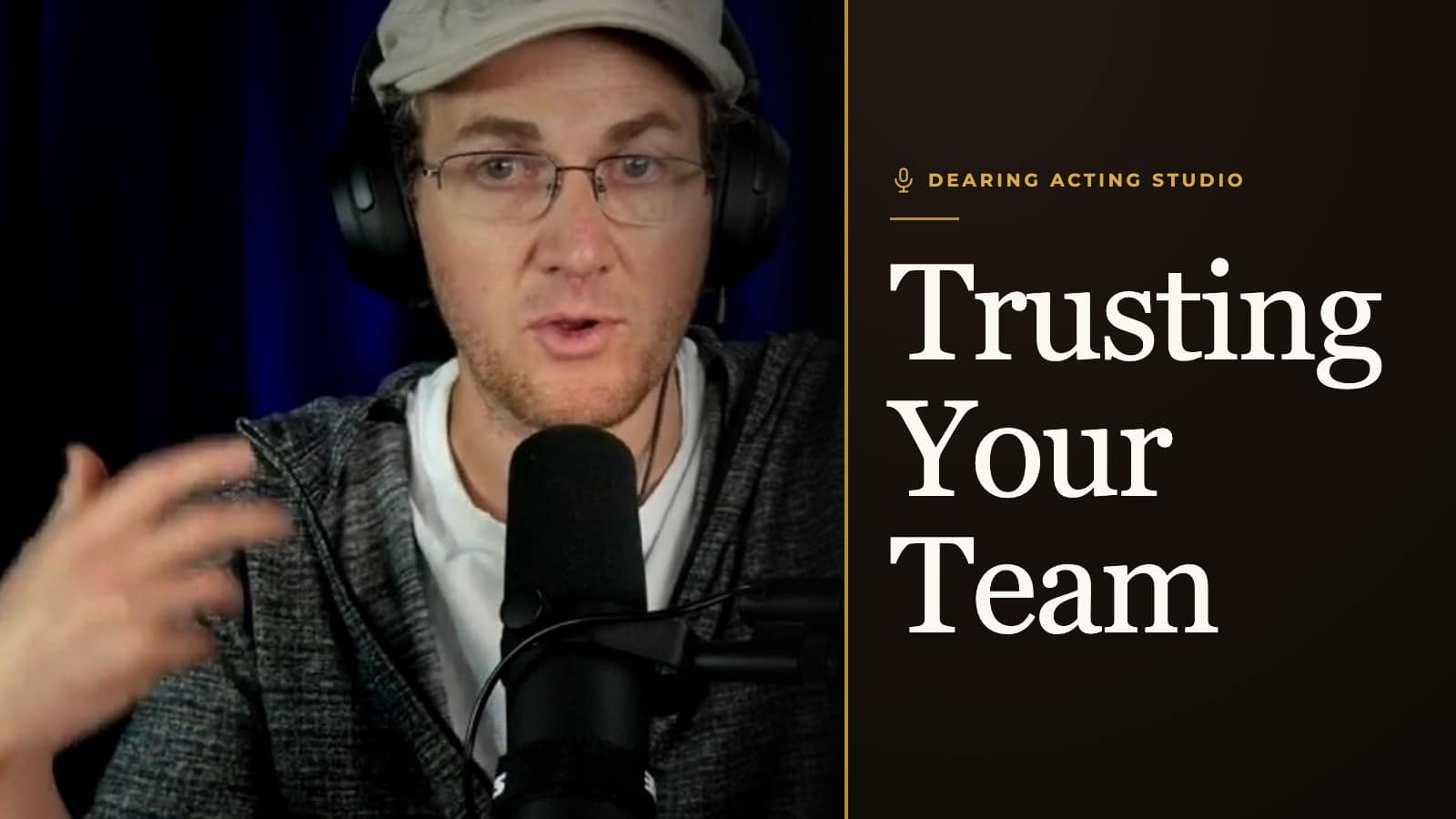
I’ve watched actors I know are good, who I know have trained, who I’ve watched prepare, walk into a casting room and freeze. The lines are there. The work is there. And the audition ends up lacking because of the fear. So we built something to fix it: we bring actors into a casting and show them every piece of it, from inside the room to outside it, run by a team where every single person is also an actor and knows exactly what that intimidation feels like.
That’s where this episode starts. Where it ends up is the reason the team can do that at all.
How do you build a team you can trust enough to fail in front of?
You spend the time. Before a Chaos Comedy rehearsal we went person to person for an hour and told each other things nobody on the troupe had heard before. It was built for the improv, and it changed everything after it, because what I want as an improviser and as a human being is the freedom to be bold, be brave and fail big, knowing my team will back me. I want to walk out with a terrible idea and have five people join me in it until the group makes it good. That only happens on a team that has done the hour. The mistakes become the gold, and the gold is only possible with trust.
Prefer audio? Listen to the episode.
What is in the episode
- 06:37 · Why we show actors the casting room. Every piece of it, inside and out, so the unknown stops being the thing that beats them. Everybody on our team is an actor and knows the intimidation first-hand.
- 09:17 · Everybody is a business. Actors see themselves as artists. You’re also a business, and if you learn to market yourself and set yourself up, you book more.
- 10:21 · Take out the word acting. Shea on the book: it’s a plan for your life that happens to be for actors. Put duct tape over the word and write storm chasing if you want.
- 12:26 · The hour that changed the troupe. The trust exercise before a Chaos rehearsal, and the fire energy that couldn’t be shaken afterward.
- 14:29 · The freedom to be bold, be brave and fail big. What trust actually buys you on a stage: a terrible idea that five people join, until it’s magically good.
- 16:04 · The kids just want to be free. And the adults have to un-learn the box first. Nobody in the room is trying to be famous; they’re there to grow on something.
- 17:41 · Ray, the football player. A college receiver who came in to learn listening. His advice for catching the ball is ours for acting: don’t practice the fancy moves. Drill the foundation until instinct takes over.
- 19:57 · The CEO who visualizes. A client who leveled up between sessions and wanted to work on visualization for a speech. He used to do it before games. It’s the same discipline, and everything we do in acting comes back to life.
Why trust is a training question
A class is a team. The night everybody fails on purpose only works if everybody in the room assumes the best of everybody else, and that trust isn’t a feeling, it’s hours. It’s the reason we know each other’s stories, the reason a football player and a teen actor can share a scene, and the reason a CEO can stand up in front of his sales team and not freeze. Drill the foundation with people who back you up, and the bold thing stops feeling brave. It just feels like the next step.
Full transcript
3,216 words, transcribed from the recording on this side of the desk. Names corrected. Part of the recording is left out of the written version.
Read the whole conversation
This is the Dearing Acting Studio Podcast, where we discuss the connection between life and acting. Alright, welcome back everybody to the Dearing Acting Studio Podcast. I'm Matthew Dearing, here with Shea Tobel, Brian Sweeney, and Mr. Joey Sweeney. What's going on everybody? Good morning. Good morning, everybody. You guys, I just realized I sound so young on that track. Yeah. For real. Well, you've grown up since then. Listen to your deep voice now.
Yeah. In order to help actors deal with some of that nervousness and intimidation that comes from the casting process. Well, the really cool part, also, is that we're, we're all, like, as a team doing it together. Yes. So, you're going to get, like, every piece of the casting from inside the room to outside the room and everything. Mm-hmm. And I, I think it's cool because it comes from the actor's perspective.
So, that's what's unique about our team is everybody is an actor. Mm-hmm. So, we all understand the intimidation factor of walking into a room with casting directors in a place you don't know and, like, your name's on a list and, and you just have to be fully confident in a room that's totally unknown to you. And I think for a long time, casting directors have sort of used this power that they have and, and they kind of liked it and enjoyed it.
And what we're going to do tomorrow is we are going to pull the curtain back on the casting process and really show actors what it is, what it looks like, so that they can lose a little bit of that fear. I know people who have been students of ours and then have come and volunteered for a casting. They've been so grateful for that experience because they, they're like, oh, I get to see the behind the scenes of it.
Now, I don't really have to be as afraid as I used to be. Yeah. It totally takes the, um, the rose colored glasses down and, and you see like the work that goes into it. And, and when you break them down into pieces, it becomes so much less scary. And part of the reason I'm so excited is that, um, I was just telling the script class this, this week is that over and over and over again, you know, we've had students in for, for years or I know they're, I know they're good.
I know they're talented. I know they have training and they come in and they freeze up when they come into an audition and I know they know what to do. I know they know the lines and all this stuff and I've watched them prepare and they come in and the, the atmosphere, um, is so nerve wracking. And then their audition ends up lacking because of the fear and the anxiousness.
And that's part of such a big reason why we really, really strive to make the atmosphere so fun and inviting and inviting and welcoming and safe for actors because essentially we want them to give their best performance so that way the client gets the best talent. Well, the other thing that's really cool is like we're about like revealing with the curtain and everything is this idea of showing people how they can better themselves on the back end.
I think a lot of times as actors, um, we just see ourselves as creative artists, you know, and forget that like we're, we're a business, you know, Matt talks about this. Yeah. A lot in his book about how we can set ourselves up with those worksheets and different things. And so like we are a business, everybody is a business. And so when you can see yourself that way, and then, you know, the ways that you need to market yourself to set yourself up for success, you're going to book more jobs.
You're going to have more things happen purely because you're setting yourself up in that way. Yeah. Can I bookend that real quickly? I, I had a super fun experience. I got to go to an elementary school last week, um, and talk at their career day. And I got to talk a little about, about what I do as a casting coordinator. And I handed out Matt's book to like 65th, 5th and 6th graders.
And by the way, if you haven't read Matt's book, it's amazing. It's available on Amazon for $18. I was a little plug there, you know, I threw it in a little early. What was so cool is a lot of the kids like asked about, you know, what is, what does it mean acting as my day job? And I said, well, here's the deal is that, and Matt had told me this before I went in as we were talking about the book and how it relates to what we do.
Um, and you can take the things that are talked about in the book and put, you know, um, like take out the word acting. And I told the kid this, he wanted to be a storm chaser and I gave him the book and I said, this book is to help you make a plan for your life and help set you up for success in whatever you want to do.
You know, if you want to put a piece of duct tape over it and put storm chasing as my day job, do it. Like it's not just for actors, it's for people. And it's to help you learn, like, how can you, um, set yourself up for, for success by giving yourself enough room to grow and kind of outlining your days and your everything. It's, it's, it's brilliant.
And if you haven't read it and if you haven't downloaded it and whatever, get on Amazon and buy it because it, it truly, truly is, um, unbelievable for any, for any person, honestly. You know, it's cool. Ruth Layton, actually, she's one of the local agents around here. She, she bought the book and read it. She was so excited to talk to me and everything. And she called and, and she said, Hey, I read your book.
And I was like, Oh, great. You know, what'd you think? And she goes, I, I get it now. What'd you guys do over there? She's like, you're, uh, you're, you're, you're really trying to change lives over there. And you're really, you, you gave a handbook for how to be successful in life. Like that's what this is. And it happens to be for actors. And I'm like, yeah, that's, that's exactly it.
Right. Let me just like give you a little applause for that. Yeah. We give Ruthie, give Ruthie a late in the world applause. Hey, Ruthie. Woo. Speaking of amazing people, we interviewed some new interns here at the studio. Drum roll, please. Oh, Joey was so excited to use that. And we had a Truman in the house yesterday, right? Yes. Or two days ago for his interview. Both of them interviewed two days ago and were both here yesterday to work.
Yeah. The other one was Isabel. Isabel. Yeah. And they're both just crazy, crazy, outgoing people. Just having them in here the day after they interviewed to work was like, okay, they came to play. You know what's cool? Can I talk about where that came from too? It was really awesome. We had a rehearsal for our chaos comedy and one of the things that we want to be working on is building trust in improv and trust in general.
And so came up with this exercise to have everybody come around and switch spots and just talk for a second and get to know each other a little better on a deeper level. And overheard Truman talking to Joey about how he wanted to be a motivational speaker and he wanted to teach. That's what he wanted to do and just make an impact. And he sort of talked about the impact that we've had on him.
And then afterwards I got a chance to talk to him and his whole thing was he said, man, I would love for an opportunity because I said, would you like to maybe interview for something like that? To his answer was, yeah, I would just love for the opportunity to help other people to learn what I've learned and be affected the way I've been affected. And I was just like, dang, like I'm so excited to bring this kid in.
And let me speak on that exercise specifically in rehearsal because that was something that I've never done as an actor. And it was specifically tailored towards our improv troupe, but it helped so much in our improv after that because we talk about it all the time. But trust is so important on the improv stage because if you don't have that fundamental trust that somebody is going to have your back at all times, there's a little bit of hesitancy to attack the stage.
And we spent an hour going person to person talking about our lives, talking about things that we hadn't told anybody on the troupe before. And you would have to tell them one on one and you'd give them a hug and say you loved and trusted them. And having that fundamental exercise work with each individual on the troupe just made me so excited for our future shows, for our future improv, because it created this fire energy that can't be shaken after that.
Well, and what that does, it gives you permission to fail. Yeah. Right. So I, as an improviser, even as a human being, because you guys know we do this stuff as a team here, I want the freedom to be bold and be brave and to fail big because I know my team's going to back me up. Right. And so as an improviser, I want to be able to feel like I can go out there with a crazy idea that turns out to be terrible, like a really bad idea.
That gives me, gives me the, the, the red cheeks that Shea gets and I'm out there and, and I'm just feeling stuck. And then all of a sudden I've got three, four, five, six people backing me up, joining me in my terrible idea, which then because of the group, that terrible idea somehow becomes magically good. And that's, that's the power of improv and what, what can happen on a stage and really what can happen with anybody, like any group of people, if they build that kind of trust, it's the, it's those dark moments.
It's the things where you mess up or you make a mistake that ends up becoming the gold. Right. I just posted yesterday, well, we posted a picture on our Instagram and I, I did like a little write up on it and it was a picture of one of our youth kids. And I wrote about failing big and failing loudly. That's exactly what I put in the post.
And it's always such a cool thing when our youth actors come in because they have no fear about anything. And they just want to be, they just want to have fun and giggle and laugh and like explode. And they have so much great energy because they don't have any inhibitions. And it's such a crazy thing because we've got our, our kiddos who just want to be free and be able to do what, whatever.
And then we've got our teens who are right in the middle of a really tough time in their lives where they're being judged and they're feeling judgment and they're judging and all this stuff. And so that's a hard thing to overcome. And then you've got the adults who are like, you're going to put me on a stage and ask me to do what? There's absolutely no way I'll do that.
And then we have to drudge through that ginormous wall that has been put up by social normalities that are saying we can't show our emotions and we can't feel free to cry. And we just can't be free because we got to fit in this box. And then when it happens, it's just this absolute ginormous release of, of this fear and knowing that everybody around you is watching you have that moment.
And they're so excited for you because you just leveled up a little bit. So watching that whole progression through the kids, teens and adults is, is magical. I think that's one of the coolest parts about like being in our program too. Like, because I, I love taking our classes when I can. And, um, and like seeing, especially now the different type of people in the room is amazing because everybody's there to just grow on something.
They're not there for one reason. They're not all trying to be famous. They're not like, we have an ASU football player who comes in every Wednesday and he's a super nice guy, super motivated. And he came in to learn listening and, and acting and really dive deep into that. And he comes with a notebook every week and, and he's just this great guy. His name's Ray. And, uh, and it's cool because you would never think like, especially with how high school works.
And like you said, all the normals, like, like football players and actors don't get along. Yeah. Talk about high school musical. In the norm. Yeah. Right. But you know what? Elite people get along. Yeah. Exactly. And that's the difference. Cause that's, cause that's, what's being attracted here. Um, because we are, we are trying to push people who want to get better. And it's funny cause you, you might, you might have a, uh, anybody might have a stigma about football players in general, right?
Like, Oh, they're probably just like focus on X. But the, but the football players, like the one you're describing, Ray, if you've made it to a certain level in anything, so let's just call it football here. If you've made it to a collegiate school and played, there's something about you that, that knows mastery, understands mastery and seeks it and wants it and wants to get better. Well, and he, he talked on that, which is what's really cool.
He talked about literally how many times a day he threw a football. He talked about, and then Joey, cause Joey loves football. Oh, I love it. And so first off, Joey was fanboying out and freaking out cause it was so cool. Cause he was like, let's go throw the football. And he was like, like throwing like crazy passes to Joey. But then, uh, he was giving Joey advice about how to catch better and how to like do that.
And his, it was so interesting to me cause what he said was actually at the end of the night, just be laying in your bed and throw the football up over and over and over. He's like, everybody thinks that what you should do is practice all these crazy moves, jumping and catching it with one hand, keep practicing catching with one hand. And he's like, just get to the foundation and drill that foundation.
Every single day and keep working your foundation and you do that. And then your instinct will kick in when you need to catch a one on football. Like, wow, what a cool point. It was so cool. I was like, that connects so deeply into what we're doing here. Absolutely. Well, and there's, and, and then, you know, on another note, the same on along the same lines, um, I read that you, you can actually, they, they have research to show that players have, have, uh, shown more improvement.
Let's say in, in, in a sport like basketball, if they spend like, let's say X amount of hours visualizing themselves playing well and, and doing the form perfect versus actually being on the court and doing it. Cause, cause, cause there's so much of it that happens up in the mind. That's right. So you've already told yourself that it's going to work out and you've, and you've watched yourself do it.
So you've already, you've already sort of pre-programmed your body before your body goes and does it. And, uh, and I find, I found that fascinating too, for what we do. And I had this, I had this experience recently with that CEO I was working with from next Steve, his name's Thomas Gorney. And I told him, I told him, Hey, you've leveled up since the last time I've, I've seen you.
Cause it had been a couple of years and we had been working together for three years before that. And so he, he was just a better speaker. So I'm like, I don't, I'm not going to have to teach you the stuff we learned before. You're going to learn all new things. And he's like, okay, you know, and he's one of those same type of people wants to grow.
And so I told him, for instance, cause he was like, what kind of, you know, like, what kind of stuff? And I was like, all right, well, it's going to sound weird to you maybe, but for instance, we're going to do visualization. Like I'm going to, I'm going to have you sit and visualize yourself giving the perfect speech. And, and he sat there for a second and he goes, you know, this makes sense to me.
And I was like, he's like, you may not know this. And I didn't, I was a professional soccer player before I, before I became, you know, a business, a businessman. And he's like, and we would do that. We would visualize ourselves playing the game. It was a very important part. So he's like, that discipline actually makes a lot of sense to me. And I go, yes, exactly.
And that's what we do. So it's not, so, so imagine if I had the chance to, to do this type of work with your sales team. Imagine if I could do this type of work with all the VPs in your company, like what kind of huge impact we can have because everything we do acting related comes back to life, which comes back to business. What a great point.
Yeah. That's just so cool. The power of your mind. You know, you set your mind to do something and you set these goals and you really stick to it and you end up doing stuff that you, you never thought you could do. And that's really the truth behind everything. It's like, there's nothing you can't do. Boom. Period. I think we ended right there. Boom. We sure do.
I agree. All right, everybody. Thank you for tuning in. Have a dearing day. Yeah. Woo. Woo. Woo. Woo. Woo.
Your next step
Fail big here first.
Adult Improv meets Wednesday and Thursday evenings in Phoenix, and the room backs you up. Kids and teens run the same curriculum on their own nights.
See Adult Improv Bring your team instead