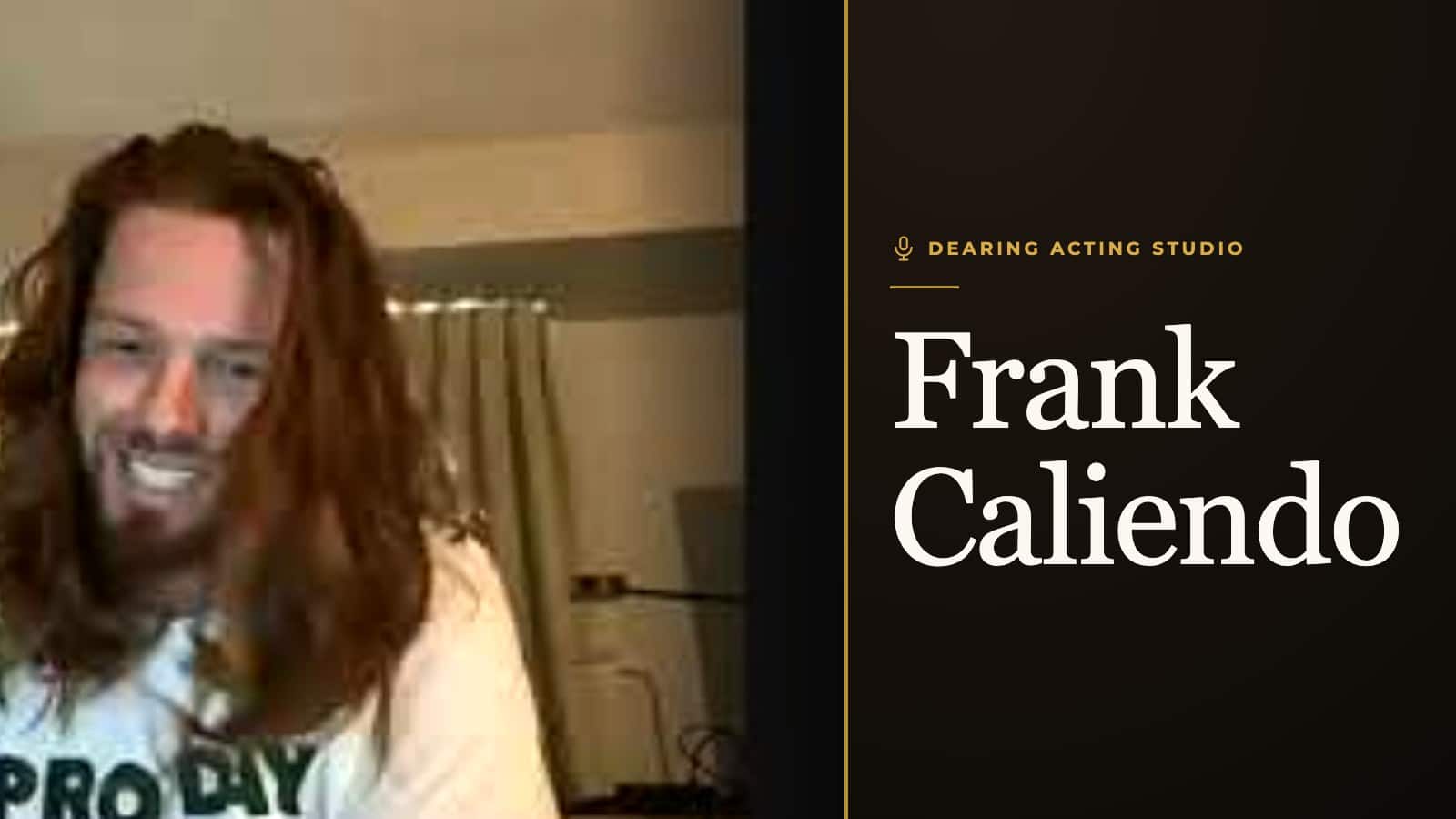
Our first episode, and our guest was a friend who happens to be one of the best-known comedians in the country. Frank Caliendo had been a regular on MADtv, had his own show on TBS, and was a student here. John Luke Grubb and Jason Jackson are at the table. We start with Shazam, because Asher Angel trained here as a kid and Frank had just seen it, and then we get into the thing I wanted people to hear: what a man who had already made it came looking for in a beginner’s acting class.
Why would a famous comedian take a beginner’s acting class?
Because he knew what he did not know. When Frank first came in I had three days’ notice, I reread every acting book I own, and I had a whole list of what we might cover. He said, treat me like a regular beginner student who doesn’t know anything. So we started with memorization, and we stayed there for three weeks. Hours and hours on the smallest first step, because he understood that everybody wants to skip to the end and you cannot. That hunger is the trait I see in the students who go the furthest. The first hour ended and he wanted another one right away. What he found was that repetition in acting is not doing the same thing over and over until it is locked; it is living the same words differently every time, and that the acting comes from listening to the other person. He also found what the masters already know, that you never stop learning. Frank has a huge career and I take zero credit for any of it. What I can tell you is that a person at his level came in wanting to learn, and that is what makes anyone better.
https://fireside.fm/player/v2/bM_J8M3W+z3O-AWds?theme=darkWhat is in the episode
- 01:49 · Our guest. MADtv, Frank TV on TBS, comedy around the world, and the man who texts me during date night.
- 02:00 · Shazam, and the kid who stole the show. Asher Angel trained here for a few years. Frank on Zachary Levi’s sidekick Freddy, played by Jack Dylan Grazer, and why alliteration runs through comic books.
- 07:05 · The trait. Some kids are 40 years old inside. Mastery of craft, a different work ethic, and why we talk people out of chasing fame.
- 07:47 · Repetition is not repeating. Frank thought people walked out and did it. Reps in the Meisner sense: the same words, different every time, until you can live it.
- 09:48 · Ten thousand hours. Malcolm Gladwell, and how the repetition behind an impression is a different kind of rep from the acting kind.
- 11:28 · Two years before an impression is good. The line of Frank’s that made it into my book, and Ross Marquand on sculpting a voice a little at a time.
- 13:07 · What brought Frank in. A pilot of his own, a friend’s recommendation, and a lot of acting coaches on TV who were not doing anything.
- 14:33 · Three days to prepare for Frank. I reread every acting book. He said: treat me like a regular beginner who knows nothing. So we started with memorization and stayed there three weeks.
- 15:06 · The muscle he had never built. Years of teleprompter sketches. The first read here felt like a real audition, mouth dry, nothing there.
- 16:52 · Everybody wants to skip to the end. Frank obsessed over the smallest first step. You have to want to learn, and the first hour was never enough for him.
- 18:54 · Become, do, live. Strong inside his act, lost outside it. What acting training gave a stand-up, and why podcasting uses it more than stand-up does.
- 21:05 · Acting is listening. Frank wanted green screen so he would not have to worry about the other person. Then he found out the whole thing is the other person.
- 22:19 · Another row on the eye chart. When it clicks you wonder how you never saw it was blurry. Give me the glasses, I’m ready.
- 23:29 · Light bulb moments, and the next mountain. Students move up a level and see another mountain. Some quit there. The best actors know they never stop learning.
- 24:42 · Working out of the pigeonhole. Sports impressions were the box. Why a known name has to be so much better than a new face to be seen differently.
- 27:02 · Improvising from within the script. Memorize the right way and the line arrives as a gift on an emotion you already feel. Think about your next line and you’re out.
- 28:47 · Brutal to brilliant. Improv was a new muscle for Frank, until he did it inside a character. Why the difference is point of view.
- 30:36 · Jack Nicholson on a boat. Dirk, the sandwiches, six jugs of water, and a man who does not care what anyone else is going through.
- 33:28 · Breaking down the scene. The point of view was already there, so Frank always knew what to say. John C. McGinley’s action-verb lesson: your character is always doing something.
- 36:51 · Same characters, new playground. Drop a character you have worked hard on into a scene that is not his. The point of view travels with him.
- 39:40 · Improv and script need each other. The philosophy we built the studio on: script work teaches character, improv teaches listening, and a great actor needs both.
- 41:43 · Do all the work. Frank’s advice: you cannot fix a scene alone, so do your part fully. If you do something you don’t like, learn from it and find the positive in it.
- 43:08 · Where to find Frank. Two podcasts and a standing invitation to rip on me.
What this has to do with the class
Frank sat in the same chair as everyone else and started where everyone else starts: memorization, then listening, then letting go of the script from inside it. That is the curriculum, and it is the same for a kid, a teenager, a nurse or a comedian with a TV show. The people who get the most out of this room are the ones who walk in the way he did, wanting to learn.
Full transcript
8,281 words, transcribed from the recording on this side of the desk. Names corrected. Part of the recording is left out of the written version.
Read the whole conversation
Welcome to the Dearing Acting Studio Podcast, where we discuss the process and dive deep into the craft of acting. Okay, welcome back everybody to the Dearing Acting Studio Podcast. I'm Matthew Dearing, here with John Luke Grubb and Jason Jackson. I'm waiting for the applause button. Hold on, stand by. Alright, here we go. No applause. Let's start over. Here we go. No, it is playing. It was. I heard it.
You heard, I didn't hear it. No, it was you. You were actually clapping. No, I was. You didn't see yourself clapping? Oh, no, no, no. Is your memory that bad? Yeah. I think I met your dad. We're not starting over. We're going to surge forward. You should meet him sometime. No, you should never start over. You never start over. It doesn't matter how bad it is. And this is pretty awful.
So we have a crazy cool setup going on today. It's nice. And that's because we've got a crazy cool guest. Wow, great segue. I thought you rolled in on one like a mall cop. Thank you very much. He's a great actor, superstar comedian. Student. Was a regular on MADtv. Had his own show called Frank TV on TBS. He's performed comedy around the world. The list continues. The world? I guess the world.
Yeah, you've been overseas. I've been to Puerto Rico. Stop interrupting your own intro, please. I'm trying to think where I've been outside the United States. Well, it doesn't matter because the thing you're most known for in my house is being the guy that text messaged me during my date nights. Oh, well. Reputation. Yeah, that is what he's known for. Welcome to the – what night is date night?
We do date night a lot. Yeah. So if you don't schedule your date night, how can I know when date night is happening? Ladies and gentlemen, this is Mr. Frank Caliendo. I hear that clapping, but I'm not clapping for myself. I deserve it, but I'm not going to do it. Thanks for being here, Frank. Absolutely. So I hear you went and saw Shazam. I did with Juliet.
Saw it right after it on the premiere night. I'm not sure when we're airing or if we're live. So if this is in the future, saw it the other day. If it's now, just saw it. And I know you worked with – Asher Angel. Asher Angel. I was going to say it, but I don't know the other kid's name. He's the kid that is actually Shazam. He turns into Shazam by saying Shazam.
The wizard gives him the power. And he was very good, very good, very good. And I don't mean this because our relationship is I just rip you constantly, you rip back, and I don't mean anything. The other kid stole the show for me. Sure, okay. Because Asher Angel, very good actor. You worked with him, I'm sure a lot of it, had to do with that. When he was, what, eight?
Yeah, no, see, here's the thing that's funny. So I can never win because I've worked with a lot of actors when they were young, and then they become something. And then I've also worked with people like you who were already something before you met me. So I don't think I ever get real credit. It's okay. I don't need it. No, I'll give you all the credit for him.
And so he was very good. He was very good. Great leading boy, I guess. Yeah, it's the dimples. The dimples are amazing. He's on the way to leading man. But the kid who was in it, I guess he's in it, he's hilarious. Okay. He's very funny. He's like the kid's sidekick, right? Yes. And he's doing adult-level comedy. Well, and, you know, that's a good role because he gets to work with the adult, right?
Because he's talking to Shazam. but he is fantastic in terms of the way he plays everything. He gets, he plays comedy into sadness. I'm just watching him going, this is a 40-year-old man in a body of probably a 15-year-old or something. Somebody, you guys have Google power here? You guys do that or you just do clap that don't work? Just clap. We're afraid to touch the computer once it's going.
Somebody use a phone because I don't want to be seen doing that. There's always the fear. Cheesy. Yeah. A little cringy. Kid who is in Shazam that isn't Asher Angel. I think he's in it. Just do Shazam IMDb. Yeah, that's the better way. Let's see, that's the way JLG would do it. You're kind of a nerd when it comes to the DC stuff, right? I'm a semi-nerd.
I met a bunch of nerds. I found out I'm not nerdly at all to adverbalize that. Okay. You haven't earned it, but you know a lot. No, I'm part-time nerd credentials, but not to the level of true comic book superhero fans. Yeah. But I do love that kind of stuff. I grew up on the Super Friends and all the bad 70s cartoons that all the comic book people hate.
So, no, I shouldn't say hate, but say that was not anything like what it actually was in the comic book. You know, that kind of thing. So, did you find his name yet? Is it Jack Dylan Grazer? His name was Freddy. Yeah, he plays Freddy. Yeah. Freddy Freeman. Yeah. He's a lot of alliteration in comic books. We went over that on our comic book podcast that is becoming less of a comic book podcast and more about the movies and stuff.
But there's always alliteration. And one of the reasons Stan Lee, I found out about this from a nerdier friend, a nerd I'm putting on a pedestal, that Stan Lee couldn't remember names. So, they would do alliteration all the time so he could remember Peter Parker. Oh, yeah. So, it's amazing. This was a DC character. Shazam actually owned by a different company at first and a lot of things went on with Catherine Marvel.
But that's a different kind of podcast. Wow. It's an acting podcast. Wow. Wow. Yeah, so none of us are even. The Fawcett comics started in the 1940s. Actually sold more than Superman. We're just curious because we don't know this and we should since our students in the movie. But where does Shazam fit in the DC world? In the movies or in the – because it's different. Like in the comic book, there's different universes and stuff like that.
In the movies, the movies aren't connecting anymore because DC's found that they're – it's not working. It wasn't working for them. Now, they're doing these slightly campier fun movies and they're really good. Shazam is filled with tons of humor. It's basically the movie Big with a superhero. And they're even in a toy store at one point and Shazam walks across the keyboard, the giant piano. Oh, wow.
Yeah. So, it's very – it's a lot of fun. And Juliet – the movie got done and Juliet went, I want to see it again. Cool. Well, that's great. The last thing – she hasn't said that since she saw It. So, so – and, yeah. She's strong. So, Asher Angel was a student here for a few years and – Oh, it was a few years. I didn't realize it was – Yeah, yeah.
He studied here. But knowing him and then knowing another student that was on a different show with him, there is a trait, which is a lot about what we talk about here, which is the mastery of craft. And you can see it in some kids who – those 40-year-old kids who you can just tell, like, they have a different work ethic than everybody else. And since we talk about that a lot on the podcast, you being someone who's, you know, seen a lot of success, I wanted to get your thoughts on that because, you know, you've sort of seen a bit of fame, I guess.
And we really try to talk people out of being focused on that and rather sort of narrowing down on their craft and just taking it one day at a time. So, do you have any advice or thoughts? Well, but when I came – when I first came here, I didn't know anything about the repetition of acting. And so, I thought people just walked out there and were able to do things and I didn't know why I couldn't.
So, I didn't realize the amount of work that went into it. And when you say repetition, that doesn't necessarily mean – it sounds like it does. The definition of repetition is doing the same thing over and over and over. Well, not really. It's also repetitions, like if we're doing some type of – or torp of, depending on what part of the country you're from. If you're doing an exercise, a repetition might mean just going through it one time.
Like the – what's the emotional exercise? I can't think of the name. Apparently, it wasn't – Like the Meisner stuff that we were doing. Yeah. So, going back and forth and that's repetitions and it's repetition as well. Yeah. You're saying the same thing, but things are changing. It's not the same every time. I didn't – I thought you went into acting and you tried to be the same.
You tried to rehearse something to get it down, not rehearse something to the point where you can just live it and it's always different. So, when I came here, it was so eye-opening in terms of that because I really had no idea what I was doing. And I wish that I had taken acting classes way before, not from you, somebody else who had nothing to do with Asher Angel.
I don't have the dimples to work with, so at least not right here. You have to work really hard for yours. That sound effect. Record it, play it back. Well, going back, before we go forward and continue to talk about me and – Yeah, Paul Abdulit. And this place. But – so, to your point is repetitions. I mean, that same idea can be used in any profession and we talk about athletes and whatnot.
Yeah, it's the Malcolm Gladwell. You ever read the – Yeah, the 10,000 hours. 10,000 hours of repetition. You don't become an expert until you've had 10,000 hours of practice repetitions, whatever. So, let's talk about that with your – I'd rather not. We can't. With your comedy and impressions and the things that you have been very well known for, the repetitions and the work that it took. Yeah, and that's funny because that was all repetition, right?
But that was repetition to get it down a certain way. And I didn't look at it the same way, although there is crossover in that. But it was, hey, I'm going to do this repetition to gain access to this muscle memory and vocal memory, vocal cord. And mochal, too. Mochals, yeah. They lived in my closet, the mochals. You're having a lot of trouble for mispronouncing things. No, the mochals – no, it's an actual thing.
The mochals are tiny little people. They have tails. A lot of people don't even know about the tails because some of the – there's a group of them that cut them off. Those are the ones that are more – have been seen a lot more. But the mochals, they come out. And it's – you can't get them wet. They're kind of like the gremlins. I think that's where gremlins got it from.
But it was repetition to learn those impressions, but that was just to do it the same way in terms of getting it – I didn't understand the living it type of thing. Am I going where you wanted me to go? Yeah, yeah. No, you're going there. So in a book I wrote this last year – You wrote a book in this year. Yeah, I brag about you in order to mention your name, which really is bragging about me.
Yeah, yeah, yeah, yeah. I wrote a pamphlet. And when I was bragging about you, I mentioned the thing you said to me, which was essentially it takes you about – or you give yourself about two years before you reveal – Is that what I said? – an impression. I don't know. Yeah. I don't remember that. Is that about right? I think it's probably true. Yeah, I mean it depends on – sometimes you have to just get them out there right away, but it would be – it probably feels like two years before it's even good sometimes.
But sometimes – once in a while you have to get it out there. Like when I was at Mad TV, you just had to do it. But, yeah, I would say if there's something – yeah, I don't know if it's always two years, but sometimes it feels like that's how long it is. So it's way more time. I talked to a friend of mine who's on The Walking Dead who does incredible impressions, Ross Marquand.
And he's like – people don't understand. You can't just do this stuff. It takes a lot of time to – it's almost like a sculpture where you're doing little bits of time. You go away from it. You come back. You mold it a little bit more. And then you go, I didn't like that, and push it back. But then you start doing – go back and hit it more and more and more.
So what was the initial question? Because I got really – I started seeing a ghost, and I've had the time of my life. I was picturing you sitting there working on a nice sculpture by yourself. Yeah, no, it was – no, it was me, my wife, and I was a ghost. Who was the guy? Okay. I'm Patrick Swanky. Patrick Frankie. Okay, so let's drive it back to the studio.
Yeah, let's put it in reverse. And to me. So you came here. I talk over you. What brought you originally? There was a show you were working on. Yeah, there was a show that was my show, and I talked to Chappelle Lacey, who wears a lot of frilly stuff. And, no, just his name is Lacey. So he told me about you guys on acting. I've seen these things on, you know, I'd say back page, but I've never been on that.
I don't even know what that is for sure. Okay, Robert Downey Jr., checking in. So I had seen a bunch of, like, terrible acting coaches and stuff like that that you watch, and you're like, they're not really doing anything. So that was what brought me here, was to work on that. Well, what's interesting is, you know, we've been doing improv comedy and just, you know, comedy in general for a decade before you walked in the door.
But you were frank, and so I was a fan of yours having done comedy, a big fan. So when I found out you were actually going to come in, it was like three days lead time. I was super nervous, and I reread all my acting books and, like, really wanted to prep really well. All you needed was the first page you found out later. Well, it's funny.
I had this whole list of, like, everything we might go over, and I asked you, I was like, you know, hey, why are you here? And you just said, hey, treat me like a regular beginner student who doesn't know anything. Yeah, because I did. Because I didn't, or because you didn't, and you said, so I said, all right, we'll start with memorization. And then we worked on that for, like, three weeks.
Right. Hours and hours and hours. So my memorization was always terrible. And I'd never gotten to the point where I realized how important memorization was. Because a lot of the sketches I had done on the sports stuff was just off a teleprompter. Now I couldn't even imagine trying to act from teleprompter because it just doesn't feel that way. Yeah. And I'd love to go back and do my whole career over because I'm like, wow, I wasn't actually acting in any of this stuff.
I was just reading. So, and they were kind of jokes as opposed to living it. But then getting and memorizing and actually memorizing, I had to build that muscle to even, I remember the first time trying to read on, you know, come here and I was so nervous with the memorization. I was, my mouth was dry and I was like, God, this feels like an actual audition and it's, I got nothing here.
So, um, just to even get in that comfort level where I didn't have that anymore took a couple of months because I was still nervous coming in here because you're kind of a tyrant. And, uh, I shouldn't like, you're a tyrant. You're a tyrant, yeah. So. I shouldn't ever do an impression of me. Not around me. That was good. Really good. Um, almost done. Except maybe, uh, you know, Matthew McConaughey.
Yeah, sure, good. Well, how are you? That's my daughter. All right, all right, all right. He did, he used to, he was, uh, he did Fat Albert, right? All right, all right, all right, all right, all right, all right, all right. Um, well, so, so my point is, you know, for everyone listening is here's, here's Frank who's, who's already had this great successful career. I take zero credit for anything and he's, he's coming in looking for training and he finds something he doesn't, he hadn't heard before, which is this way to memorize.
It was difficult and just obsessed over this, the, the smallest, tiny detail, the very beginning step in order to go. To go to the next step. So rather than, because everybody seems like they want to skip all the way to the end. And, and I just want you to. Well, I wanted to, I just knew that I couldn't. Right, well, that's good. You know that kind of a feeling?
That's good, yeah. And I, I just want people to hear that and, and understand that that's a, a good trait to have. You have to want to learn. I remember you saying this about me. You're like, you, you, I said, what did you think? You said, well, the, the most important thing is you want to learn and you're listening because I think a lot of people come in and think they're going to blow everybody away.
And you just have to come in and go, I know nothing. I'm the, uh, clay that Frank wants to mold, uh, from the segment earlier. Yeah, and, and your hunger for knowledge is, was, it was always astounding to me. So even on that very first day, you were, the hour went by the first hour and you just wanted another one right away. Right. And then you wanted another one.
I was like, I have another appointment. I didn't care about them. And you didn't. And, and, uh, and then you were texting me that night. Who's now, who was up next? I had a sure angel. I had a date night that night. So Frank, the first day I met him, he's already texting me. So it became a, it became a thing. Which is different than my wife.
She's glad I'm texting because then I'm not bothering her. So we've worked together for a while, Frank, and I'm a, I'm a big fan now of you as a person and your family and whatnot. But, um, you know, you, you, you came in here at an interesting point in your life and in some transitions took place. And your, your show now that you travel with is a little different.
And I wanted to maybe talk about that. Yeah, I'm working on that still. I mean, it's, it's amazing. Listen, there's, there are different elements of, uh, everything seems to come together and little parts of life, uh, or even the training that you do in different aspects of entertainment can bring a lot, um, can, when they come together, you start to feel it. So I started out doing this, I could do my act.
I had always come on and do my act and I felt that was really strong doing my act. But if I got outside of my act, I was weirded out about it. What I learned here at the acting studio was more about how to become and do and live. And I still struggled, um, even after that, even for a while of doing that with new stuff and doing something different.
It's funny because the latest part of my life, which is doing a couple of different podcasts has brought me into, I have to say something different all the time. And it's, it's opening up another muscle, but it's going back and using a lot of the stuff from the acting training. And it's funny because the standup stuff is probably the stuff I use the least now to try and get better.
It all comes from the acting and the just talking and hoping you're going in a direction, um, to get something new and not, I've always been very aware of the audience and you have to be, I think you have to be when people are paying. That's one of the things about going to do a guest set somewhere, which is a set that you, you just show up and do a little bit of time and nobody knows that you might be there.
Um, they're not paying for you. So you can just dork around. It doesn't matter. You can do whatever you want when they're paying for you. It's a little tougher because you're worried. Hey, they paid for me. It's like, I think it's seven grand a ticket. So, um, it's, it's amazing that the, the, these last couple of years, it makes me wish that I'd prepared, done this stuff all earlier because getting into, uh, what we did here in the classes.
Uh, I did mostly private stuff cause I just, I'm a weirdo when it comes to that. And I found I needed other people. It was amazing cause I, I really only wanted to do stuff where it was, uh, understanding a monologue at first. And then I was like, Oh my God, I don't even like doing this unless there's other people to be around. I was used to think green screen was the way to go cause you'd have to worry what the other person was doing.
Well, that's totally not understanding what acting is. So, uh, yeah, I was, it, it, it, it amazed me how much it was, uh, the actual acting came from listening to the other person. And when you break it down to how easy it's so easy and hard at the same time, cause we do it in real life. If we listen, sometimes we don't, if we, especially if we have a phone in front of us, but if we listen, we were constantly listening.
We're constantly taking in, um, uh, what's the word, um, stimuli, um, or stimuli truth. You can coin it, use it. Whoa, there we go. Um, stim your truth. So, uh, you should be recording at all times so you can play back stim your truth. It sounds like a drug that might have some interesting side effects. Um, so, but when we have something memorized, all of a sudden all that goes away, right?
We stop listening. We start concentrating on just what we think we're supposed to say or what the other person is supposed to say and not just living in the moment and letting everything that we would take in normally. Be part of the environment and that's, you think it's easy to do, but it's really, for some reason it's difficult. And then at some point it kind of clicks and you go, oh, there it's, it's funny how acting to me and like almost anything you do.
And it's part of the 10,000 hours probably is I'm just tying all the segments together, texting you during date night that how it's like going to the eye doctor and they, they put the lens in front of you. And then all of a sudden you can see another row on the eye chart. And you're like, how did I not know that I couldn't see this, that this was this blurry and that clearness that's there is all of a sudden you're going, okay, just give me the glasses.
I'm ready. I'm ready to go. So that's, that's what it's been like for me, especially, like I said, these last two stages of what I've been doing have been the, the acting side of stuff and the podcast side of stuff, which is really improv. It's basically improv, but an interviewing type of improv more than an acting type of improv. But I'm hoping for that all in this next phase of the FCU, Frank Caliendo universe, which sounds like FU with a C in them.
Yeah. We're working on it. Logos are being printed up. Does anybody print stuff anymore? I don't know. 3D printing it. Yeah. I call those, I call the, the moments that you're talking about with the, the lens in front of you, the light bulb moments. Yeah. Students have these light bulb moments and they move up a level if they choose to. And what's interesting is some people, they, they move up and they see what they can see, but they, they notice there's another mountain in front of them.
And sometimes they just, they, they quit because they, they think I'm good there. Like that's enough for me. Right. But you're not. I see, I see that happen a lot. But I'm happy. Unless it's just what you're trying to get to, like in business or something like that, it can work and be there. But in terms of acting, I don't think you ever, I've heard this before and never understood it until I started to understand acting more.
You never stop learning. Yeah. So even the masters, they'll, they'll tell you, you know, you talk to a Robert De Niro, great way to fit in an impression. Yeah. I learn every time. Learning something new. You know, so I think that's a big deal that the best actors probably know that they never stop learning. And it's people who get to just a certain level probably think that, Hey, I'm fine with this.
This makes me a living. But for me, it's more about just getting better and trying to learn and be something better in terms of entertainment and what I'm doing. I mean, listen, I was, I was stuck in a pigeonhole of doing just straight up impressions and sports stuff. So it's sports impressions and it's been tough for me because I'm trying to work out of them, still trying to work out of that.
And I think I have to be so much better than somebody I've, I've advantages and disadvantages. Somebody who has never been seen before has the advantage of you're a brand new thing. You have a look. This is what you're going to be. I have predisposed determinations with, I'm not sure it sounds like Stephen A. I predisposed just to determinations. People think that they say, Oh, he's going to do the impressions.
Then when I don't, they're like, Oh, and it takes them a while to learn what. It's like an Adam Sandler does a serious role every once in a while. You're waiting for him to go, Hey, don't cry, grandma. Can you do that again? Hey, don't cry, grandma. You are going to be my only survivor. Thank you. What just happened? So I'm really happy for you, Frank, because, you know, you, you actually seem lighter to me.
You seem like you're in a really happy place. And I don't know if it's because you haven't seen me in a little while. I could be part of it. Yeah. Yeah, so speaking of improv, it is such a huge element, as you mentioned. And so what, what Frank was mentioning, what's really hard and one of the difficulties of the scripted work is to have that light bulb moment that Frank had, which is you're working the script, you know the script, you understand it, and then being able to let go and improvise from within the script so that.
But not the words you're saying. Right. The moments. But if you're doing it right, you're listening so deeply that you, you want to react. And then the line that, that is just sort of presented to you because you memorize the right way. You're, you're grateful for it. You're like, oh good, I get to say this line right now on this emotion that I'm already feeling, but you're not thinking, what's my next line?
Because as soon as you get to that place, you're going to be out, which is, so it brings me round about to getting back to improv. I'm doing kind of what Jason does on every improv, on every podcast, which is try to just insert improv in somehow. Are you a big improv guy, Jason? I love the improv thing. Yeah, he's a good improviser. He's been, he's on the chaos troupe here and he's been a long time student and he has, he has a lot of other talents that he doesn't even like me to talk about.
But he's a, he's, he is a general contractor. So he, he built our kitchen back here. He's done, he's done tons of stuff. Oh, okay. Yeah. And you've been really great with improvising on the show so far. I just don't want to mess up. Which is really great for an improviser. Valid point. So, so I was, so I was interested in this idea because when, when you and I first did improv together, it was a new muscle for you and it was something that was, okay.
Brutal, I, I would, um. It's true. Agree, I guess. Yeah. And, um, but watching you improvise from within one of, one of your characters that you've developed, one of your impressions. Right. It's, it's effortless. It feels, it feels like. Yeah. It goes from brutal to brilliant quickly. Yeah. Yeah. From me to me. So, so I've thought it might be a fun exercise because I think I know the why behind that for us.
If you're, if you're willing to, to grab a couple of, of impressions and here's how brilliant Frank is. Frank can actually improvise with himself. He can pick two, we can pick two characters and he can improvise with himself. I can't do that anymore, but. No, but, but maybe, but maybe today. Yeah. Would you be willing to do that? I can try and bring it back. So, so I, I, I like some of the, I like some of the more, um, I like some of the older characters that people don't talk about as much.
Um, I'm trying to remember one of the ones from the lesson that I just fell in love with. Aesop. I do a great Aesop with his fables. What's A, who's that? Aesop's fables? No, I never heard of it. It's all the old fables. Let me hear it. Uh, that's a joke. I was going to say, how can you do that in French? I don't know what that is.
You don't know what Aesop's fables are? No, I've never heard that. Google it. You're much older than I am. You know what all the Aesop's fables are. No, I don't. Yeah, it's every. Is that Greek? Yeah, it's all the original fables you've. Okay, and they're called Aesop? That's the guy's name. Oh, all right. I don't know if I'm saying it right. It may be a soap, eh?
Oh, I know who it is. Uh, uh, Jack. Jack Nicklaus. Jack Nicholson? Jack Nicholson, yes. No, the golfer. I want you to impersonate the golfer. Yeah, Jack Nicholson. You, you do a great Jack Nicholson. So, let me. So does everybody from 1985. There you go. So we're going to do Jack Nicholson. And, um, Jason's actually a big fan of yours as well. He, he, um, probably wouldn't want me to say this, but he listens to all your, all your stuff you do with Holmberg.
All that. All that. He's a, he's a big Holmberg fan too. So. I love the Hollywood Squares. Or the Guadalupe Squares. Guadalupe Squares. Yeah, so, so I got to pick my character, Jason. Do you want to pick a character that, one of your fave slaves? Why don't we, you don't want to just do an improvisation with Jack Nicholson first? No, you, you, you're going to, you're going to improvise with Jack Nicholson and you're going to improvise with the other character as well.
I knew that's what you wanted, but I tried to change that. No, we can do that. Let's, let's do that instead. All right. And then we're going to do both of them. Yeah. All right. So, so let's, let's do this then. We need to, we need a scenario. JL. Hmm. Do we have three characters going on right now? No. So it's just going to be Jack Nicholson.
Maybe if you paid attention for a second. And then, and then, uh, and then we, we can all just either be characters or, or versions of ourselves that are in this, in this scene. Saline? I guess we're sailing a boat. Oh, I thought it was. Saline. Working on our solution. Eyedrops. All right. So, uh, so there's a boat involved, uh, sailing. Thank you, Jason, for that. Hoping this goes well.
So far, nothing, huh, fellas? No, sir. Um, I, I haven't seen any, any land in a while. Good thing you brought sandwiches over there. Yeah. Um, I got, I got Dirk on the sandwiches. Dirk, uh, what, what do we got there in the basket? Um, we got, uh, cheese and ham, peanut butter and jelly. We got cheese and ham, sir. How did I never notice that Dirk sounds like a mouse from a Disney movie?
Huh? Is that just the seas talking to me right now? Is that just the seas talking to me right now? Have we been out here too long? Yeah, yeah, yeah. Dirk has, uh, he hasn't had any, um, any water in, in, uh, probably three days, I think, sir. Yeah, I'm kind of thirsty. Dirk, I got six jugs over here. It's unfortunate for you, isn't it? I would say so, sir.
Because I feel vibrant. And you sound deathly. I'm worried about you, fella. Yeah, I'm kind of shaking right now. Yeah. Can you stop that? It's annoying me. I'll do my best, sir. Yeah. Listen, if we can't get rid of this guy pretty soon, he's going to drive me crazy. Well, I was hoping if we, if we stopped, uh, giving him water, sir, that he might die and then we could eat him.
Ah, I hadn't thought of that, but he does. Well, a couple, a couple days ago you looked pretty good. Now you're looking a little bit on the, uh, how shall I say it, bony side. So let's feed him and not give him any water. Like a turkey. Like a Thanksgiving, say it. Who the hell are you over here? How did I not notice you on this boat?
How long we been on this thing? Sorry, sir. Yeah, sir, sorry. This is, uh, this is George. Um, we, we found him. He was, he was floating. He was, uh, I don't know. I think you were- How long ago was that? Yeah, you were sleeping. That was four days ago. I had a nice rest. I can't believe I- That explains why one of those jugs was missing, doesn't it?
And why you're still with us, Durky. I appreciate it. So do you guys want a sandwich or what? How come you haven't eaten any of the sandwiches? You're that scared of me? Yeah. Good. Good. You're on board with this. All right. So let's break down the scene. So obviously Frank was amazing there. And, um, and so, so, so let's think about it. What is it about when you've got that character that helps you know, you know, what to say?
Uh, I just was, with that I just figured I was just going to be, everybody, as Jack Nicholson there, he didn't care what anybody else was going through, right? But does Jack Nicholson ever? Well, that's why. Yeah. Because it's already, the point of view is already there. Right. So the Jack Nicholson is that he's, he doesn't care what anybody else, everybody could be dying, everybody else is dying on the ship or on the boat, but he doesn't really care, uh, as long as they're entertaining him slightly or, or tending to him.
So. And so then what is Jack Nicholson essentially doing? Uh. Because that was the lesson you, you talked about on, on the John, Dan Patrick show that John C. McGinley gave you, which was figuring out that, that those action verbs, like your character's always doing something, right? Oh, yeah. Well, yeah. My, my point of, I guess I'm saying his point of view, but what I was doing was, uh, making sure you guys were going to take care of me.
Right. Everybody was dying. Right. So what am I doing in terms of that? Yeah. That, that's where I was kind of going with that, even though I made a couple of mistakes but tried to fix them. But, um, yeah. I mean, in terms of that in general, there's Nick Nicholson's a weird one because he doesn't really give a rip about what else is going on. So it was, the whole mindset there was we're on a boat, but then I thought, you know, how long have we been on this boat and people can be dying and then you sounded so deathly that.
Well, so it's, it's what it is. It's that specific point of view and then knowing, and this is what I was thinking was you really know what the character's doing by having that point of view. And I think what's, what's so tough about the improv stage is you, you haven't worked the character necessarily. And so you have to figure out some of those elements on the fly and then fall into it.
And, and then you have to say yes. So here's John Luke here who, you know, he had, he had, he picked a voice and then we just labeled them and then I kind of dogpiled on top of it. And so he has to say yes to that and then sort of embody who that character is and, and what is, what, what is his point of view? Yeah.
I became more nervous as the scene went on as the character. Yeah. So that was just like my point of view is just, I'm here to serve everybody. I'm kind of like the, I felt tiny. To the point, to the point where you would die. Yeah. Just to, yeah. And we might not even have noticed, but luckily you had some sandwiches, even though we've been on this boat for months.
Yeah. Um, so, so that's very cool. Um, and, and, and I, I like to talk about too, when we, when we talk script, you know, cause Frank and I have done all sorts of stuff with different monologues and, and other characters that, that didn't involve, um, his impressions. And the more you dive in and develop a character of any kind that you might, that might be in a scripted play or, or, or scene or movie, um, you can then use those points of view cause you'll, you'll feel that there's something similar in a scene.
And you can grab a character you've worked really hard on and then drop them into a scene where it's, it's not even them. It's not, it's not their name, but it's like, um, like for, okay, for instance, let's, let's pretend that I've worked a character in a play and it was like this Jack Nicholson guy. Right. So we could pick him up and don't call him Jack Nicholson, but now, um, he's on a playground.
Okay. And same thing with this guy here. Okay. So the, the, um, what was the name? Dirk. So Dirk's here. You're a couple of kids, but that, but you're not the same names, right? So you're not Jack, you're not Dirk, but, but you just, just bring the same point of view. Okay. And yeah, you're a couple of kids. Okay. We're on the playground. Uh, here we go.
Hey, dad, you got a problem? Uh, yeah, I just have no one to push me on the swing. Well, it looks like you still have nobody to push you around, huh? At least not on the swings. I mean, sometimes the guys push me around at school. Well, I might be one of those fellas in the future. I'm new in town, huh? My name's, you know who I am.
I screwed this up. Hold on, he'd already told me I wasn't listening well enough. Let's take it back a second. Hello, hello, Tad and Jimmy. Everything okay, Jimmy? Yeah, everything's okay. Okay, Tad, welcome to the school. I'm the principal. Just if you need anything, let me know. I do have something I'd like to talk to you about. This fellow over here, he's, uh, he's ruining my experience on the playground.
I'm trying to have fun and stuff, and he's over here. He's, look at him, he's shaking. I just, I just want someone to push me on the swing. Right, and he's needy. Yeah. I mean, can't you find a way to propel yourself on the swings? How old are you, kid? 15, 16 years old. I'm, I'm six. Not great with age. Hey, Tad, I'm gonna, if you don't mind, I'm gonna go inside.
I'll go ahead and call his parents for you. Yeah. And, uh, and just so you know, the, uh, the, the, the lunchbox you requested is, is already there, and it's on your desk. Oh, fantastic. I appreciate it. All right, thanks. Is it the sandwiches? Yeah, it's the sandwiches. Thank you. That's right. That might be your job someday. I'll end up on a boat one day, maybe. You like boats?
I like sailing. Yeah. All right, other than forgetting that I met you already. Yeah. So, so, so point being, as an actor. You can edit that part out, right? Can you do, edit in live, uh, theater? Yeah, yeah, we, we, that's right. Yeah, you just, you just, you just talk to the audience, you're like, hey guys, we're just gonna start over real quick. Hey guys, we're gonna, just forget everything real quick.
Strike that from the record, didn't know what I had to say. But it's one of those things where you gotta, you gotta listen. You gotta, I wasn't listening completely, or I forgot, I was trying to get into it, and I broke it. Broken. Okay, so what was the next question? I mean, I just want to tie this up. So the idea there being, as an actor, and this is, this is sort of the philosophy we've built our, our studio on right now, and, and we believe in growth too, so whatever our philosophy is right now is probably going to be different five years from now, but, but the idea right now is that there's the one half is improv, and the other half is script, and they are seamless, and they need each other.
So to do good improv, you have to do the work on the scripted side, and understand characters, read plays, develop yourself. And then on the improv stage, you have to develop that skill of listening, of connecting, and being in the moment. And, and you can't really do good script work without the improv, and you can't do good improv without developing yourself on the scripted side as well.
At least the way we teach it, and then bringing it all together, that's, that's what makes a great actor, somebody that can be completely engaged and focused in a scene, and forget that anything else is going on, and just, and believe the circumstances they're in. So, uh, thank you, Frank, for doing some improvisation with us. That was, uh, level B, level B, uh, improv. I think, uh, I think we would have, it would have made it on the chaos show, I think.
Yeah. I wish I would have stayed in, I wish I would have made it, I stayed in character and corrected myself with some sort of, I got hit by a dodgeball earlier, sorry. There you go. Things happen, you know, you're on the playground. We can be friends as long as you do whatever I say. Okay. All right, he's a good kid. As long as he keeps his distance.
Hey, you need help on the slide, too? Um, yeah. Yeah, we're going down the other way this time. I don't, I don't get it. You will. Okay. Tony! Get over here! We're going to do the slide game again. Sweet. Give me your ankles. There we go. Boom. Yeah, good. So, so that, those are all the questions I have for you, Frank. I guess I'll leave, leave with this.
Here's the problem. I have a lot more answers. Okay. No. All right. Yeah, yeah. Jeopardy, jeopardy. Well, I wanted to leave with this. If you have any, any advice for the, the aspiring actors that are working here and training. To me, it's all just going with the, do all the work. You have to, I've experienced that. People who do all the work and you do all the work as well.
It's a much, and it's going to happen where other people, this happens in even Hollywood, where people don't do the work and then you're sitting there going, you didn't do the work and then you're sitting there by yourself and you can't fix it. You can't, you can do your best, but you need the other person to be their best to, to make something work. But just, just keep fighting, kids.
It's really, it's just constant. And if you do something that you don't like, learn from it and then use that, that muscle memory to either stay away from it or use it and try and find a positive in it. Find something that will work from what you just did. Because it's not always going to be perfect. And because life isn't perfect. And we make all sorts of mistakes every day.
So why, why can't you during acting? You should. I think that's how you grow. Yeah. Okay. Thank you, Mr. Frank Caliendo. I'm very grateful to, uh, to know you and to work with you. And I can tell you that I have learned, um, a ton from, from, from coaching you. So 2,000 pounds worth of knowledge. Let me give a quick, uh, shout out to Frank. You can go to his website, frankcaliendo.com.
He's got two new podcasts on there. Try to be serious. Alan Frank, try to be serious. And then, uh, what is it? Alan Frank. Oh, Alan Frank, try to be serious and comic playground. What is, what is Alan Frank try to be serious? Got it. Okay. And then, uh, we've got comic playground, which is a cooking show. Your, uh, your nerddom, right? Makes sense. Yeah. Cause it's not, it's not comedians.
This is talking about comics. Yeah. That's part of the problem with the comic playground. People think it's going to be a standup comedy show, which is why I'm changing. So you trick them, get them to come and then you don't talk about it. It was a complete mistake. It was, yeah, it was the wrong thing. Van and Frank Caliendo, please go to frankcaliendo.com. Thank you very much for being here, Frank.
Appreciate it. Great job. Thank you for listening to the Dearing Acting Studio podcast. This episode is produced by Jason Jackson, John Luke Grubb, and Matthew Dearing. To enroll in classes, visit dearingstudio.com. This is the Dearing Acting Studio reminding you that to act is to do and to act with passion.
Your next step
Start where Frank started.
Adult Script meets Monday and Tuesday evenings in Phoenix, script in hand and on camera. Doctors, lawyers, actors and everyone in between, on the same curriculum.
See Adult Script All classes, ages 5 and up